


Efficacy and safety of transepithelial corneal collagen crosslinking surgery versus standard corneal collagen crosslinking surgery for keratoconus: a meta-analysis of randomized controlled trials
- PMID: 29282020
- PMCID: PMC5745766
- DOI: 10.1186/s12886-017-0657-2
Efficacy and safety of transepithelial corneal collagen crosslinking surgery versus standard corneal collagen crosslinking surgery for keratoconus: a meta-analysis of randomized controlled trials
Abstract
Background: The aim of this study was to evaluate the efficacy and safety of transepithelial corneal collagen crosslinking (transepithelial CXL) versus standard corneal collagen crosslinking (epithelium-off CXL) on keratoconus.
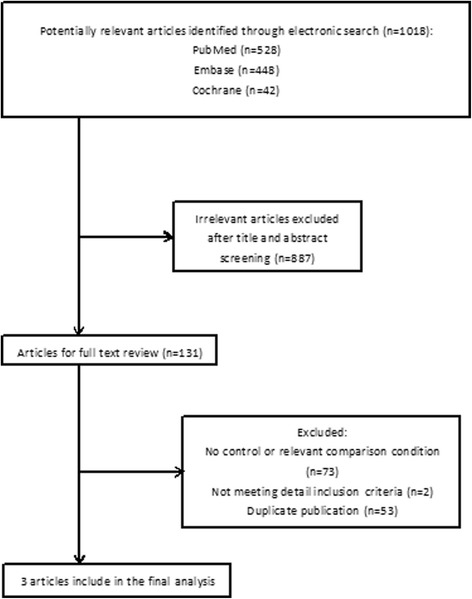
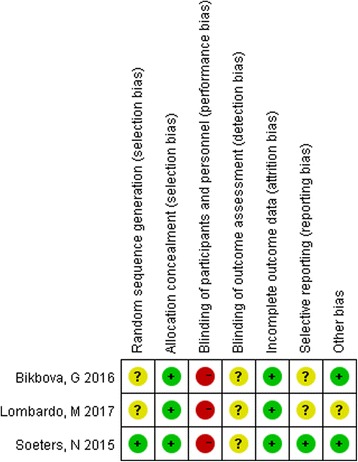
Methods: Eligible studies were identified by systematically searching PubMed, the Cochrane Library and Embase. Topographic parameters, corrected distant visual acuity (CDVA), uncorrected distant visual acuity (UDVA), and corneal thickness (CT) were assessed by the pooled weighted mean differences (WMDs) of the change from baseline to the end of follow up. Quality was assessed according to Cochrane handbook. And we used Review Manager to analysis the included trials.
Results: Three trials involving 244 eyes were evaluated, with 111 eyes in the standard CXL group and 133 eyes in the transepithelial CXL group. The pooled results showed that there were significant differences between the two groups in maximum keratometry (mean difference = 1.05D, 95% CI 0.19 to 1.92, P = 0.02)),and the standard CXL is more effective in decreasing the maximum keratometry at least 12 months after operation; the transepithelial CXL group gained more improvement in CDVA (mean difference = -0.07, 95% CI -0.12 to -0.02, P = 0.007);there were no significant differences in uncorrected distant visual acuity (UDVA) between the two groups (mean difference = -0.03, 95% CI -0.20 to 0.15, P = 0.75). A similar change was found in corneal thickness (mean difference = 4.35, 95% CI -0.43 to 9.13, P = 0.07)).
Conclusions: The standard CXL is more effective in decreasing the maximum keratometry than the transepithelial CXL; the transepithelial CXL provided favorable visual outcomes; they both exhibit similar safety.
Keywords: Corneal thickness; Keratoconus; Maximum keratometry; Meta analysis; Standard corneal collagen crosslinking; Transepithelial corneal collagen crosslinking; Visual acuity.
Conflict of interest statement
Ethics approval and consent to participate
Not applicable.
Consent for publication
Not applicable.
Competing interests
The authors declare that they have no competing interests.
Publisher’s Note
Springer Nature remains neutral with regard to jurisdictional claims in published maps and institutional affiliations.
Figures




References
-
- Corneal O’BD. Collagen cross-linking for corneal Ectasias. In: Alió JL, editor. Keratoconus: recent advances in diagnosis and treatment. Cham: Springer International Publishing; 2017. pp. 219–238.
-
- Jenkins AD, Kratochvíl P, Stepto RFT, Suter UW. Pure and applied chemistry. 1996. Glossary of basic terms in polymer science (IUPAC recommendations 1996) p. 2287.
Publication types
MeSH terms
Substances
LinkOut - more resources
Full Text Sources
Other Literature Sources
