


Improving learning and confidence through small group, structured otoscopy teaching: a prospective interventional study
- PMID: 29282128
- PMCID: PMC5745954
- DOI: 10.1186/s40463-017-0249-4
Improving learning and confidence through small group, structured otoscopy teaching: a prospective interventional study
Abstract
Background: Otologic diseases are common and associated with significant health care costs. While accurate diagnosis relies on physical exam, existing studies have highlighted a lack of comfort among trainees with regards to otoscopy. As such, dedicated otoscopy teaching time was incorporated into the undergraduate medical curriculum in the form of a small group teaching session. In this study, we aimed to examine the effect of a small-group, structured teaching session on medical students' confidence with and learning of otoscopic examination.
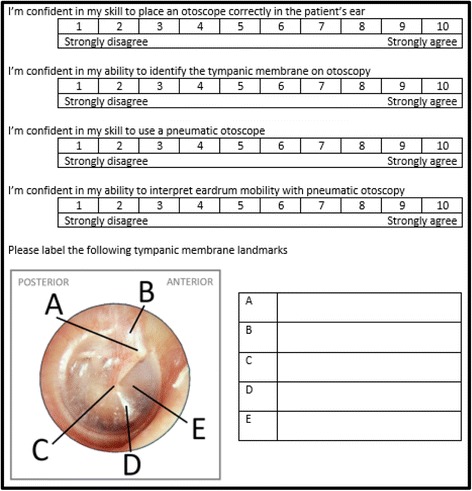
Methods: Using a prospective study design, an otolaryngologist delivered an one-hour, small group workshop to medical learners. The workshop included introduction and demonstration of otoscopy and pneumatic otoscopy followed by practice with peer feedback. A survey exploring students' confidence with otoscopy and recall of anatomical landmarks was distributed before(T1), immediately after(T2), and 1 month following the session(T3).
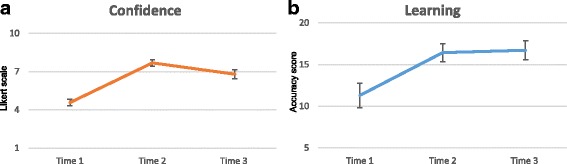
Results: One hundred and twenty five learners participated from February 2016 to February 2017. Forty nine participants with complete data over T1-T3 demonstrated significant improvement over time in confidence (Wilk's lambda = .09, F(2,48) = 253.31 p < .001, η 2 = .91) and learning (Wilk's lambda = 0.34, F(2,47) = 24.87 p < .001, η 2 = .66).
Conclusions: A small-group, structured teaching session had positive effects on students' confidence with otoscopy and identification of otologic landmarks. Dedicated otoscopy teaching sessions may be a beneficial addition to the undergraduate medical curriculum.
Keywords: Knowledge; Medical education; Otology; Otoscopy; Skills; Training.
Conflict of interest statement
Ethics approval and consent to participate
This study was approved by Western University Research Ethics Boards (File number 107347). All participants were voluntary and provided an informed consent.
Consent for publication
No individual data was presented in this manuscript.
Competing interests
The authors declare that they have no competing interests.
Publisher’s Note
Springer Nature remains neutral with regard to jurisdictional claims in published maps and institutional affiliations.
Figures
References
MeSH terms
LinkOut - more resources
Full Text Sources
Other Literature Sources
Research Materials
Miscellaneous
