


Family level variation in Wolbachia-mediated dengue virus blocking in Aedes aegypti
- PMID: 29282144
- PMCID: PMC5746003
- DOI: 10.1186/s13071-017-2589-3
Family level variation in Wolbachia-mediated dengue virus blocking in Aedes aegypti
Abstract
Background: The mosquito vector Aedes aegypti is responsible for transmitting a range of arboviruses including dengue (DENV) and Zika (ZIKV). The global reach of these viruses is increasing due to an expansion of the mosquito's geographic range and increasing urbanization and human travel. Vector control remains the primary means for limiting these diseases. Wolbachia pipientis is an endosymbiotic bacterium of insects that has the ability to block the replication of pathogens, including flaviviruses such as DENV or ZIKV, inside the body of the vector. A strain of Wolbachia called wMel is currently being released into wild mosquito populations to test its potential to limit virus transmission to humans. The mechanism that underpins the virus blocking effect, however, remains elusive.
Methods: We used a modified full-sib breeding design in conjunction with vector competence assays in wildtype and wMel-infected Aedes aegypti collected from the field. All individuals were injected with DENV-2 intrathoracically at 5-6 days of age. Tissues were dissected 7 days post-infection to allow quantification of DENV and Wolbachia loads.
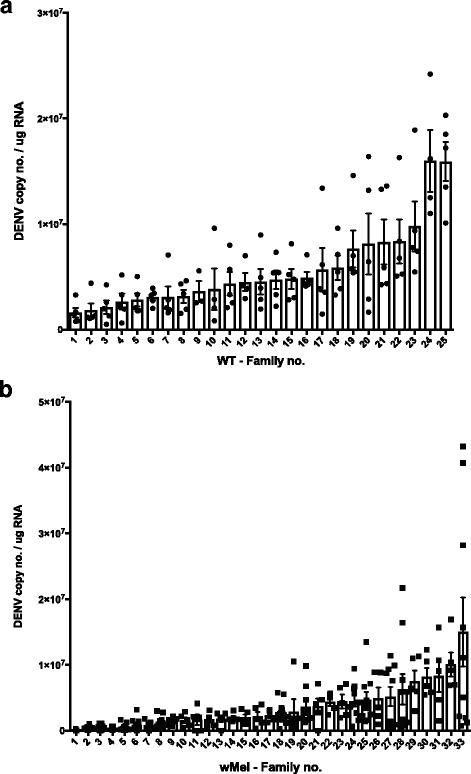
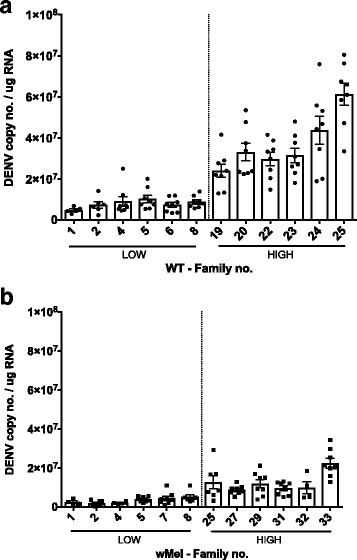
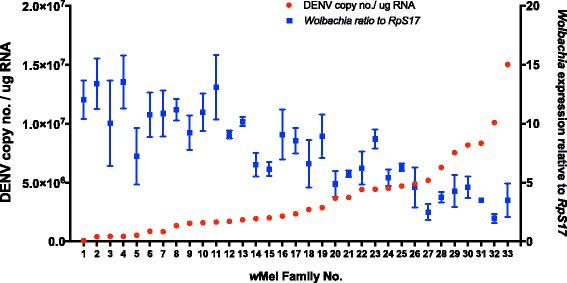
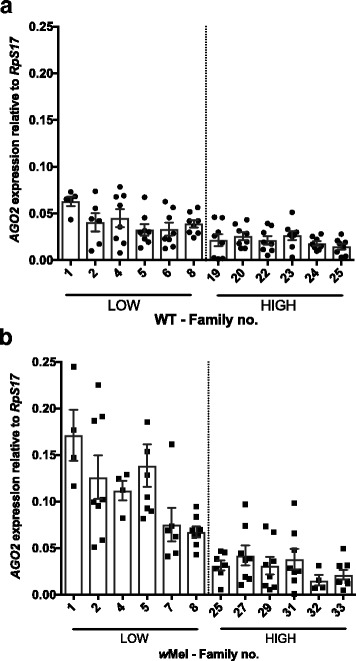
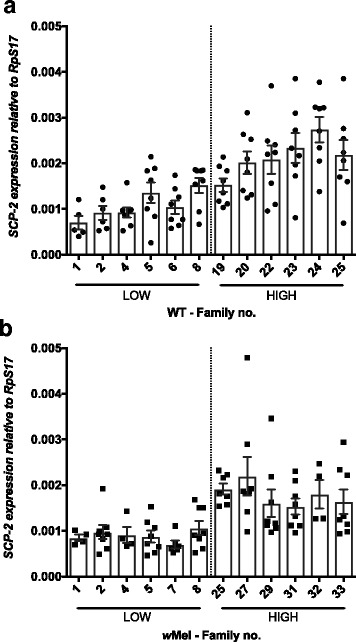
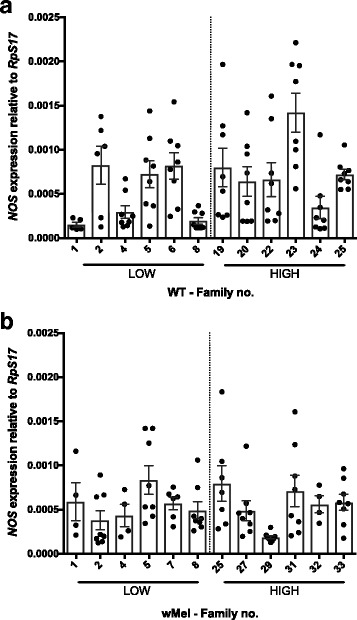
Results: We show the first evidence of family level variation in Wolbachia-mediated blocking in mosquitoes. This variation may stem from either genetic contributions from the mosquito and Wolbachia genomes or environmental influences on Wolbachia. In these families, we also tested for correlations between strength of blocking and expression level for several insect immunity genes with possible roles in blocking, identifying two genes of interest (AGO2 and SCP-2).
Conclusions: In this study we show variation in Wolbachia-mediated DENV blocking in Aedes aegypti that may arise from genetic contributions and environmental influences on the mosquito-Wolbachia association. This suggests that Wolbachia-mediated blocking may have the ability to evolve through time or be expressed differentially across environments. The long-term efficacy of Wolbachia in the field will be dependent on the stability of blocking. Understanding the mechanism of blocking will be necessary for successful development of strategies that counter the emergence of evolved resistance or variation in its expression under diverse field conditions.
Keywords: Aedes; Dengue virus; Evolution; Genetic variation; Wolbachia.
Conflict of interest statement
Ethics approval and consent to participate
The ET300 DENV strain used in the study was received from researchers associated with Queensland Health (QH), Australia/University of Queensland (UQ). IRB approval was obtained from UQ. Patient data were anonymized by QH. The Monash University Human Research Ethics Committee gave ethical approval (permit CF11/0766-2011000387) for the experimental research. Human volunteer blood-feeders were provided and agreed upon written informed consent prior to the study.
Consent for publication
Not applicable
Competing interests
The authors declare that they have no competing interests.
Publisher’s Note
Springer Nature remains neutral with regard to jurisdictional claims in published maps and institutional affiliations.
Figures
References
Publication types
MeSH terms
Grants and funding
LinkOut - more resources
Full Text Sources
Other Literature Sources
