


Economic evaluation of an experience sampling method intervention in depression compared with treatment as usual using data from a randomized controlled trial
- PMID: 29284448
- PMCID: PMC5747107
- DOI: 10.1186/s12888-017-1577-7
Economic evaluation of an experience sampling method intervention in depression compared with treatment as usual using data from a randomized controlled trial
Abstract
Background: Experience sampling, a method for real-time self-monitoring of affective experiences, holds opportunities for person-tailored treatment. By focussing on dynamic patterns of positive affect, experience sampling method interventions (ESM-I) accommodate strategies to enhance personalized treatment of depression-at potentially low-costs. This study aimed to investigate the cost-effectiveness of an experience sampling method intervention in patients with depression, from a societal perspective.
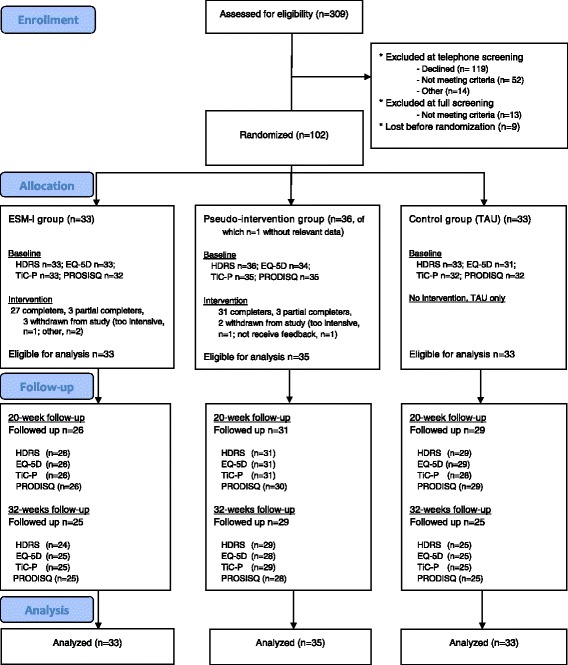
Methods: Participants were recruited between January 2010 and February 2012 from out-patient mental health care facilities in or near the Dutch cities of Eindhoven and Maastricht, and through local advertisements. Out-patients diagnosed with major depression (n = 101) receiving pharmacotherapy were randomized into: (i) ESM-I consisting of six weeks of ESM combined with weekly feedback regarding the individual's positive affective experiences, (ii) six weeks of ESM without feedback, or (iii) treatment as usual only. Alongside this randomised controlled trial, an economic evaluation was conducted consisting of a cost-effectiveness and a cost-utility analysis, using Hamilton Depression Rating Scale (HDRS) and quality adjusted life years (QALYs) as outcome, with willingness-to-pay threshold for a QALY set at €50,000 (based on Dutch guidelines for moderate severe to severe illnesses).
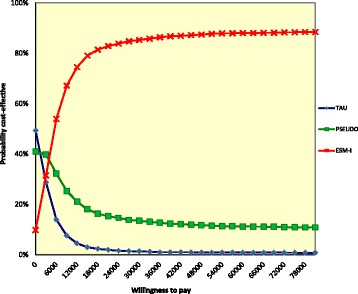
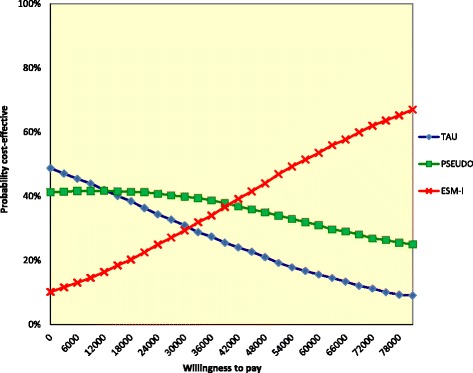
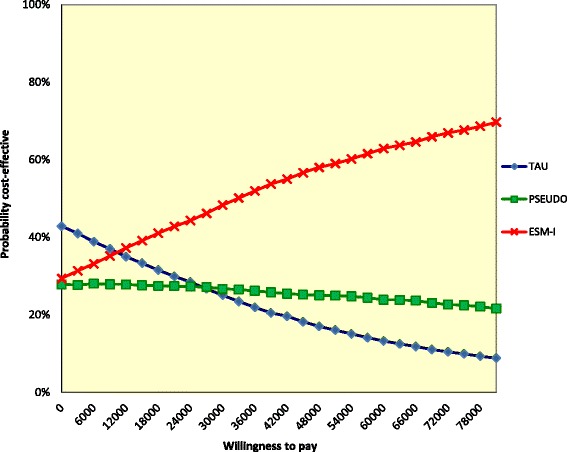
Results: The economic evaluation showed that ESM-I is an optimal strategy only when willingness to pay is around €3000 per unit HDRS and around €40,500 per QALY. ESM-I was the least favourable treatment when willingness to pay was lower than €30,000 per QALY. However, at the €50,000 willingness-to-pay threshold, ESM-I was, with a 46% probability, the most favourable treatment (base-case analysis). Sensitivity analyses confirmed the robustness of these results.
Conclusions: We may tentatively conclude that ESM-I is a cost-effective add-on intervention to pharmacotherapy in outpatients with major depression.
Trial registration: Netherlands Trial register, NTR1974 .
Keywords: Cost-effectiveness analysis; Cost-utility analysis; Depressive disorder; Ecological momentary assessment; Experience sampling method; Intervention study; Psychological feedback.
Conflict of interest statement
Ethics approval and consent to participate
The study was approved by an institutional review board (Medical Ethics Committee of Maastricht University Medical Centre; id: NL26181.068.09 / MEC 09–3-013) and all participants provided written informed consent before their enrolment.
Consent for publication
Not applicable.
Competing interests
JvO is or has been an unrestricted research grant holder with, or has received financial compensation as an independent symposium speaker from, Eli Lilly, BMS, Lundbeck, Organon, Janssen-Cilag, GlaxoSmithKline, AstraZeneca, Pfizer, and Servier. All other authors declare no competing interests.
Publisher’s Note
Springer Nature remains neutral with regard to jurisdictional claims in published maps and institutional affiliations.
Figures
References
-
- Murray CJ, Vos T, Lozano R, Naghavi M, Flaxman AD, Michaud C, et al. Disability-adjusted life years (DALYs) for 291 diseases and injuries in 21 regions, 1990-2010: a systematic analysis for the global burden of disease study 2010. Lancet. 2012;380:2197–2223. doi: 10.1016/S0140-6736(12)61689-4. - DOI - PubMed
-
- Vos T, Flaxman AD, Naghavi M, Lozano R, Michaud C, Ezzati M, et al. Years lived with disability (YLDs) for 1160 sequelae of 289 diseases and injuries 1990-2010: a systematic analysis for the global burden of disease study 2010. Lancet. 2012;380:2163–2196. doi: 10.1016/S0140-6736(12)61729-2. - DOI - PMC - PubMed
-
- World Health Organization . Depression. A global public health concern. 2012.
Publication types
MeSH terms
Associated data
Grants and funding
LinkOut - more resources
Full Text Sources
Other Literature Sources
