Prevalence, Characteristics, and Complications of Supernumerary Teeth in Nonsyndromic Pediatric Population of South India: A Clinical and Radiographic Study
- PMID: 29284970
- PMCID: PMC5731020
- DOI: 10.4103/jpbs.JPBS_154_17
Prevalence, Characteristics, and Complications of Supernumerary Teeth in Nonsyndromic Pediatric Population of South India: A Clinical and Radiographic Study
Abstract
Introduction: Supernumerary teeth are the presence of more number of teeth over the normal dental formula and may occur in permanent as well as early mixed dentition. This study determined the prevalence, characteristics, and complications caused by supernumerary teeth in nonsyndromic South Indian pediatric population.
Materials and methods: Characteristics of supernumerary teeth determined by clinical and radiographic examination were recorded. The age, sex, number of supernumerary teeth, eruption status, morphology, position, orientation, and complications (if any) associated with supernumerary teeth were recorded for each patient who had supernumerary teeth. The data collected were statistically analyzed.
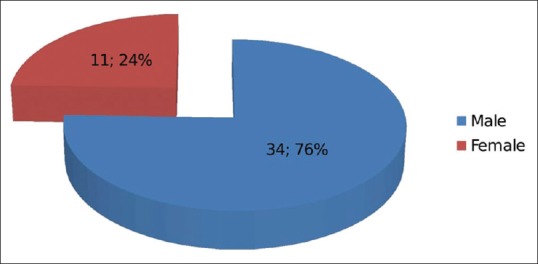
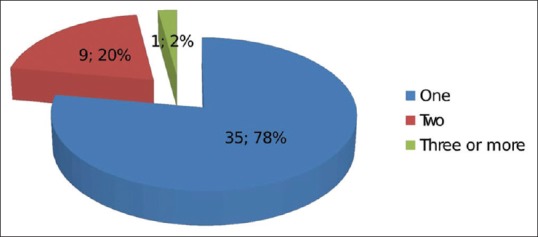
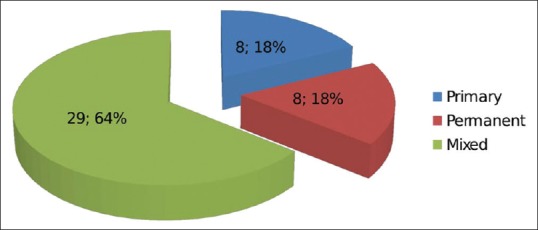
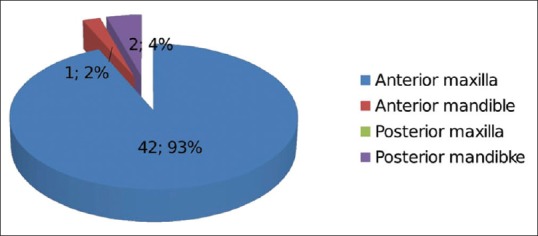
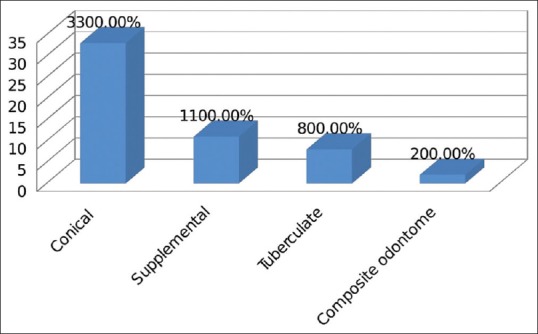
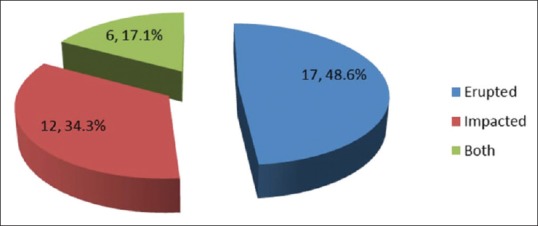
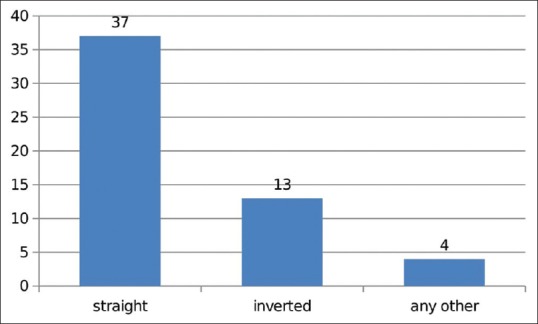
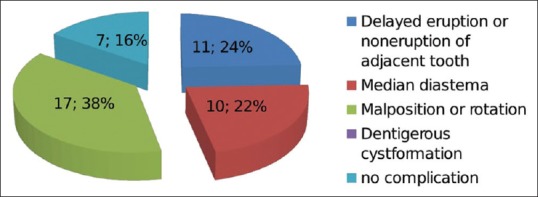
Results: Supernumerary teeth were detected in 45 subjects (1.1%), of which 34 (75.6%) were male and 11 (24.4%) were female. There was no association between the number of supernumerary teeth and the gender of the patient. The total number of supernumerary teeth among the affected 45 patients was 54. The average number of supernumerary teeth per person was 1.2. The number of supernumerary teeth was one in 35 cases, two in 8 cases, and 3 in 1 case. Of the 45 patients, 8 patients with supernumerary teeth were in deciduous dentition stage, 29 patients were in mixed dentition stage, and 8 patients were in permanent dentition stage. Most supernumerary teeth presented in the anterior maxilla. Morphologically, conical-shaped supernumerary teeth were the most common finding. 68.5% of supernumerary teeth presented with straight orientation and inverted orientation was seen in 24.1%. Complications seen in patients with supernumerary teeth were delayed or noneruption of adjacent tooth malposition or rotation of adjacent teeth, diastema formation, and formation of dentigerous cyst.
Conclusions: Supernumerary teeth have an incidence of 1.1% in South Indian population and can cause many complications that can harm the developing occlusion. Knowledge about supernumerary teeth may help the dentist in early diagnosis and early intervention.
Keywords: Hyperdontia; mesiodens; supernumerary teeth.
Conflict of interest statement
There are no conflicts of interest.
Figures
References
-
- Mukhopadhyay S. Mesiodens: A clinical and radiographic study in children. J Indian Soc Pedod Prev Dent. 2011;29:34–8. - PubMed
-
- Celikoglu M, Kamak H, Oktay H. Prevalence and characteristics of supernumerary teeth in a non-syndrome Turkish population: Associated pathologies and proposed treatment. Med Oral Patol Oral Cir Bucal. 2010;15:e575–8. - PubMed
-
- Garvey MT, Barry HJ, Blake M. Supernumerary teeth – An overview of classification, diagnosis and management. J Can Dent Assoc. 1999;65:612–6. - PubMed
-
- Díaz A, Orozco J, Fonseca M. Multiple hyperodontia: Report of a case with 17 supernumerary teeth with non syndromic association. Med Oral Patol Oral Cir Bucal. 2009;14:E229–31. - PubMed
-
- Nazif MM, Ruffalo RC, Zullo T. Impacted supernumerary teeth: A survey of 50 cases. J Am Dent Assoc. 1983;106:201–4. - PubMed
LinkOut - more resources
Full Text Sources
Other Literature Sources