Outcome of EGFR-mutated NSCLC patients with MET-driven resistance to EGFR tyrosine kinase inhibitors
- PMID: 29285237
- PMCID: PMC5739624
- DOI: 10.18632/oncotarget.21707
Outcome of EGFR-mutated NSCLC patients with MET-driven resistance to EGFR tyrosine kinase inhibitors
Abstract
Background: Several mechanisms of acquired resistance to EGFR tyrosine kinase inhibitors (TKIs) in EGFR-mutated NSCLC have been described including the T790M mutation and MET amplification. Whereas T790M mutation confers prolonged survival and sensitivity to 3rd generation TKIs, data are lacking on clinical features and outcome of MET-driven resistant EGFR-mutated NSCLC patients.
Methods: Patients with metastatic EGFR-mutated NSCLC displaying high MET overexpression or MET amplification, detected on a biopsy performed after progression on EGFR TKI, were identified in 15 centers. Clinical and molecular data were retrospectively collected.
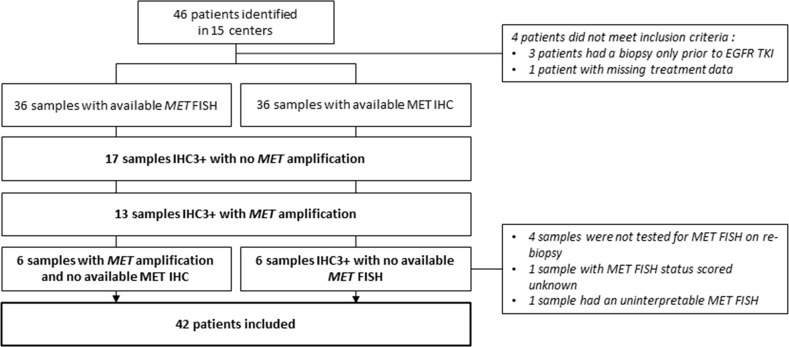
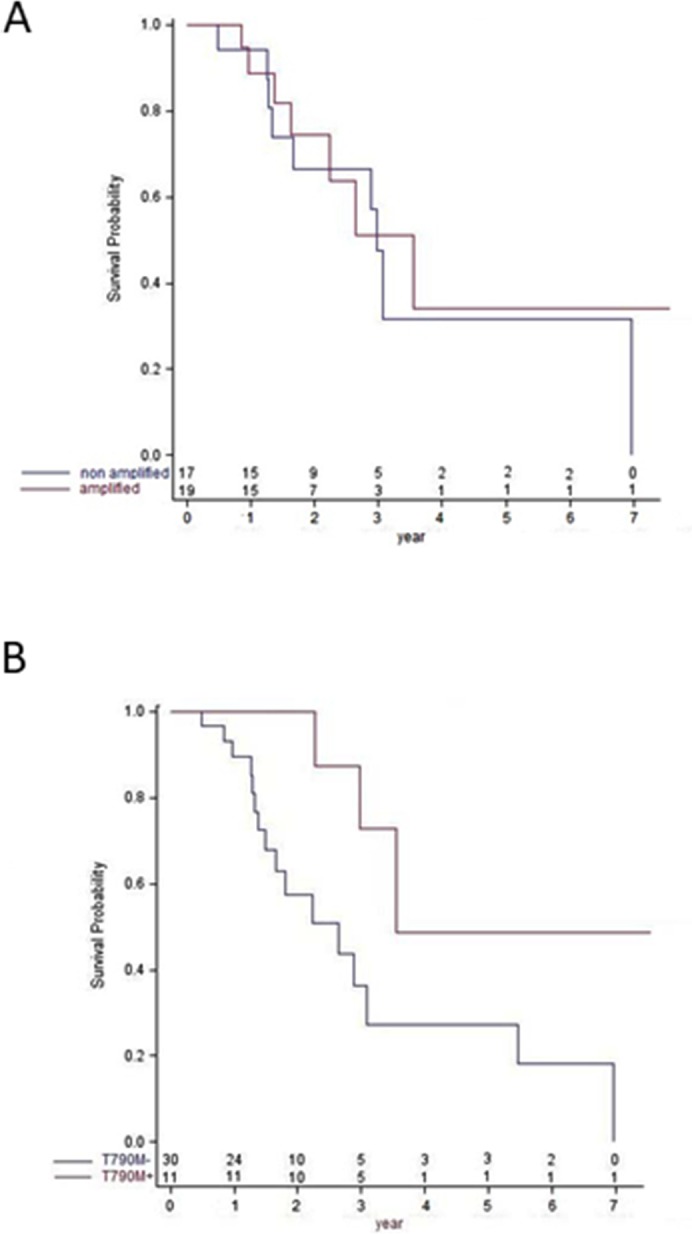
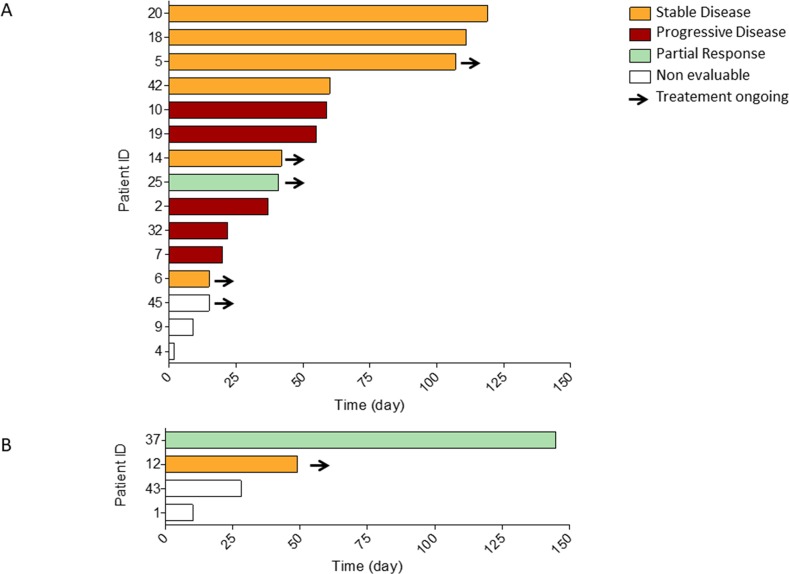
Results: Forty two patients were included. The median overall survival (OS), and the median post EGFR TKI progression overall survival (PPOS) were 36.2 months [95%CI 27.3-66.5] and 18.5 months [95%CI 10.6-27.4] respectively. Nineteen out of 36 tumors tested for MET FISH had MET amplification. A T790M mutation was found in 11/41 (26.8%) patients. T790M-positive patients had a better OS than T790M-negative patients (p=0.0224). Nineteen patients received a MET TKI. Objective response was reported in 1 out of 12 evaluable patients treated with a MET inhibitor as a single agent and in 1 of 2 patients treated with a combination of MET and EGFR TKIs.
Conclusion: MET-driven resistance to EGFR TKI defines a specific pattern of resistance characterized by low objective response rate to MET inhibitors given alone and overlapping with T790M mutations. Further studies are warranted to define adequate therapeutic strategies for MET-driven resistance to EGFR TKI.
Keywords: EGFR; MET; non small cell lung cancer; resistance; tyrosine kinase inhibitors.
Conflict of interest statement
CONFLICTS OF INTEREST A B. Cortot reported conflicts of interest with : Astra-Zeneca, Boehringer-Ingelheim, Roche, Novartis, BMS, MSD, Pfizer Simon Baldacci reported conflicts of interest with : Lilly, GSK, Pfizer, Roche Nicolas Girard reported conflicts of interest with : Astra-Zeneca, Boehringer-Ingelheim, Roche, Novartis, BMS, MSD, Pfizer Clarisse Audigier-Valette reported conflicts of interest with : Astra-Zeneca, Boehringer-Ingelheim, Roche, Novartis, BMS, MSD, Pfizer Florian Guisier reported conflicts of interest with : Boehringer-Ingelheim, BMS
Figures
References
-
- Barlesi F, Mazieres J, Merlio JP, Debieuvre D, Mosser J, Lena H, Ouafik L, Besse B, Rouquette I, Westeel V, Escande F, Monnet I, Lemoine A, et al. Routine molecular profiling of patients with advanced non-small-cell lung cancer: results of a 1-year nationwide programme of the French Cooperative Thoracic Intergroup (IFCT) Lancet Lond Engl. 2016;387:1415–26. doi: 10.1016/S0140-6736(16)00004-0. - DOI - PubMed
-
- Rosell R, Carcereny E, Gervais R, Vergnenegre A, Massuti B, Felip E, Palmero R, Garcia Gomez R, Pallares C, Sanchez JM, Porta R, Cobo M, Garrido P, et al. Erlotinib versus standard chemotherapy as first-line treatment for European patients with advanced EGFR mutation-positive non-small-cell lung cancer (EURTAC): a multicentre, open-label, randomised phase 3 trial. Lancet Oncol. 2012;13:239–46. doi: 10.1016/S1470-2045(11)70393-X. - DOI - PubMed
-
- Sequist LV, Yang JCH, Yamamoto N, O'Byrne K, Hirsh V, Mok T, Geater SL, Orlov S, Tsai CM, Boyer M, Su WC, Bennouna J, Kato T, et al. Phase III study of afatinib or cisplatin plus pemetrexed in patients with metastatic lung adenocarcinoma with EGFR mutations. J Clin Oncol. 2013;31:3327–34. doi: 10.1200/JCO.2012.44.2806. - DOI - PubMed
LinkOut - more resources
Full Text Sources
Other Literature Sources
Research Materials
Miscellaneous