


Clinical significance of atypical squamous cells of undetermined significance after treatment for cervical intraepithelial grade 3 neoplasia: A retrospective single-center cohort study
- PMID: 29285369
- PMCID: PMC5740842
- DOI: 10.3892/mco.2017.1443
Clinical significance of atypical squamous cells of undetermined significance after treatment for cervical intraepithelial grade 3 neoplasia: A retrospective single-center cohort study
Abstract
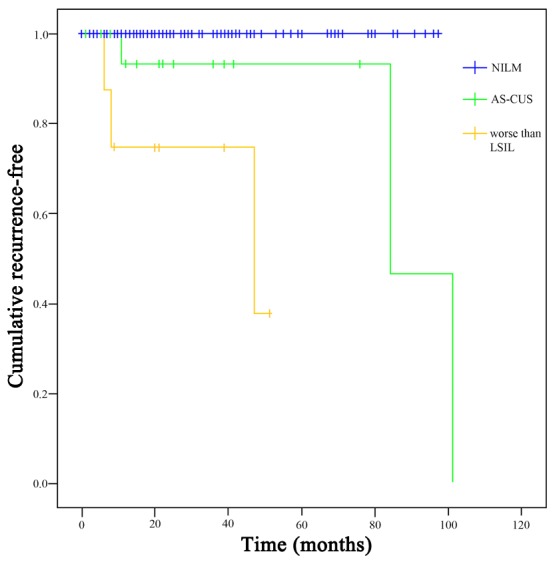
The aim of the present study was to evaluate the clinical significance of atypical squamous cells of undetermined significance (ASC-US) following cervical conization for cervical intraepithelial neoplasia (CIN) grade 3. This study was a retrospective cohort analysis. The medical records of women treated with conization for CIN 2-3 were reviewed and 142 patients with CIN 3 who had been diagnosed using the conization specimens were selected. The mean follow-up period after conization was 41.8 months. Cytological abnormalities after conization were observed in 19.0% of the patients and consisted of ASC-US (13.4%) and worse than low-grade squamous intraepithelial lesion (LSIL; 5.6%). Recurrence was defined as a diagnosis worse than CIN 2, and the recurrence rate was 29.6% among patients with abnormal cytology. The recurrence rate was 15.7% in the ASC-US group and 71.4% in the worse than LSIL group. There was no significant difference in the time of initial identification of abnormal cytology after treatment between the worse than LSIL and the ASC-US groups (P=0.054). However, the ASC-US group had a significantly better cumulative recurrence-free rate compared with the worse than LSIL group (P<0.05). Women with ASC-US following treatment for CIN appear to be at a relatively high risk. Regarding the risk stratification of women following treatment for CIN, if surveillance cytology shows ASC-US, immediate colposcopy is recommended, along with long-term follow-up.
Keywords: atypical squamous cells of undetermined significance; cervical intraepithelial neoplasia grade 3; conization; follow-up cytology; recurrence.
Figures
References
-
- Massad LS, Einstein MH, Huh WK, Katki HA, Kinney WK, Schiffman M, Solomon D, Wentzensen N, Lawson HW. 2012 ASCCP Consensus Guidelines Conference: 2012 updated consensus guidelines for the management of abnormal cervical cancer screening tests and cancer precursors. Obstet Gynecol. 2013;121:829–846. doi: 10.1097/AOG.0b013e3182883a34. - DOI - PubMed
-
- van der Heijden E, Lopes AD, Bryant A, Bekkers R, Galaal K. Follow-up strategies after treatment (large loop excision of the transformation zone (LLETZ)) for cervical intraepithelial neoplasia (CIN): Impact of human papillomavirus (HPV) test. Cochrane Database Syst Rev. 2015;1:CD010757. - PMC - PubMed
-
- Melnikow J, Kulasingam S, Slee C, Helms LJ, Kuppermann M, Birch S, McGahan CE, Coldman A, Chan BK, Sawaya GF. Surveillance after treatment for cervical intraepithelial neoplasia: Outcomes, costs, and cost-effectiveness. Obstet Gynecol. 2010;116:1158–1170. doi: 10.1097/AOG.0b013e3181f88e72. - DOI - PubMed
LinkOut - more resources
Full Text Sources
Other Literature Sources
Miscellaneous