


Regulatory mechanisms of hypoxia-inducible factor 1 activity: Two decades of knowledge
- PMID: 29285833
- PMCID: PMC5834787
- DOI: 10.1111/cas.13483
Regulatory mechanisms of hypoxia-inducible factor 1 activity: Two decades of knowledge
Abstract
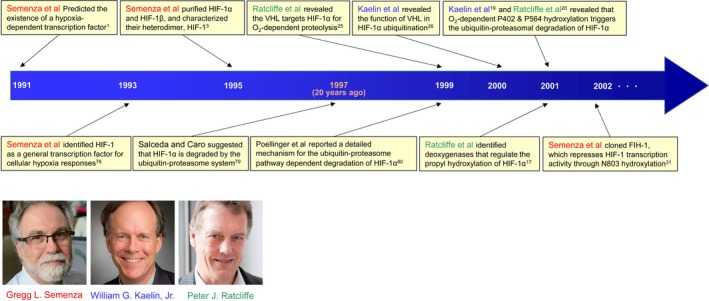
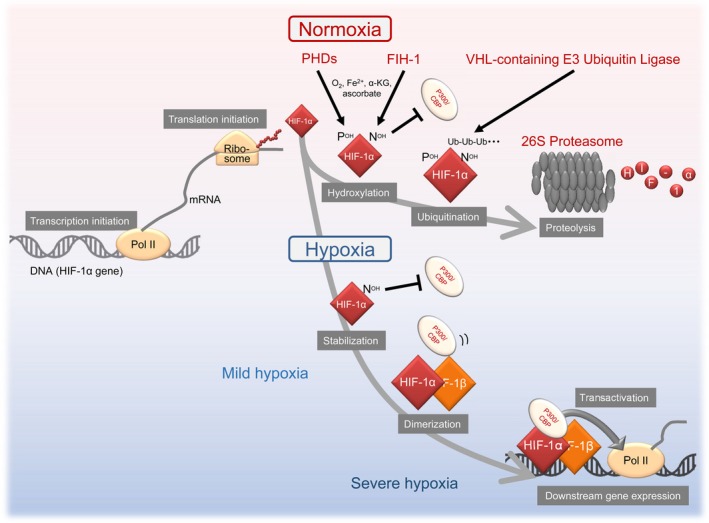
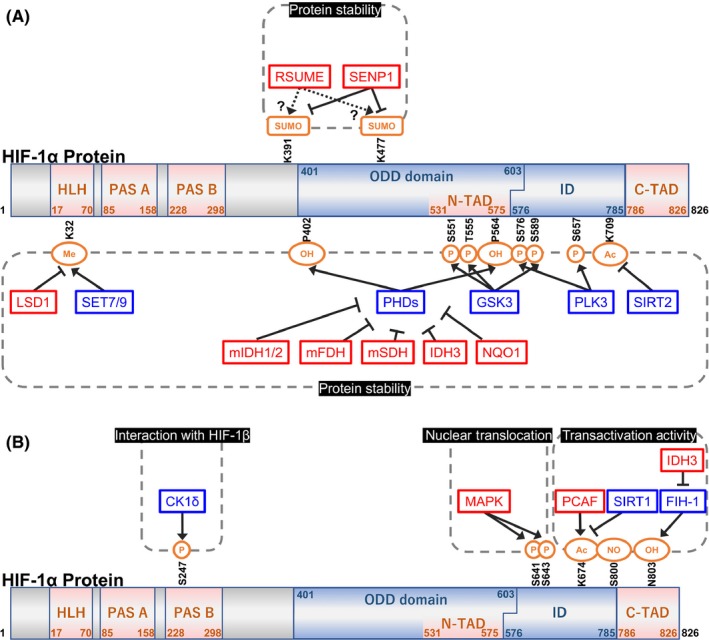
Hypoxia-inducible factor 1 (HIF-1) is a transcriptional activator of various genes related to cellular adaptive responses to hypoxia. Dysfunctions in the regulatory systems of HIF-1 activity have been implicated in the pathogenesis of various diseases including malignant tumors and, thus, elucidating the molecular mechanisms underlying the activation of HIF-1 is eagerly desired for the development of novel anti-cancer strategies. The importance of oxygen-dependent and ubiquitin-mediated proteolysis of the regulatory subunit of HIF-1 (HIF-1α) was first reported in 1997. Since then, accumulating evidence has shown that HIF-1α may become stable and active even under normoxic conditions; for example, when disease-associated genetic and functional alterations in some genes trigger the aberrant activation of HIF-1 regardless of oxygen conditions. We herein review the last two decades of knowledge, since 1997, on the regulatory mechanisms of HIF-1 activity from conventional oxygen- and proteolysis-dependent mechanisms to up-to-the-minute information on cancer-associated genetic and functional alteration-mediated mechanisms.
Keywords: gene expression; hypoxia-inducible factor 1 (HIF-1); molecular mechanism; tumor hypoxia.
© 2017 The Authors. Cancer Science published by John Wiley & Sons Australia, Ltd on behalf of Japanese Cancer Association.
Figures
References
-
- Imagawa S, Goldberg MA, Doweiko J, Bunn HF. Regulatory elements of the erythropoietin gene. Blood. 1991;77:278‐285. - PubMed
-
- Wang GL, Semenza GL. Purification and characterization of hypoxia‐inducible factor 1. J Biol Chem. 1995;270:1230‐1237. - PubMed
-
- Harada H, Kizaka‐Kondoh S, Li G, et al. Significance of HIF‐1‐active cells in angiogenesis and radioresistance. Oncogene. 2007;26:7508‐7516. - PubMed
-
- Semenza GL. Targeting HIF‐1 for cancer therapy. Nat Rev Cancer. 2003;3:721‐732. - PubMed
Publication types
MeSH terms
Substances
LinkOut - more resources
Full Text Sources
Other Literature Sources
Medical
