


Treatment of Atrial Fibrillation in Patients with Dementia: A Cohort Study from the Swedish Dementia Registry
- PMID: 29286925
- PMCID: PMC5798527
- DOI: 10.3233/JAD-170575
Treatment of Atrial Fibrillation in Patients with Dementia: A Cohort Study from the Swedish Dementia Registry
Abstract
Background: Patients with dementia might have higher risk for hemorrhagic complications with anticoagulant therapy prescribed for atrial fibrillation (AF).
Objective: This study assesses the risks and benefits of warfarin, antiplatelets, and no treatment in patients with dementia and AF.
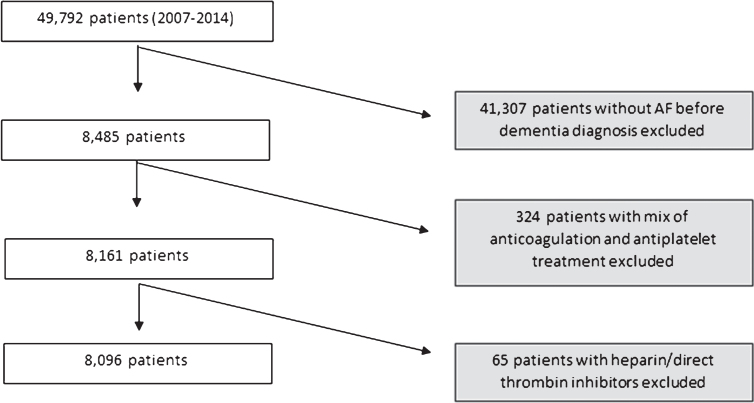
Methods: Of 49,792 patients registered in the Swedish Dementia Registry 2007-2014, 8,096 (16%) had a previous diagnosis of AF. Cox proportional hazards models were used to calculate the risk for ischemic stroke (IS), nontraumatic intracranial hemorrhage, any-cause hemorrhage, and death.
Results: Out of the 8,096 dementia patients with AF, 2,143 (26%) received warfarin treatment, 2,975 (37%) antiplatelet treatment, and 2,978 (37%) had no antithrombotic treatment at the time of dementia diagnosis. Patients on warfarin had fewer IS than those without treatment (5.2% versus 8.7%; p < 0.001) with no differences compared to antiplatelets. In adjusted analyses, warfarin was associated with a lower risk for IS (HR 0.76, CI 0.59-0.98), while antiplatelets were associated with increased risk (HR 1.25, CI 1.01-1.54) compared to no treatment. For any-cause hemorrhage, there was a higher risk with warfarin (HR 1.28, CI 1.03-1.59) compared to antiplatelets. Warfarin and antiplatelets were associated with a lower risk for death compared to no treatment.
Conclusions: Warfarin treatment in Swedish patients with dementia is associated with lower risk of IS and mortality, and a small increase in any-cause hemorrhage. This study supports the use of warfarin in appropriate cases in patients with dementia. The low percentage of patients on warfarin treatment indicates that further gains in stroke prevention are possible.
Keywords: Atrial fibrillation; dementia; hemorrhage; ischemic stroke; warfarin.
References
-
- Heeringa J, van der Kuip DA, Hofman A, Kors JA, van Herpen G, Stricker BH, Stijnen T, Lip GY, Witteman JC (2006) Prevalence, incidence and lifetime risk of atrial fibrillation: The Rotterdam study. Eur Heart J 27, 949–953. - PubMed
-
- Ferrucci L, Guralnik JM, Salive ME, Pahor M, Corti MC, Baroni A, Havlik RJ (1996) Cognitive impairment and risk of stroke in the older population. J Am Geriatr Soc 44, 237–241. - PubMed
-
- Garcia-Ptacek S, Kareholt I, Cermakova P, Rizzuto D, Religa D, Eriksdotter M (2016) Causes of death according to death certificates in individuals with dementia: A cohort from the Swedish Dementia Registry. J Am Geriatr Soc 64, e137–e142. - PubMed
-
- Cermakova P, Johnell K, Fastbom J, Garcia-Ptacek S, Lund LH, Winblad B, Eriksdotter M, Religa D (2015) Cardiovascular diseases in 30,000 patients in the Swedish Dementia Registry. J Alzheimers Dis 48, 949–958. - PubMed
Publication types
MeSH terms
Substances
LinkOut - more resources
Full Text Sources
Other Literature Sources
Medical
