. 2018 Jan 25;36(4):442-452.
doi: 10.1016/j.vaccine.2017.12.019. Epub 2017 Dec 26.

How close are countries of the WHO European Region to achieving the goal of vaccinating 75% of key risk groups against influenza? Results from national surveys on seasonal influenza vaccination programmes, 2008/2009 to 2014/2015

Affiliations

How close are countries of the WHO European Region to achieving the goal of vaccinating 75% of key risk groups against influenza? Results from national surveys on seasonal influenza vaccination programmes, 2008/2009 to 2014/2015

Pernille Jorgensen et al. Vaccine. .

Abstract

Background: Influenza vaccination is recommended especially for persons at risk of complications. In 2003, the World Health Assembly urged Member States (MS) to increase vaccination coverage to 75% among older persons by 2010.

Objective: To assess progress towards the 2010 vaccination goal and describe seasonal influenza vaccination recommendations in the World Health Organization (WHO) European Region.

Methods: Data on seasonal influenza vaccine recommendations, dose distribution, and target group coverage were obtained from two sources: European Union and European Economic Area MS data were extracted from influenza vaccination surveys covering seven seasons (2008/2009-2014/2015) published by the Vaccine European New Integrated Collaboration Effort and European Centre for Disease Prevention and Control. For the remaining WHO European MS, a separate survey on policies and uptake for all seasons (2008/2009-2014/2015) was distributed to national immunization programmes in 2015.

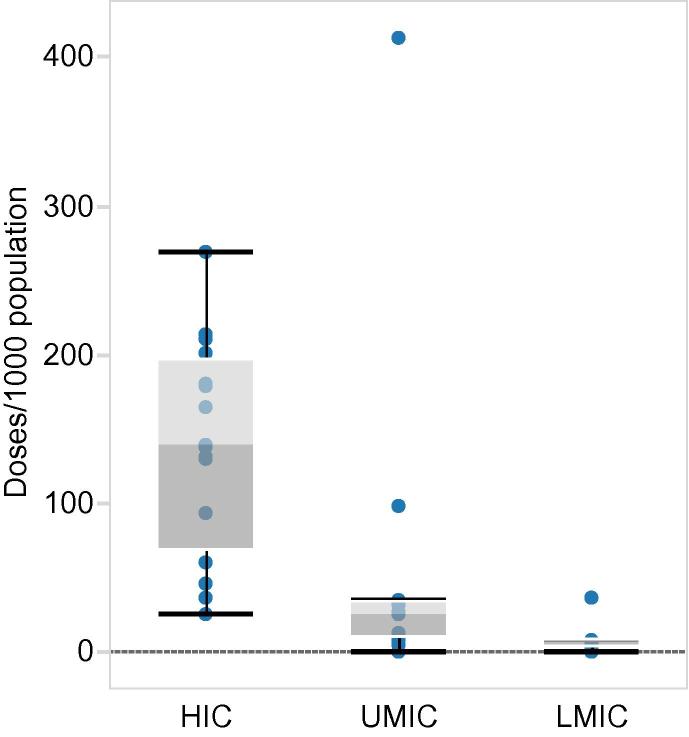
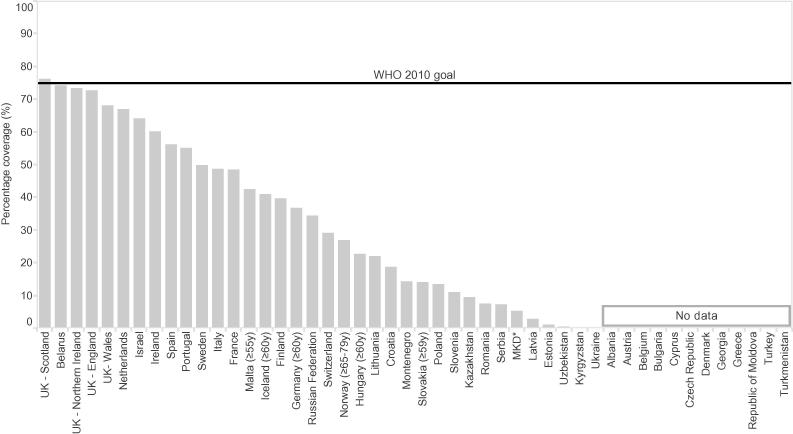
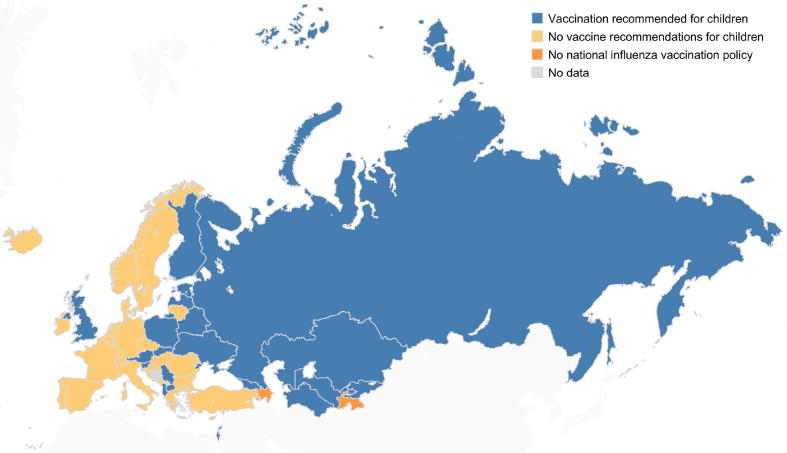
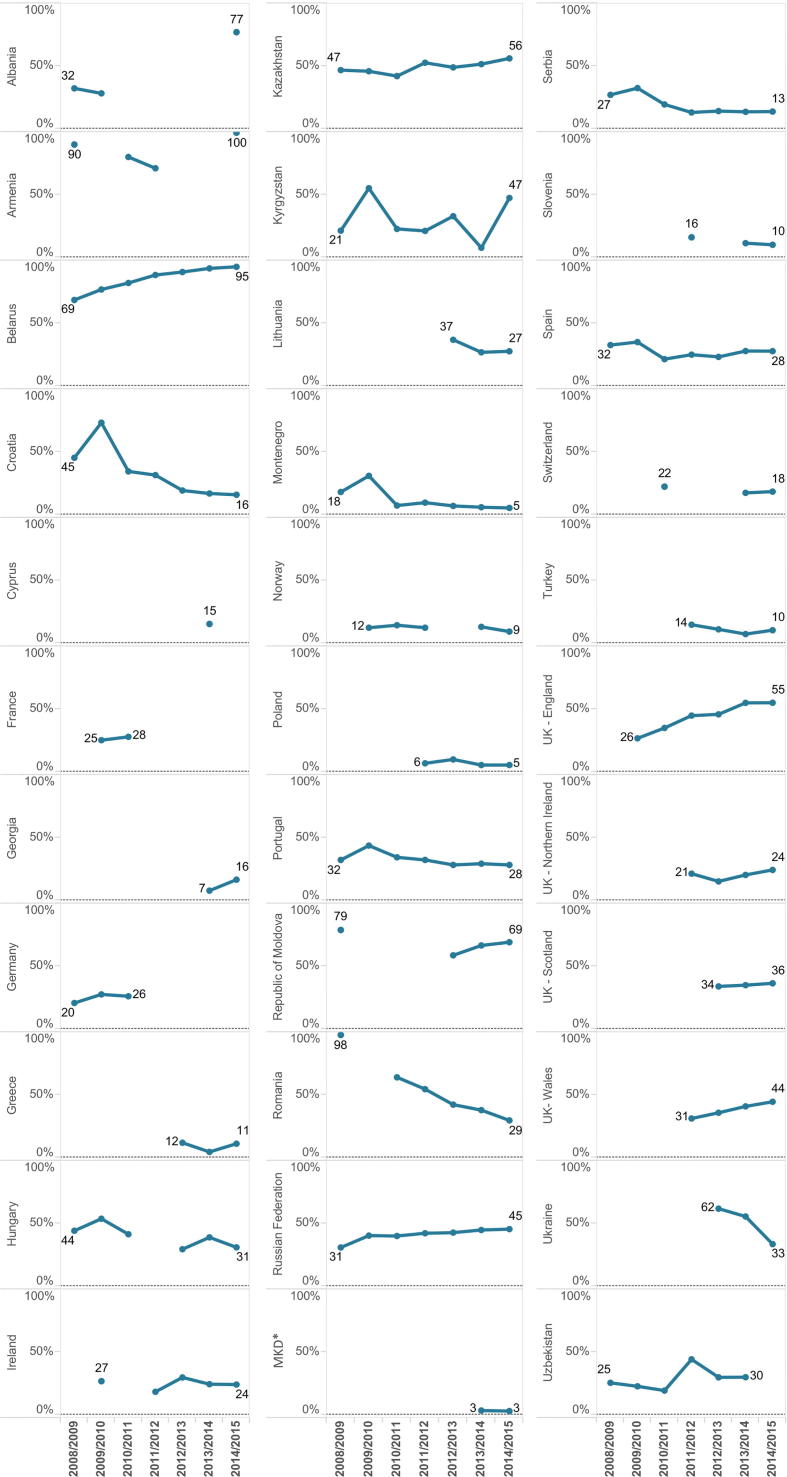
Results: Data was available from 49 of 53 MS. All but two had a national influenza vaccination policy. High-income countries distributed considerably higher number of vaccines per capita (median; 139.2 per 1000 population) compared to lower-middle-income countries (median; 6.1 per 1000 population). Most countries recommended vaccination for older persons, individuals with chronic disease, healthcare workers, and pregnant women. Children were included in < 50% of national policies. Only one country reached 75% coverage in older persons (2014/2015), while a number of countries reported declining vaccination uptake. Coverage of target groups was overall low, but with large variations between countries. Vaccination coverage was not monitored for several groups.

Conclusions: Despite policy recommendations, influenza vaccination uptake remains suboptimal. Low levels of vaccination is not only a missed opportunity for preventing influenza in vulnerable groups, but could negatively affect pandemic preparedness. Improved understanding of barriers to influenza vaccination is needed to increase uptake and reverse negative trends. Furthermore, implementation of vaccination coverage monitoring is critical for assessing performance and impact of the programmes.

Keywords: Immunization programmes; Influenza vaccines; Vaccination coverage.


Figures

Fig. 1
Fig. 1
Map showing member states of the WHO European Region. AL: Albania, AD: Andorra, AM: Armenia, AT: Austria, AZ: Azerbaijan, BY: Belarus, BE: Belgium, BA: Bosnia and Herzegovina, BG: Bulgaria, HR: Croatia, CY: Cyprus, CZ: Czech Republic, DK: Denmark, EE: Estonia, FI: Finland, FR: France, GE: Georgia, DE: Germany, GR: Greece, HU: Hungary, IS: Iceland, IE: Ireland, IL: Israel, IT: Italy, KZ: Kazakhstan, KG: Kyrgyzstan, LV: Latvia, LT: Lithuania, LU: Luxembourg, MT: Malta, MC: Monaco, ME: Montenegro, NL: Netherlands, NO: Norway, PL: Poland, PT: Portugal, MD: Republic of Moldova, RO: Romania, RU: Russian Federation, SM: San Marino, RS: Serbia, SK: Slovakia, SI: Slovenia, ES: Spain, SE: Sweden, CH: Switzerland, TJ: Tajikistan, MK: The former Yugoslav Republic of Macedonia, TR: Turkey, TM: Turkmenistan, UA: Ukraine, GB: United Kingdom of Great Britain and Northern Ireland, and UZ: Uzbekistan. Note: The boundaries and names shown and the designations used on this map do not imply the expression of any opinion whatsoever on the part of the World Health Organization concerning the legal status of any country, territory, city or area or of its authorities, or concerning the delimitation of its frontiers or boundaries. Dotted lines on maps represent approximate borderlines for which there may not yet be full agreement.
Fig. 2
Fig. 2
Seasonal influenza vaccine doses distributed in 2014/2015 according to country income status: HIC = high income countries, UMIC = upper middle income countries, LMIC = lower middle income countries (income categories according to The World Bank [27]).
Fig. 3
Fig. 3
Influenza vaccination coverage among older people (≥65 years of age, unless otherwise indicated) in member states of the WHO European Region during the 2014/2015 season. *The former Yugoslav Republic of Macedonia. Note: Data for the United Kingdom of Great Britain and Northern Ireland (UK) are shown separately for England, Northern Ireland, Scotland and Wales.
Fig. 4
Fig. 4
Trends in influenza vaccination coverage (%) among older people by country between 2008/2009 and 2014/2015. Only countries with ≥ 4 years of data included (n = 33). Note: Data for the United Kingdom of Great Britain and Northern Ireland (UK) are shown separately for England, Northern Ireland, Scotland and Wales; France 2009/2010 data estimated through a survey (data for other years measured by administrative methods); Germany 2008/2009-2010/2011 data estimated through surveys and 2012/2013-2014/2015 data measured by administrative methods, 2008/2009-2009/2010 data show coverage for persons ≥65 years, while data for the following years show coverage for persons ≥60 years; Hungary data shows coverage for persons ≥60 years in 2008/2009-2011/2012 and 2014/2015, other years for persons ≥65 years; Malta data shown for persons ≥65 years in 2008/2009 and 2010/2011 and for persons ≥55 years in 2012/2013-2014/2015; Netherlands coverage data shown for person ≥60 years (2009/2010-2010/2011 and 2012/2013) and for persons ≥65 years (2011/2012 and 2013/2014-2014/2015); Norway 2008/2009-2009/2010 data measured by administrative methods, other years through surveys. Estimates for 2008/2009-2009/2010 include all persons at risk, coverage data for 2013/2014-2014/2015 are for persons ≥65–79 years. Portugal 2008/2009 coverage measured by administrative methods, 2010/2011-2011/2012 through surveys, and 2012/2013-2014/2015 through a combination of the two methods; Sweden coverage data (2008/2009-2011/2012) measured by administrative methods, 2012/2013 data estimated by a combination of administrative and survey methods and 2013/2014-2014/2015 data estimated by surveys, 2009/2010 data incomplete.
Fig. 5
Fig. 5
Member states in the WHO European Region with influenza vaccine recommendations for children in the 2014/2015 season. Note: The boundaries and names shown and the designations used on this map do not imply the expression of any opinion whatsoever on the part of the World Health Organization concerning the legal status of any country, territory, city or area or of its authorities, or concerning the delimitation of its frontiers or boundaries. Dotted lines on maps represent approximate borderlines for which there may not yet be full agreement.
Fig. 6
Fig. 6
Influenza vaccine recommendations for children in the WHO European Region, 2014-2015 season. Note: Data for the United Kingdom of Great Britain and Northern Ireland (UK) are shown separately for England, Northern Ireland, Scotland and Wales.
Fig. 7
Fig. 7
Vaccine recommendations for pregnant women in the WHO European Region in 2008/2009 and 2014/2015. All: Recommended for all pregnant women irrespective of trimester and presence of underlying illness (details on specific groups recommended for vaccination not available for EU/EEA countries in 2007/2008); only chronic illness: Recommended for pregnant women with underlying chronic illness; certain trimesters: Recommended for pregnant women in 2nd and/or 3rd trimester only; none: No recommendation for pregnant women; no national policy: No national seasonal influenza vaccination programme. Information shown for Denmark, Germany and Norway for 2014/2015 is for healthy pregnant women; pregnant women with chronic medical conditions were recommended vaccination during all trimesters. Note: The boundaries and names shown and the designations used on this map do not imply the expression of any opinion whatsoever on the part of the World Health Organization concerning the legal status of any country, territory, city or area or of its authorities, or concerning the delimitation of its frontiers or boundaries. Dotted lines on maps represent approximate borderlines for which there may not yet be full agreement.
Fig. 8
Fig. 8
Trends in influenza vaccination coverage (%) among health care workers by country for seven influenza seasons in the WHO European Region. *The former Yugoslav Republic of Macedonia. Note: Data for the United Kingdom of Great Britain and Northern Ireland (UK) are shown separately for England, Northern Ireland, Scotland and Wales; Ireland coverage data for 2009/2010 and 2012/2013 estimated by surveys, while 2011/2012, 2013/2014 and 2014/2015 estimated by administrative methods; Portugal 2008/2009 coverage data incomplete.

References

    1. World Health Organization. Influenza (Seasonal). Fact sheet no. 211. Geneva, 2014. http://www.who.int/mediacentre/factsheets/fs211/en/ [accessed 4 September 2017].
    1. Mølbak K., Espenhain L., Nielsen J., Tersago K., Bossuyt N., Denissov G. Excess mortality among the elderly in European countries, December 2014 to February 2015. Euro Surveill. 2015:20. - PubMed
    1. Vestergaard L.S., Nielsen J., Krause T.G., Espenhain L., Tersago K., Bustos Sierra N. Excess all-cause and influenza-attributable mortality in Europe, December 2016 to February 2017. Euro Surveill. 2017:22. - PMC - PubMed
    1. Molinari N.M., Ortega-Sanchez I.R., Messonnier M.L., Thompson W.W., Wortley P.M., Weintraub E. The annual impact of seasonal influenza in the US: measuring disease burden and costs. Vaccine. 2007;25:5086–5096. - PubMed
    1. Schanzer D.L., Zheng H., Gilmore J. Statistical estimates of absenteeism attributable to seasonal and pandemic influenza from the Canadian Labour Force Survey. BMC Infect Dis. 2011;11:90. - PMC - PubMed

Publication types

MeSH terms

Substances