


Many layers of embryonic hematopoiesis: new insights into B-cell ontogeny and the origin of hematopoietic stem cells
- PMID: 29287940
- PMCID: PMC5857217
- DOI: 10.1016/j.exphem.2017.12.008
Many layers of embryonic hematopoiesis: new insights into B-cell ontogeny and the origin of hematopoietic stem cells
Abstract
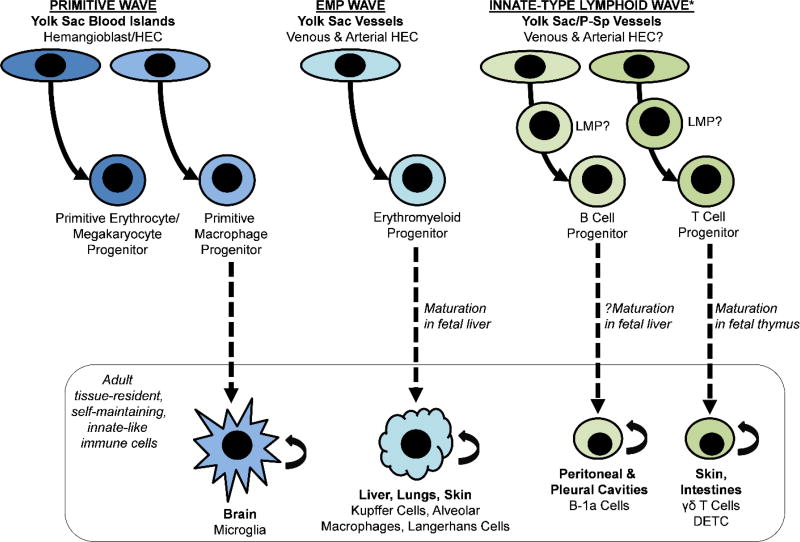
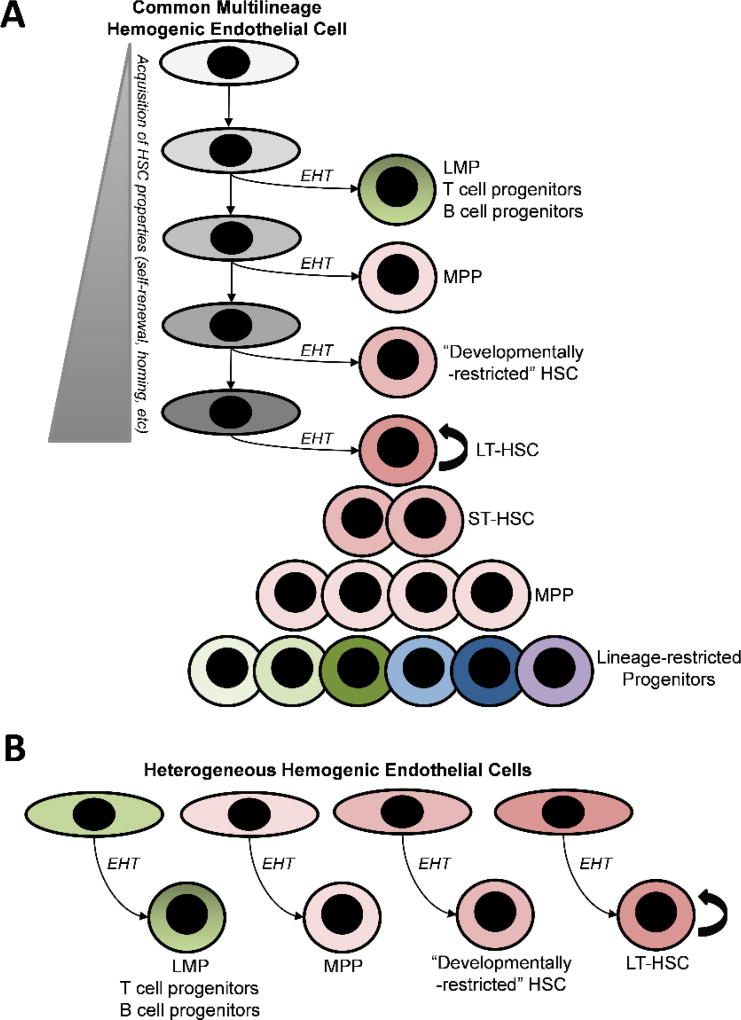
In adult hematopoiesis, the hematopoietic stem cell (HSC) sits at the top of a hierarchy of hematopoietic progenitors responsible for generating the diverse repertoire of blood and immune cells. During embryonic development, however, the initial waves of hematopoiesis provide the first functioning blood cells of the developing embryo, such as primitive erythrocytes arising in the yolk sac, independently of HSCs. In the field of developmental immunology, it has been recognized that some components of the immune system, such as B-1a lymphocytes, are uniquely produced during the embryonic and neonatal period, suggesting a "layered" development of immunity. Several recent studies have shed new light on the developmental origin of the layered immune system, suggesting complex and sometimes multiple contributions to unique populations of innate-like immune cells from both fetal HSCs and earlier HSC-independent progenitors. In this review, we will attempt to synthesize these studies to provide an integrated model of developmental hematopoiesis and layered immunity that may offer new insights into the origin of HSCs.
Copyright © 2018 ISEH – Society for Hematology and Stem Cells. Published by Elsevier Inc. All rights reserved.
Conflict of interest statement
The authors declare no conflicts of interest pertaining to this manuscript.
Figures
References
-
- Moore MA, Metcalf D. Ontogeny of the haemopoietic system: yolk sac origin of in vivo and in vitro colony forming cells in the developing mouse embryo. Br J Haematol. 1970;18(3):279–96. - PubMed
-
- Palis J, Robertson S, Kennedy M, Wall C, Keller G. Development of erythroid and myeloid progenitors in the yolk sac and embryo proper of the mouse. Development. 1999;126(22):5073–84. Epub 1999/10/26. - PubMed
-
- Xu MJ, Matsuoka S, Yang FC, Ebihara Y, Manabe A, Tanaka R, Eguchi M, Asano S, Nakahata T, Tsuji K. Evidence for the presence of murine primitive megakaryocytopoiesis in the early yolk sac. Blood. 2001;97(7):2016–22. - PubMed
-
- Tober J, Koniski A, McGrath KE, Vemishetti R, Emerson R, de Mesy-Bentley KK, Waugh R, Palis J. The megakaryocyte lineage originates from hemangioblast precursors and is an integral component both of primitive and of definitive hematopoiesis. Blood. 2007;109(4):1433–41. doi: 10.1182/blood-2006-06-031898. Epub 2006/10/24. - DOI - PMC - PubMed
Publication types
MeSH terms
Grants and funding
LinkOut - more resources
Full Text Sources
Other Literature Sources
