


Contemporary Incidence and Outcomes of Prostate Cancer Lymph Node Metastases
- PMID: 29288121
- PMCID: PMC6530582
- DOI: 10.1016/j.juro.2017.12.048
Contemporary Incidence and Outcomes of Prostate Cancer Lymph Node Metastases
Abstract
Purpose: The incidence of localized prostate cancer has decreased with shifts in prostate cancer screening. While recent population based studies demonstrated a stable incidence of locoregional prostate cancer, they categorized organ confined, extraprostatic and lymph node positive disease together. However, to our knowledge the contemporary incidence of prostate cancer with pelvic lymph node metastases remains unknown.
Materials and methods: We used SEER (Surveillance, Epidemiology and End Results) data from 2004 to 2014 to identify men diagnosed with prostate cancer. We analyzed trends in the age standardized prostate cancer incidence by stage. The impact of disease extent on mortality was assessed by adjusted Cox proportional hazard analysis.
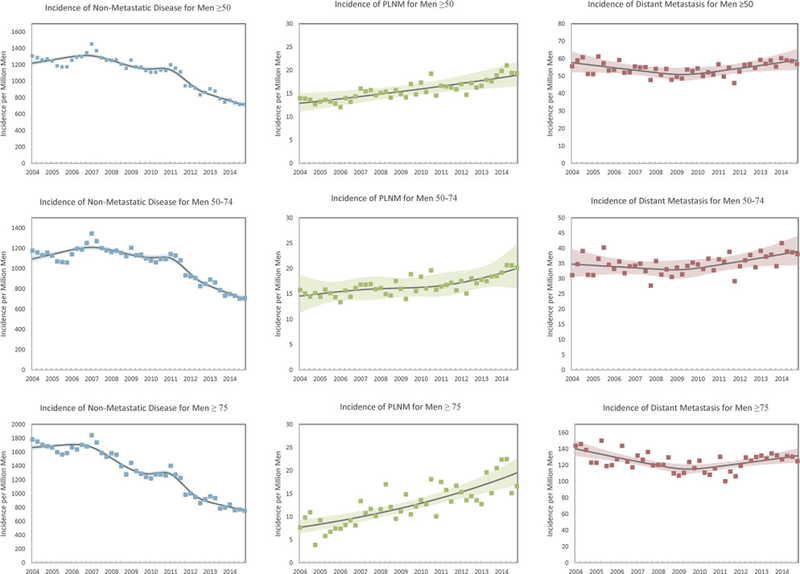
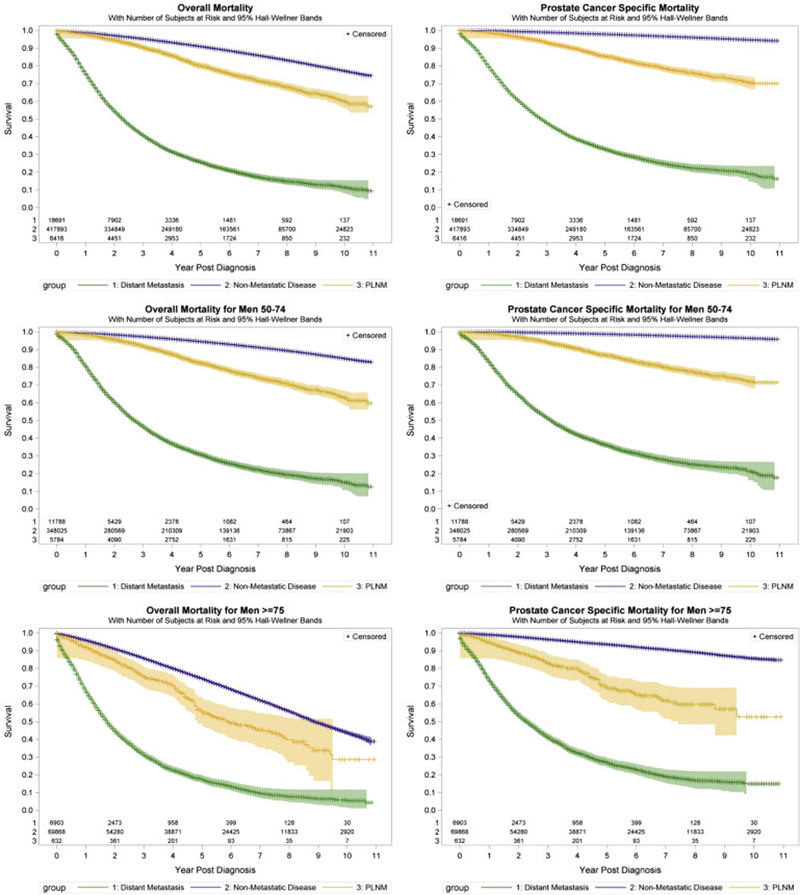
Results: During the study period the annual incidence of nonmetastatic prostate cancer decreased from 5,119.1 to 2,931.9 per million men (IR 0.57, 95% CI 0.56-0.58, p <0.01) while the incidence of pelvic lymph node metastases increased from 54.1 to 79.5 per million men (IR 1.47, 95% CI 1.33-1.62, p <0.01). The incidence of distant metastases in men 75 years old or older reached a nadir in 2011 compared to 2004 (IR 0.81, 95% CI 0.74-0.90, p <0.01) and it increased in 2012 compared to 2011 (IR 1.13, 95% CI 1.02-1.24, p <0.05). The risk of cancer specific mortality significantly increased in men diagnosed with pelvic lymph node metastases (HR 4.5, 95% CI 4.2-4.9, p <0.01) and distant metastases (HR 21.9, 95% CI 21.2-22.7, p <0.01) compared to men with nonmetastatic disease.
Conclusions: The incidence of pelvic lymph node metastases is increasing coincident with a decline in the detection of localized disease. Whether this portends an increase in the burden of advanced disease or simply reflects decreased lead time remains unclear. However, this should be monitored closely as the increase in N1 disease reflects an increase in incurable prostate cancer at diagnosis.
Keywords: SEER Program; mortality; neoplasm metastasis; practice guidelines as topic; prostatic neoplasms.
Copyright © 2018 American Urological Association Education and Research, Inc. Published by Elsevier Inc. All rights reserved.
Figures
References
-
- Ong MS and Mandl KD: Trends in prostate-specific antigen screening and prostate cancer interventions 3 years after the U.S. Preventive Services Task Force recommendation. Ann Intern Med 2017; 166: 451. - PubMed
-
- Jemal A, Ma J, Siegel R et al. : Prostate cancer incidence rates 2 years after the US Preventive Services Task Force recommendations against screening. JAMA Oncol 2016; 2: 1657. - PubMed
-
- National Cancer Institute Surveillance, Epidemiology and End Results Program: Cancer of the Prostate Cancer Stat Facts. Available at https://seer.cancer.gov/statfacts/html/prost.html. Accessed April 19, 2017.
-
- Lee DJ, Mallin K, Graves AJ et al. : Recent changes in prostate cancer screening practices and epidemiology. J Urol 2017; 198: 1230. - PubMed
-
- National Cancer Institute Surveillance, Epidemiology and End Results Program: SEER Cancer Statistics Review, 2016. Available at http://seer.cancer.gov/csr/1975_2013/. Accessed August 2016.
MeSH terms
Substances
Grants and funding
LinkOut - more resources
Full Text Sources
Other Literature Sources
Medical
