


Trends and Predictors of Participation in Cardiac Rehabilitation Following Acute Myocardial Infarction: Data From the Behavioral Risk Factor Surveillance System
- PMID: 29288154
- PMCID: PMC5778971
- DOI: 10.1161/JAHA.117.007664
Trends and Predictors of Participation in Cardiac Rehabilitation Following Acute Myocardial Infarction: Data From the Behavioral Risk Factor Surveillance System
Abstract
Background: Participation in cardiac rehabilitation (CR) after acute myocardial infarction has been proven to significantly reduce morbidity and mortality. Historically, participation rates have been low, and although recent efforts have increased referral rates, current data on CR participation are limited.
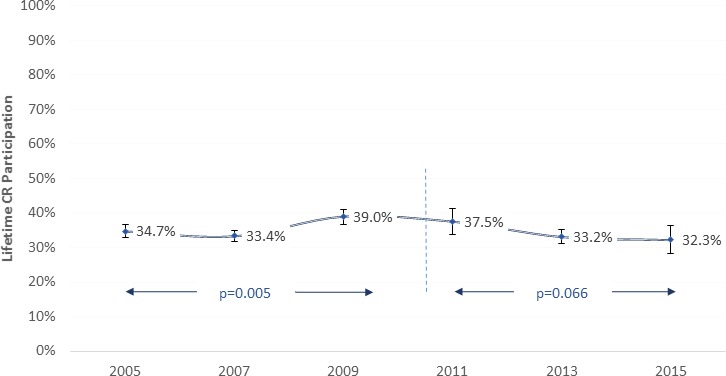
Methods and results: Utilizing data from the Behavioral Risk Factor Surveillance System conducted by Centers for Disease Control and Prevention, we performed a population-based, cross-sectional analysis of CR post-acute myocardial infarction. Unadjusted participation from 2005 to 2015 was evaluated by univariable logistic regression. Multivariable logistic regression was performed with patient characteristic variables to determine adjusted trends and associations with participation in CR in more recent years from 2011 to 2015. Among the 32 792 survey respondents between 2005 and 2015, participation ranged from 35% in 2005 to 39% in 2009 (P=0.005) and from 38% in 2011 to 32% in 2015 (P=0.066). Between 2011 and 2015, participants were less likely to be female (odds ratio [OR] 0.763, 95% confidence interval [CI] 0.646-0.903), black (OR 0.700, 95% CI 0.526-0.931), uninsured (OR 0.528, 95% CI 0.372-0.751), less educated (OR 0.471, 95% CI 0.367-0.605), current smokers (OR 0.758, 95% CI 0.576-0.999), and were more likely to be retired or self-employed (OR 1.393, 95% CI 1.124-1.726).
Conclusions: Only one third of patients participate in CR following acute myocardial infarction despite the known health benefits. Participants are less likely to be female, black, and uneducated. Future studies should focus on methods to maximize the proportion of CR referrals converted into CR participation.
Keywords: cardiac rehabilitation; morbidity; mortality; myocardial infarction.
© 2017 The Authors. Published on behalf of the American Heart Association, Inc., by Wiley.
Figures
References
-
- Lawler PR, Filion KB, Eisenberg MJ. Efficacy of exercise‐based cardiac rehabilitation post‐myocardial infarction: a systematic review and meta‐analysis of randomized controlled trials. Am Heart J. 2011;162:571–584. - PubMed
-
- Anderson L, Oldridge N, Thompson DR, Zwisler AD, Rees K, Martin N, Taylor RS. Exercise‐based cardiac rehabilitation for coronary heart disease. J Am Coll Cardiol. 2016;67:1–12. - PubMed
-
- Doll JA, Hellkamp A, Thomas L, Ho PM, Kontos MC, Whooley MA, Boyden TF, Peterson ED, Wang TY. Effectiveness of cardiac rehabilitation among older patients after acute myocardial infarction. Am Heart J. 2015;170:855–864. - PubMed
Publication types
MeSH terms
LinkOut - more resources
Full Text Sources
Other Literature Sources
Medical
