


Empathic Accuracy Deficits in Patients with Neurodegenerative Disease: Association with Caregiver Depression
- PMID: 29289452
- PMCID: PMC5860967
- DOI: 10.1016/j.jagp.2017.10.012
Empathic Accuracy Deficits in Patients with Neurodegenerative Disease: Association with Caregiver Depression
Abstract
Objectives: To investigate whether deficits in empathic accuracy (i.e., ability to recognize emotion in others) in patients with neurodegenerative disease are associated with greater depression in their caregivers.
Design: Two cross-sectional studies.
Setting: Academic medical center and research university.
Participants: Two independent samples (N = 172, N = 63) of patients with a variety of neurodegenerative diseases and their caregivers; comparison group of healthy couples.
Measurement: Patients' empathic accuracy was assessed in the laboratory using a novel dynamic tracking task (rating another person's changing emotions over time) and more traditional measures (recognizing the emotion expressed in photographs of facial expressions and by characters in films). Caregivers completed self-report inventories of depression.
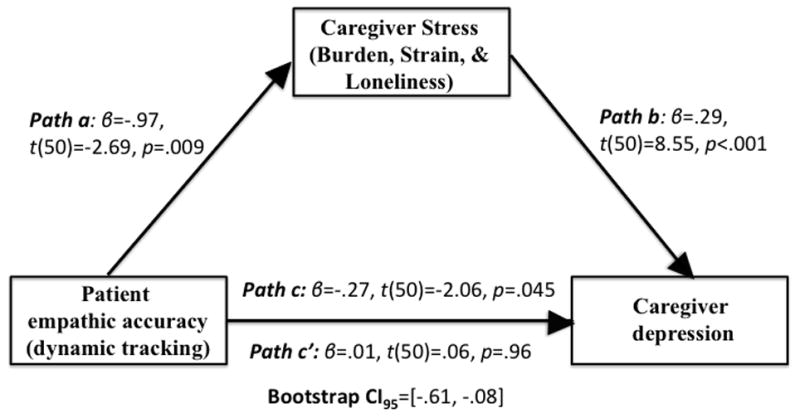
Results: Lower empathic accuracy in patients was associated with greater depression in caregivers in both studies. In study 1, this association was found when empathic accuracy was measured using the dynamic tracking measure but not when measured using the more traditional photograph and film measures. In study 2, we found preliminary support for our theoretical model wherein lower empathic accuracy in patients is associated with increased caregiver stress (loneliness, strain, and burden), which in turn is associated with greater caregiver depression.
Conclusions: Caring for a patient with deficits in empathic accuracy is associated with greater loneliness, strain, and burden for caregivers, and increased depression. Caregivers may benefit from interventions designed to compensate for the stress and interpersonal loss associated with patients' declining empathic accuracy.
Keywords: Caregiver; depression; empathic accuracy; neurodegenerative disease.
Copyright © 2017 American Association for Geriatric Psychiatry. Published by Elsevier Inc. All rights reserved.
Figures
References
-
- Schulz R, O’Brien AT, Bookwala J, Fleissner K. Psychiatric and Physical Morbidity Effects of Dementia Caregiving: Prevalence, Correlates, and Causes. Gerontologist. 1995;35(6):771–91. - PubMed
-
- Cuijpers P. Depressive disorders in caregivers of dementia patients: a systematic review. Aging Ment Health. 2005;9(4):325–30. - PubMed
-
- Blazer D, Burchett B, Service C, George LK. The Association of Age and Depression Among the Elderly: An Epidemiologic Exploration. J Gerontol Oxford University Press. 1991;46(6):M210–M215. - PubMed
-
- Ornstein K, Gaugler JE. The problem with “problem behaviors”: a systematic review of the association between individual patient behavioral and psychological symptoms and caregiver depression and burden within the dementia patient–caregiver dyad. Int Psychogeriatrics. 2012;24(10):1536–52. - PMC - PubMed
-
- Schulz R, O’Brien AT, Bookwala J, Fleissner K. Psychiatric and physical morbidity effects of dementia caregiving: Prevalence, correlates, and causes. Gerontologist. 1995;35(6):771–91. - PubMed
Publication types
MeSH terms
Grants and funding
LinkOut - more resources
Full Text Sources
Other Literature Sources
Medical
