Review
. 2018 Mar;34(3):232-245.
doi: 10.1016/j.tig.2017.12.001. Epub 2017 Dec 28.

Zipping and Unzipping: Protein Modifications Regulating Synaptonemal Complex Dynamics

Affiliations
Review

Zipping and Unzipping: Protein Modifications Regulating Synaptonemal Complex Dynamics

Jinmin Gao et al. Trends Genet. 2018 Mar.

Abstract

The proteinaceous zipper-like structure known as the synaptonemal complex (SC), which forms between pairs of homologous chromosomes during meiosis from yeast to humans, plays important roles in promoting interhomolog crossover formation, regulating cessation of DNA double-strand break (DSB) formation following crossover designation, and ensuring accurate meiotic chromosome segregation. Recent studies are starting to reveal critical roles for different protein modifications in regulating SC dynamics. Protein SUMOylation, N-terminal acetylation, and phosphorylation have been shown to be essential for the regulated assembly and disassembly of the SC. Moreover, phosphorylation of specific SC components has been found to link changes in SC dynamics with meiotic recombination. This review highlights the latest findings on how protein modifications regulate SC dynamics and functions.

Keywords: N-terminal acetylation; SUMOylation; meiosis; meiotic recombination; phosphorylation; synaptonemal complex.


Figures

Figure 1
Figure 1
EM images of the SC in meiotic nuclei from different organisms. The SCs are visible as zipper-like structures flanked by electron-dense chromatin patches. In the case of the Ascomycete Sordaria macrospora, an electron-dense recombination nodule is observed associated with the central element, as indicate by a white arrowhead. Images were originally published in [, –89]. Scale bars equal 100 nm.
Figure 2
Figure 2
(A) Diagram of the SC structure and SC components in different organisms. The C. elegans SYP-2 protein was initially classified as a central region component due to lack of specific information regarding its protein-protein interactions or sublocalization within the SC [87]. Based on recent immuno-EM analysis and protein-protein interaction data [11], we now reclassify SYP-2 as a central element protein. (B) Known modifications for SC components and their functions.
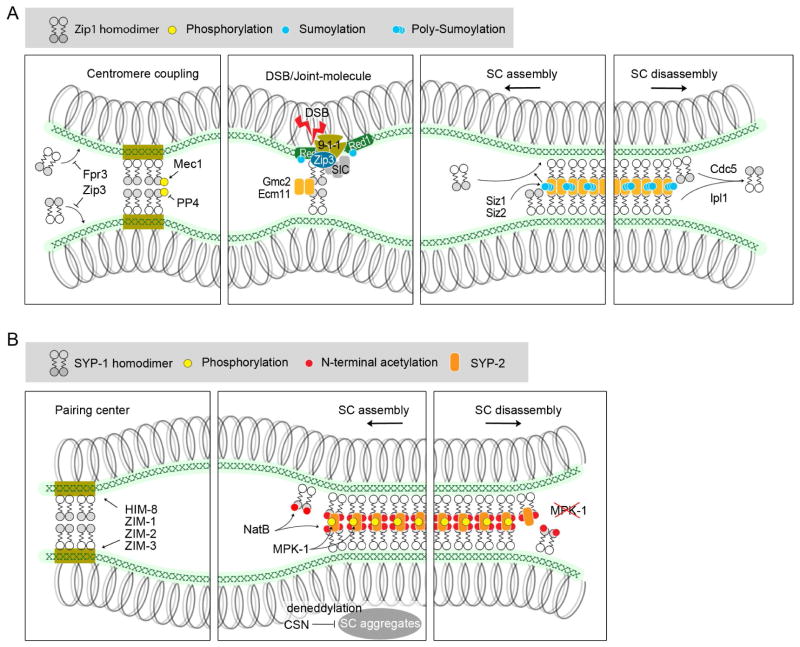
Figure 3, Key Figure
Summary cartoons for the involvement of protein modifications in SC assembly and disassembly in yeast (A) and worms (B). Note that although Zip1 is depicted as having the same organization at centromeres as it does within the SC, there is some evidence suggesting potentially different configurations at these locations [65]. For simplicity, only SYP-1 and SYP-2 are shown in the central region of the worm SC. CSN, COP9 signalosome.
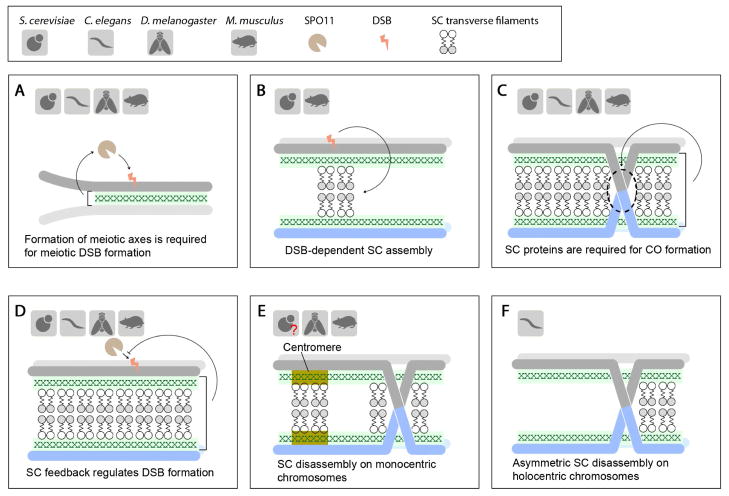
Figure 4
Figure 4
Interactions between the SC and meiotic recombination. (A) Formation of the meiotic axes is required for SPO11-induced DSB formation across organisms. (B) Initiation of SC assembly is DSB-dependent in yeast and mice. (C) The SC is required for crossover (CO) formation among the majority of studied organisms. In budding yeast, some SC proteins, but not necessarily an intact SC structure, are required for CO formation. (D) The SC plays a role in feedback regulation of DSB formation across organisms. (E) SC disassembly in monocentric organisms. In the case of budding yeast, while Zip1 promotes centromere interactions, it is yet unclear if this involves the SC structure. (F) Asymmetric SC disassembly in worms is coupled with CO formation.

References

    1. Zickler D, Kleckner N. Recombination, Pairing, and Synapsis of Homologs during Meiosis. Cold Spring Harb Perspect Biol. 2015;7(6) - PMC - PubMed
    1. Hassold T, et al. The origin of human aneuploidy: where we have been, where we are going. Hum Mol Genet. 2007;16(2):R203–8. - PubMed
    1. Moses MJ. Structure and function of the synaptonemal complex. Genetics. 1969;61(1) Suppl:41–51. - PubMed
    1. Cahoon CK, Hawley RS. Regulating the construction and demolition of the synaptonemal complex. Nat Struct Mol Biol. 2016;23(5):369–77. - PubMed
    1. Page SL, Hawley RS. Chromosome choreography: the meiotic ballet. Science. 2003;301(5634):785–9. - PubMed

Publication types

MeSH terms

LinkOut - more resources