Review
. 2017 Dec 14;23(46):8109-8119.
doi: 10.3748/wjg.v23.i46.8109.

Relation of the IGF/IGF1R system to autophagy in colitis and colorectal cancer

Affiliations
Review

Relation of the IGF/IGF1R system to autophagy in colitis and colorectal cancer

Ferenc Sipos et al. World J Gastroenterol. .

Abstract

Metabolic syndrome (MetS), as a chronic inflammatory disorder has a potential role in the development of inflammatory and cancerous complications of the colonic tissue. The interaction of DNA damage and inflammation is affected by the insulin-like growth factor 1 receptor (IGF1R) signaling pathway. The IGF1R pathway has been reported to regulate autophagy, as well, but sometimes through a bidirectional context. Targeting the IGF1R-autophagy crosstalk could represent a promising strategy for the development of new antiinflammatory and anticancer therapies, and may help for subjects suffering from MetS who are at increased risk of colorectal cancer. However, therapeutic responses to targeted therapies are often shortlived, since a signaling crosstalk of IGF1R with other receptor tyrosine kinases or autophagy exists, leading to acquired cellular resistance to therapy. From a pharmacological point of view, it is attractive to speculate that synergistic benefits could be achieved by inhibition of one of the key effectors of the IGF1R pathway, in parallel with the pharmacological stimulation of the autophagy machinery, but cautiousness is also required, because pharmacologic IGF1R modulation can initiate additional, sometimes unfavorable biologic effects.

Keywords: Autophagy; Colitis; Colorectal cancer; IGF1R; Insulin-like growth factor; Metabolic syndrome.


Conflict of interest statement

Conflict-of-interest statement: No conflict of interest.

Figures
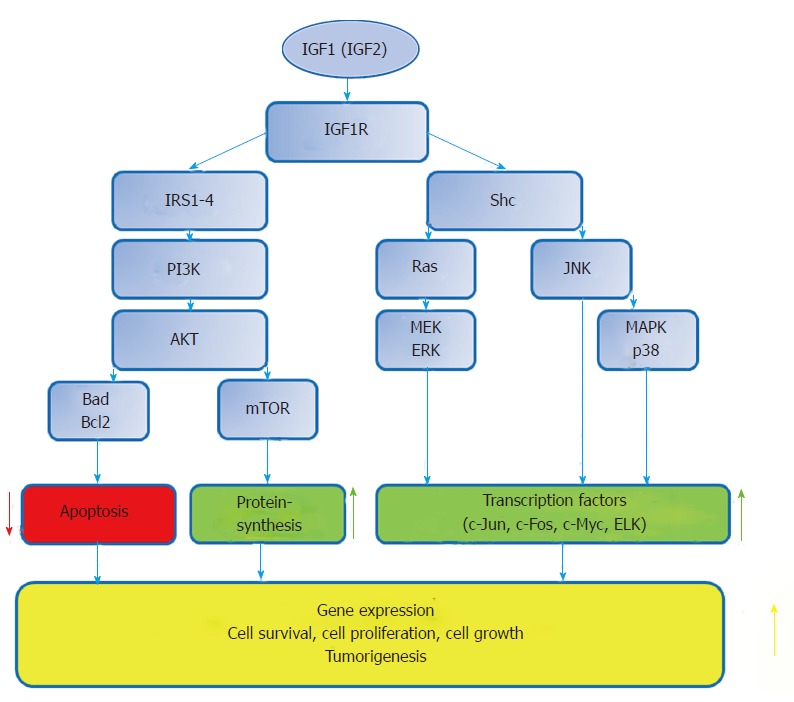
Figure 1
Figure 1
The IGF/IGF1R axis: schematic representation of the composition and function. Signaling of the IGF/IGF1R axis is mediated by IRS and Shc. PI3K-AKT activation is the predominant downstream event, but the Ras/MEK/ERK and JNK/MAPK pathways can also be activated. IGF: Insulin-like growth factor; IGF1R: Insulin-like growth factor receptor 1; IRS: Insulin receptor substrate; PI3K: Phosphatidylinositol-3-kinase; AKT: Serine/threonine kinase, named protein kinase B (PKB); mTOR: Mammalian target of rapamycin; Bad: Bcl-2-associated death promoter; Bcl2: B-cell lymphoma 2; Shc: Adaptor protein; Ras: GTPase protein; JNK: c-Jun N-terminal kinase; MEK: Mitogen-activated protein kinase kinase; ERK: Extracellular regulated kinase; MAPK: Mitogen-activated protein kinase; ELK: ETS domain-containing protein.
Figure 2
Figure 2
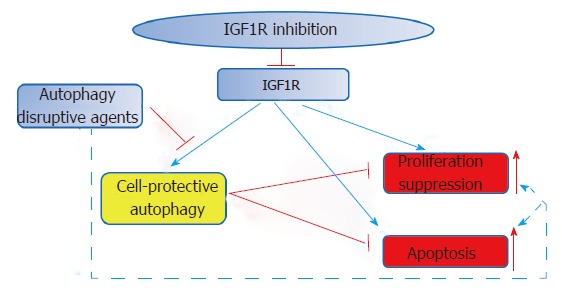
Controversial therapeutic effects of IGF1R inhibition. In case of IGF1R inhibition the simultaneously induced cell-protective autophagy could promote cell proliferation and suppress apoptosis, thus via autophagy antagonize its own original actions on cells. If IGF1R inhibition is combined with autophagy disruptive agents autophagy can be blocked, hence cancer cell proliferation will be suppressed and apoptosis enhanced. IGF1R: Insulin-like growth factor receptor 1.
Figure 3
Figure 3
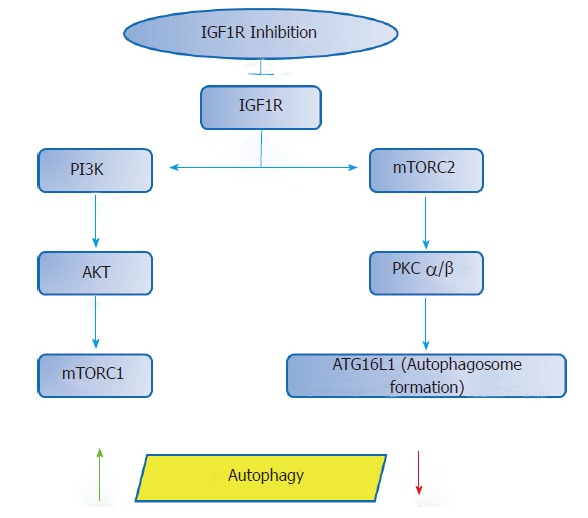
Proposed model for the bi-directional IGF1R signaling-dependent modulation of the autophagic pathway. IGF1R targeting via suppression of the "canonical" PI3K/Akt/mTORC1 pathway stimulates the autophagy process. However, it can also result in a reduced formation of autophagosomal precursors at the plasma membrane. IGF1R depletion inhibits mTORC2, which reduces the activity of protein kinase C alpha and beta. This finally negatively impacts autophagosome precursor formation. IGF1R: Insulin-like growth factor receptor 1; PI3K: Phosphatidylinositol-3-kinase; AKT: Serine/threonine kinase, named protein kinase B (PKB); mTORC1/2: Mammalian target of rapamycin complex 1/2; PKC: Protein kinase C; ATG16L1: Autophagy-related protein 16-1.

References

    1. Lopez-Candales A, Hernández Burgos PM, Hernandez-Suarez DF, Harris D. Linking Chronic Inflammation with Cardiovascular Disease: From Normal Aging to the Metabolic Syndrome. J Nat Sci. 2017;3:Pii: e341. - PMC - PubMed
    1. Bastard JP, Maachi M, Lagathu C, Kim MJ, Caron M, Vidal H, Capeau J, Feve B. Recent advances in the relationship between obesity, inflammation, and insulin resistance. Eur Cytokine Netw. 2006;17:4–12. - PubMed
    1. Sipos F, Galamb O, Herszényi L, Molnár B, Solymosi N, Zágoni T, Berczi L, Tulassay Z. Elevated insulin-like growth factor 1 receptor, hepatocyte growth factor receptor and telomerase protein expression in mild ulcerative colitis. Scand J Gastroenterol. 2008;43:289–298. - PubMed
    1. Ge RT, Mo LH, Wu R, Liu JQ, Zhang HP, Liu Z, Liu Z, Yang PC. Insulin-like growth factor-1 endues monocytes with immune suppressive ability to inhibit inflammation in the intestine. Sci Rep. 2015;5:7735. - PMC - PubMed
    1. Kawanishi S, Ohnishi S, Ma N, Hiraku Y, Murata M. Crosstalk between DNA Damage and Inflammation in the Multiple Steps of Carcinogenesis. Int J Mol Sci. 2017;18:Pii: E1808. - PMC - PubMed

MeSH terms