


Phylogeny of Anophelinae using mitochondrial protein coding genes
- PMID: 29291068
- PMCID: PMC5717642
- DOI: 10.1098/rsos.170758
Phylogeny of Anophelinae using mitochondrial protein coding genes
Abstract
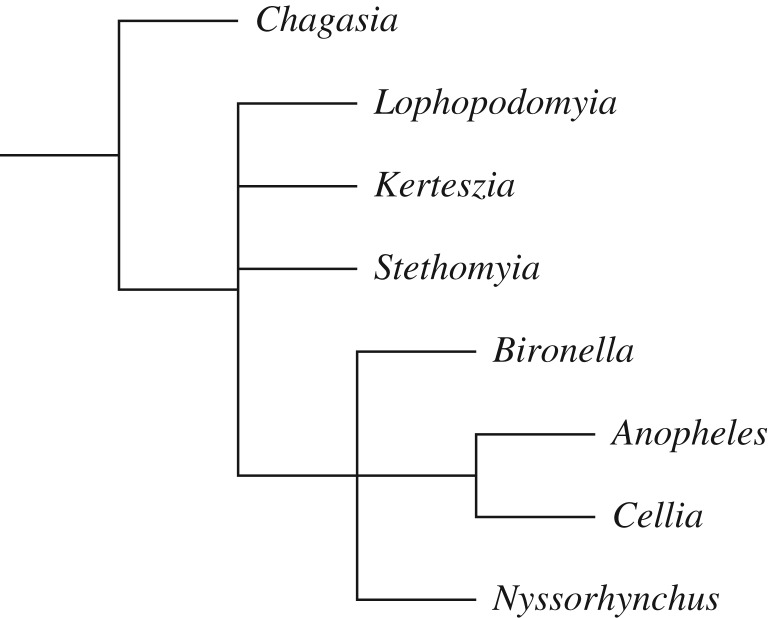
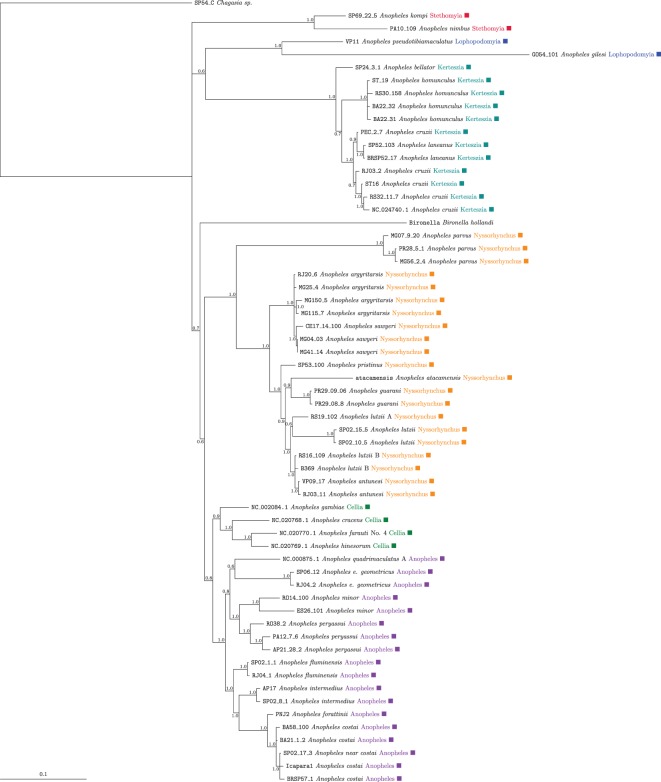
Malaria is a vector-borne disease that is a great burden on the poorest and most marginalized communities of the tropical and subtropical world. Approximately 41 species of Anopheline mosquitoes can effectively spread species of Plasmodium parasites that cause human malaria. Proposing a natural classification for the subfamily Anophelinae has been a continuous effort, addressed using both morphology and DNA sequence data. The monophyly of the genus Anopheles, and phylogenetic placement of the genus Bironella, subgenera Kerteszia, Lophopodomyia and Stethomyia within the subfamily Anophelinae, remain in question. To understand the classification of Anophelinae, we inferred the phylogeny of all three genera (Anopheles, Bironella, Chagasia) and major subgenera by analysing the amino acid sequences of the 13 protein coding genes of 150 newly sequenced mitochondrial genomes of Anophelinae and 18 newly sequenced Culex species as outgroup taxa, supplemented with 23 mitogenomes from GenBank. Our analyses generally place genus Bironella within the genus Anopheles, which implies that the latter as it is currently defined is not monophyletic. With some inconsistencies, Bironella was placed within the major clade that includes Anopheles, Cellia, Kerteszia, Lophopodomyia, Nyssorhynchus and Stethomyia, which were found to be monophyletic groups within Anophelinae. Our findings provided robust evidence for elevating the monophyletic groupings Kerteszia, Lophopodomyia, Nyssorhynchus and Stethomyia to genus level; genus Anopheles to include subgenera Anopheles, Baimaia, Cellia and Christya; Anopheles parvus to be placed into a new genus; Nyssorhynchus to be elevated to genus level; the genus Nyssorhynchus to include subgenera Myzorhynchella and Nyssorhynchus; Anopheles atacamensis and Anopheles pictipennis to be transferred from subgenus Nyssorhynchus to subgenus Myzorhynchella; and subgenus Nyssorhynchus to encompass the remaining species of Argyritarsis and Albimanus Sections.
Keywords: Anopheles; mitochondrial genomes; phylogenetics.
Conflict of interest statement
We declare we have no competing interests.
Figures
References
-
- Feachem RGA, et al. 2010. Shrinking the malaria map: progress and prospects. Lancet 376, 1566–1578. (doi:10.1016/S0140-6736(10)61270-6) - DOI - PMC - PubMed
-
- Liu J, Modrek S, Gosling RD, Feachem RGA. 2013. Malaria eradication: is it possible? Is it worth it? Should we do it? Lancet Glob. Health 1, e2–e3. (doi:10.1016/S2214-109X(13)70002-0) - DOI - PubMed
-
- WHO. 2016. World malaria report. Geneva, Switzerland: World Health Organization.
-
- PAHO. 2016. Report on the situation of malaria in the Americas 2014. Washington DC: Pan American Health Organization.
-
- Calderaro A, et al. 2013. Accurate identification of the six human Plasmodium spp. causing imported malaria, including Plasmodium ovale wallikeri and Plasmodium knowlesi. Malar. J. 12, 321 (doi:10.1186/1475-2875-12-321) - DOI - PMC - PubMed
Associated data
Grants and funding
LinkOut - more resources
Full Text Sources
Other Literature Sources