. 2018 Jan 2;13(1):e0190531.
doi: 10.1371/journal.pone.0190531. eCollection 2018.

The cold tolerance of the northern root-knot nematode, Meloidogyne hapla

Affiliations

The cold tolerance of the northern root-knot nematode, Meloidogyne hapla

Xiaojing Wu et al. PLoS One. .

Abstract

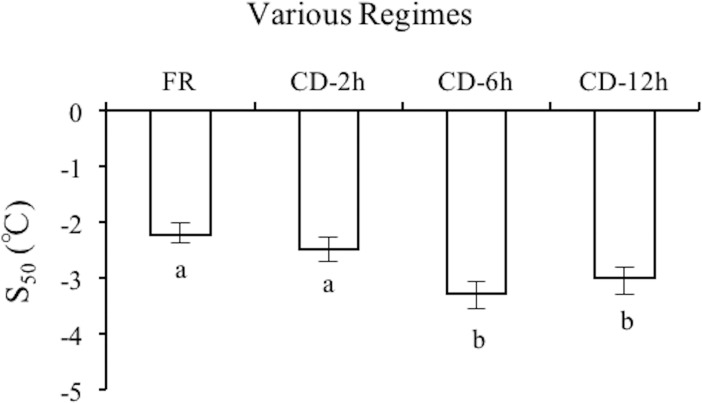
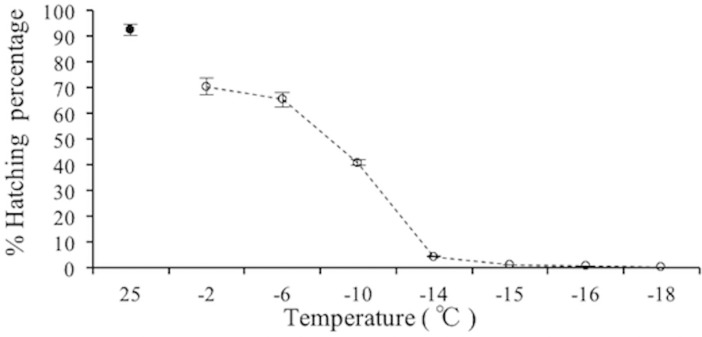
The northern root-knot nematode, Meloidogyne hapla, is one of the most important nematode pathogens occurring in cold regions. It is a sedentary, biotrophic parasites of plants and overwinter in the soil or in diseased roots. This study showed that the cold tolerance for the second-stage juveniles (J2) of M. hapla was moderate with the 50% survival temperature (S50) of -2.22°C and the fatal temperature was -6°C when cooling at 0.5°C min-1. Cryoprotective dehydration significantly enhance cold tolerance of M. hapla J2 with the lowest S50 of -3.28°C after held being at -1°C for 6 h. Moreover, cold shock and cold acclimation had significant effects on the freezing survival of M. hapla J2. The lethal temperature of eggs was -18°C. Therefore, the cold tolerance of M. hapla is sufficiently favorable to withstand winters in cold temperature environments.


Conflict of interest statement

Competing Interests: The authors have declared that no competing interests exist.

Figures

Fig 1
Fig 1. The S50 values of M. hapla J2 exposed to freezing regime and cryoprotective dehydration.
FR = freezing regime, CD-2 h = Cryoprotective dehydration regime that held for 2 h at -1°C before cooled to Tmin, CD-6 h = Cryoprotective dehydration regime that held for 6 h at -1°C before cooled to Tmin, CD-12 h = Cryoprotective dehydration regime that held for 12 h at -1°C before cooled to Tmin. The bars are the estimations in the 95% confidence limits. The different lowercase letters on the bars represent significantly different among various regimes, according to RMP estimates. N = 10.
Fig 2
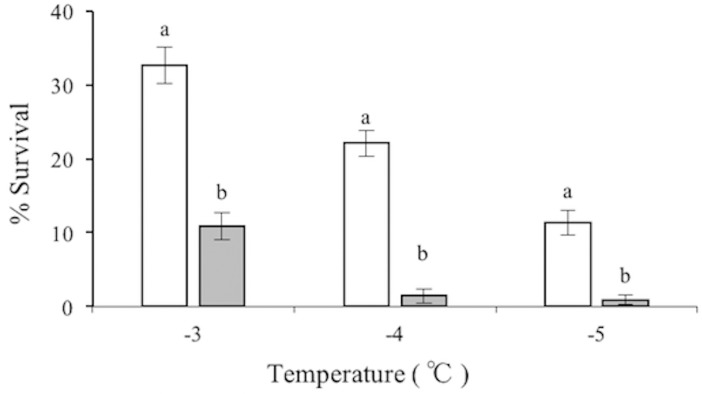
Fig 2. The effect of cold acclimation on survival of M. hapla J2.
Samples acclimated at 4°C (open bars), and survival at freezing regime without acclimation (filled bars). The different lowercase letters on the bars represent significantly different (P < 0.05) between treatments at the same temperature. The bars are the mean ± SE in this figure. N = 10.
Fig 3
Fig 3. The S50 values of M. hapla J2 subjected to various regimes.
FR = freezing regime; CD-6 h = Cryoprotective dehydration regime that held for 6 h at -1°C before cooled to Tmin, CS = cold shock at -1°C for 1 h and then kept at room temperature for 1 h before cooled to Tmin, A4 = acclimated at 4°C for 12 h before cooled to Tmin. The bars are the estimations in the 95% confidence limits. The different lowercase letters on the bars represent significantly different among various regimes, according to RMP estimates. N = 10.
Fig 4
Fig 4. The hatching percentage for egg mass of M. hapla at various low temperature.
Open circles = hatching percentage at various low temperature during 10 days, Closed circle = 25°C. The values are the mean ± SE in this figure. N = 6.

References

    1. Perry RN, Moens M, Starr JL. Root-knot nematodes: CABI; 2009:1–17.
    1. Gheysen G, Mitchum MG. How nematodes manipulate plant development pathways for infection. Current Opinion in Plant Biology. 2011;14(4):415–21. doi: 10.1016/j.pbi.2011.03.012 - DOI - PubMed
    1. Koenning S, Overstreet C, Noling J, Donald P, Becker J, Fortnum B. Survey of crop losses in response to phytoparasitic nematodes in the United States for 1994. Journal of nematology. 1999;31(4S):587–618. - PMC - PubMed
    1. Taylor A, Sasser J. Biology, identification and control of root-knot nematodes North Carolina State University Graphics; 1978:35–42.
    1. Taylor AL, Sasser JN, Nelson L . Relationship of climate and soil characteristics to geographical distribution of Meloidogyne species in agricultural soils: North Carolina State University/AID; 1982. 1–8 p.

Publication types

LinkOut - more resources