Review
. 2018 Mar 5;121(3):385-403.
doi: 10.1093/aob/mcx145.

On the origins and domestication of the olive: a review and perspectives

Affiliations
Review

On the origins and domestication of the olive: a review and perspectives

Guillaume Besnard et al. Ann Bot. .

Erratum in

Abstract

Background: Unravelling domestication processes is crucial for understanding how species respond to anthropogenic pressures, forecasting crop responses to future global changes and improving breeding programmes. Domestication processes for clonally propagated perennials differ markedly from those for seed-propagated annual crops, mostly due to long generation times, clonal propagation and recurrent admixture with local forms, leading to a limited number of generations of selection from wild ancestors. However, additional case studies are required to document this process more fully.

Scope: The olive is an iconic species in Mediterranean cultural history. Its multiple uses and omnipresence in traditional agrosystems have made this species an economic pillar and cornerstone of Mediterranean agriculture. However, major questions about the domestication history of the olive remain unanswered. New paleobotanical, archeological, historical and molecular data have recently accumulated for olive, making it timely to carry out a critical re-evaluation of the biogeography of wild olives and the history of their cultivation. We review here the chronological history of wild olives and discuss the questions that remain unanswered, or even unasked, about their domestication history in the Mediterranean Basin. We argue that more detailed ecological genomics studies of wild and cultivated olives are crucial to improve our understanding of olive domestication. Multidisciplinary research integrating genomics, metagenomics and community ecology will make it possible to decipher the evolutionary ecology of one of the most iconic domesticated fruit trees worldwide.

Conclusion: The olive is a relevant model for improving our knowledge of domestication processes in clonally propagated perennial crops, particularly those of the Mediterranean Basin. Future studies on the ecological and genomic shifts linked to domestication in olive and its associated community will provide insight into the phenotypic and molecular bases of crop adaptation to human uses.


Figures

Fig. B1.
Fig. B1.
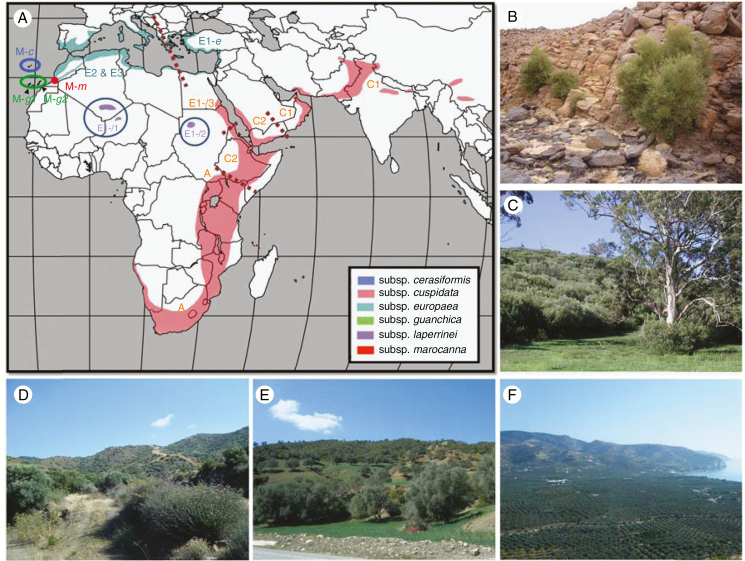
The olive complex (Olea europaea L.). (A) Native distribution of wild olive relatives (according to Rubio de Casas et al., 2006). Six subspecies are currently recognized (Green, 2002). The plastid DNA data set used to define lineages (and sub-lineages) is available in Supplementary Data Table S2 and Fig. S2. Dotted lines indicate approximate limits of the distributions of two adjacent plastid lineages (indicative for putative secondary contacts). Note that lineages E2 and E3 are admixed in western Oleaster populations (subsp. europaea); (B–F) Various habitats with wild or cultivated olives in native and invasive ranges. (B) Ramets from the same stump of a Laperrine’s olive at Akerakar, south Algeria. Subspecies laperrinei persists in very dry habitats (mean annual rainfall <100 mm); (C) African olive invasion at Mt Annan, NSW, Australia (photo credit: Peter Cuneo). Subspecies cuspidata is highly invasive in east Australia, north New Zealand and Hawaii. It usually colonizes disturbed habitats, such as abandoned pastures in particular (Cuneo and Leishman, 2006); (D) scrubland dominated by oleasters at Lageia, Cyprus; (E) Traditional agrosystem with cultivated olives in northern Morocco (Chefchaouen, Rif). Annual crops (here, wheat) are usually cultivated between trees; (F) monoculture of olive trees near Mattinata, Puglia, Italy. A small number of genotypes (usually one or two major clones) are generally cultivated in such agrosystems.
Fig. 1.
Fig. 1.
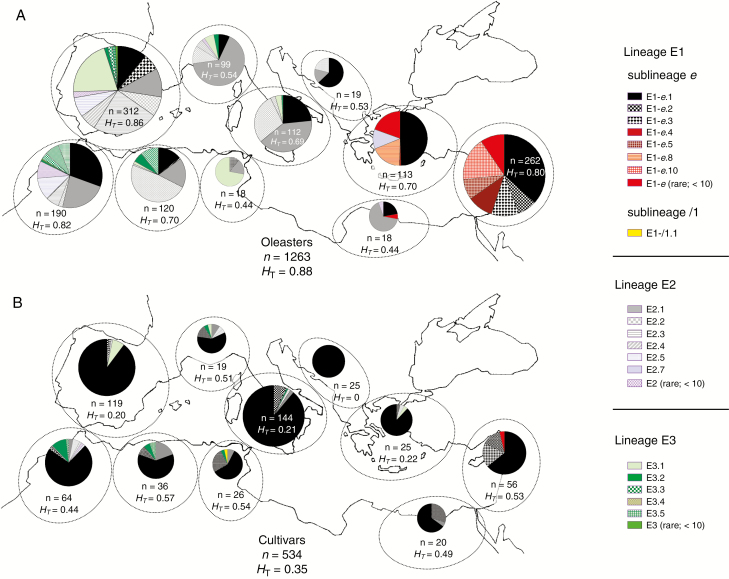
Distribution of chlorotypes (A) in oleaster populations, and (B) in the Mediterranean cultivated olive [based on data from Besnard et al. (2013b)]. Each chlorotype is represented by a specific motif, as defined in Supplementary Data Fig. S1. The number of accessions (n) and the total diversity (HT; Nei, 1987) of chloroplast DNA variation are given for each area and for the total sample. The size of pie charts is proportional to the number of individuals analysed per area. Chlorotypes primarily found in oleaster were mostly observed in the East (from the Peloponnese to the Levant; lineage E1) and westernmost part of the Mediterranean Basin (Iberian Peninsula and Morocco; lineages E2 and E3). Note that the geographic distribution of chlorotypes is clearly different between wild and cultivated olives, despite the extensive admixture of these two forms. In the western Mediterranean oleaster, lineage E1 is represented by only three chlorotypes (E1-e.1, E1-e.2 and E1-e.3) that were recently introduced into this area with the human-mediated spread of Levantine cultivated olives (Besnard et al., 2013b). For a detailed distribution of chlorotypes at the population level, see Besnard et al. (2013b).
Fig. 2.
Fig. 2.
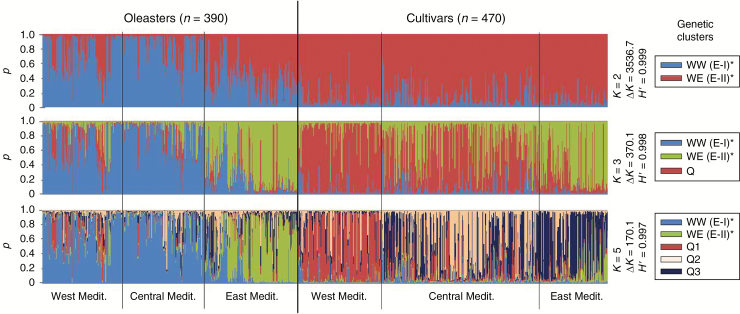
Bayesian inference of population structure (based on ten nuclear microsatellite loci) in the Mediterranean olive (including both cultivated and wild accessions; 860 individuals), for K = 2, 3 and 5 clusters [modified from Besnard et al. (2013a)], inferred with a model-based clustering method implemented in STRUCTURE v.2.3.4 (Pritchard et al., 2000). Q is the membership coefficient. H’ is the similarity coefficient between ten runs for each K, and ΔK is an ad-hoc measure described by Evanno et al. (2005). According to ΔK and H’, the most probable genetic structure model is K = 2 clusters (ΔK = 3536.7 and H’ = 0.99), with most wild accessions from the Western and Central Mediterranean Basin (cluster WW; * or E-I in the article by Besnard et al., 2013a) distinguished from cultivars and eastern wild accessions (cluster WE; or E-II); at K = 3, the western oleaster cluster remains but eastern cultivated olives and oleasters are distinguished from western and central Mediterranean cultivars (cluster Q); and at K = 5, a trend for the occurrence of a cultivar cluster in each pre-defined geographic zone [i.e. West (Q1), Central (Q2) and East (Q3)] is revealed, as reported by Haouane et al. (2011), Belaj et al. (2012) and Díez et al. (2012). Central Mediterranean cultivars revealed the highest level of admixture among the Q1, Q2 and Q3 genepools, consistent with the inferred admixed ancestry of most of its genotypes, whereas western and eastern cultivars were found to be more strongly assigned to their respective genepools. The five genetic clusters are named as described by Díez et al. (2015). In each group (oleaster or cultivars), the individuals are classified on the axis, from left to right, according to their geographic origin (from west to east).
Fig. B2.
Fig. B2.
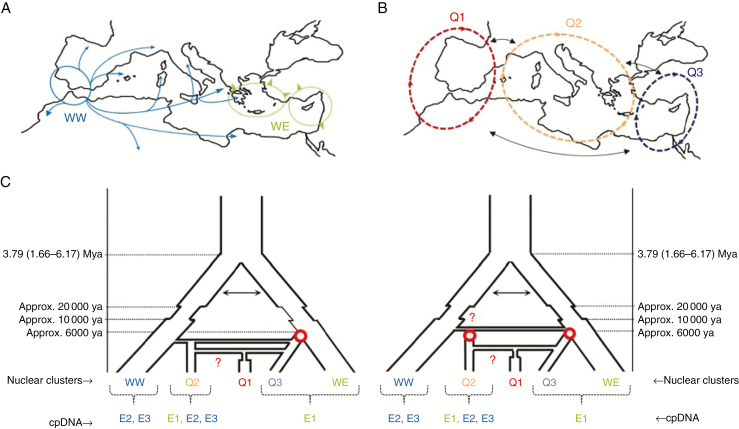
Debate about olive evolutionary history and domestication. (A and B) Distribution of wild and cultivated genepools in the Mediterranean Basin (Besnard et al., 2013a; Dίez et al., 2015). (A) WW and WE (E-I and E-II, respectively, in the article by Besnard et al., 2013a) correspond to the western and eastern Mediterranean oleaster populations that expanded extensively during the Holocene, with habitat clearance mediated by humans. Contact is thought to occur in the Central Mediterranean area (e.g. Peloponnese; Besnard et al., 2013a). (B) Q1, Q2 and Q3 correspond to the main genetic clusters of cultivated olive (Fig. 2; named according to Dίez et al., 2015). (C) Simplified scenarios of domestication. Two alternative scenarios of population divergence and admixture are proposed, but there are many other non-exclusive possibilities. In both cases, the divergence of eastern and western oleaster genepools is thought to have started during the Late Pliocene (i.e. based on molecular dating; Besnard et al., 2009, 2013b), with possible gene flow (as indicated by arrows). Population reduction followed by subsequent expansion is also thought to have occurred during the Last Glacial Maximum and the Holocene. On the left, a primary domestication event (red circle) is thought to have occurred in the Eastern Mediterranean Basin, leading to Q3, whereas Q2 and Q1 were derived from admixture events (horizontal connections) between Q3 and WW (for Q2) or Q3 and Q2 (for Q1). For Q1, the red question mark indicates a possible alternative admixture event involving local wild genepools (i.e. WW instead of Q2; see Dίez et al., 2015). A bottleneck is also indicated for Q1, as revealed by Dίez et al. (2015). On the right, two independent primary domestication events are considered, one for Q3 in the Eastern Mediterranean Basin, and one for Q2 in the Central Mediterranean Basin. As Q2 cultivars include a high proportion of E1 haplotypes (see Dίez et al., 2015), and a relatively strong genetic affinity with WE on the basis of nuclear loci (Fig. 2; Besnard et al., 2013a; Dίez et al., 2015), we presume that admixture between WE and WW occurred before domestication, but it would be difficult to distinguish between this scenario and early domestication from WW, followed by introgression from Q3, as suggested by Dίez et al. (2015). The origin of Q1 is identical in both scenarios. Note that feral olives are not shown here, but could be considered as additional populations. Indeed, numerous intermediate forms have probably escaped from cultivation and may have contributed to the diversification of cultivated olives.
Fig. B3.
Fig. B3.
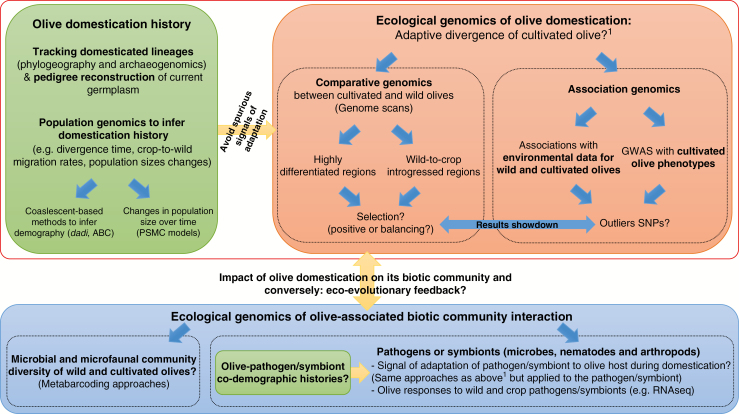
Methodological framework to address major questions on the impact of domestication on the evolution of olive and its associated biotic communities.

References

    1. Abdelfattah A, Li Destri Nicosia MG, Cacciola SO, Droby S, Schena L. 2015. Metabarcoding analysis of fungal diversity in the phyllosphere and carposphere of olive (Olea europaea). PLoS One 10: e0131069. - PMC - PubMed
    1. Albertini E, Torricelli R, Bitocchi E et al. 2011. Structure of genetic diversity in Olea europaea L. cultivars from central Italy. Molecular Breeding 27: 533–547.
    1. Akagi T, Hanada T, Yaegaki H, Gradziel TM, Tao R. 2016. Genome-wide view of genetic diversity reveals paths of selection and cultivar differentiation in peach domestication. DNA Research 23: 271–282. - PMC - PubMed
    1. Alcántara JM, Rey PJ. 2003. Conflicting selection pressures on seed size: evolutionary ecology of fruit size in a bird-dispersed tree, Olea europaea. Journal of Evolutionary Biology 16: 1168–1176. - PubMed
    1. Ali N, Tavoillot J, Besnard G et al. 2017. How anthropogenic changes may affect soil-borne parasite diversity? Plant-parasitic nematode communities associated with olive trees in Morocco as a case study. BMC Ecology 17: 4. - PMC - PubMed