Review
. 2018 Feb;176(2):1384-1407.
doi: 10.1104/pp.17.01481. Epub 2018 Jan 2.

Vacuolar Transporters - Companions on a Longtime Journey

Affiliations
Review

Vacuolar Transporters - Companions on a Longtime Journey

Enrico Martinoia. Plant Physiol. 2018 Feb.

Abstract

Biochemical and electrophysiological studies on plant vacuolar transporters became feasible in the late 1970s and early 1980s, when methods to isolate large quantities of intact vacuoles and purified vacuolar membrane vesicles were established. However, with the exception of the H+-ATPase and H+-PPase, which could be followed due to their hydrolytic activities, attempts to purify tonoplast transporters were for a long time not successful. Heterologous complementation, T-DNA insertion mutants, and later proteomic studies allowed the next steps, starting from the 1990s. Nowadays, our knowledge about vacuolar transporters has increased greatly. Nevertheless, there are several transporters of central importance that have still to be identified at the molecular level or have even not been characterized biochemically. Furthermore, our knowledge about regulation of the vacuolar transporters is very limited, and much work is needed to get a holistic view about the interplay of the vacuolar transportome. The huge amount of information generated during the last 35 years cannot be summarized in such a review. Therefore, I decided to concentrate on some aspects where we were involved during my research on vacuolar transporters, for some our laboratories contributed more, while others contributed less.


Figures

Figure 1.
Figure 1.
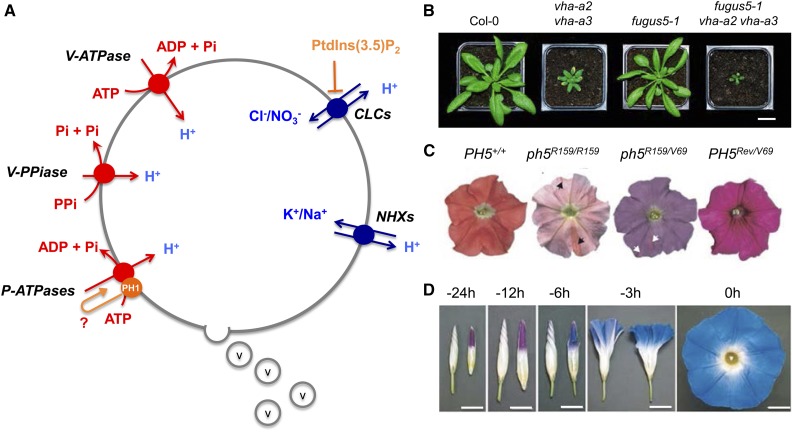
Transporters involved in vacuolar pH regulation. A, Vacuolar pumps (in red) and transporters (blue) known to be implicated in establishing the vacuolar pH. In orange are factors involved in the regulation of pumps and transporters. PH1 has been shown to interact with the P-ATPase PH5 by stimulating the pump activity of PH5; for PH1, no pump activity could be demonstrated. Vesicles (v) from the secretory pathway participate in acidifying the vacuole. B, Phenotypes of double mutants of the two V-ATPases and V-PPase (fugus) and the corresponding triple knockout (Kriegel et al., 2015). C, Colors of ph5 mutants and complementation lines of petunia flowers (Verweij et al., 2008). The different colors indicate different pH levels. D, Color change in morning glory flowers during flower opening. The transition from pink to blue is correlated with an increase in expression of a vacuolar HNX and reflects the more alkaline pH (Yoshida et al., 2009).
Figure 2.
Figure 2.
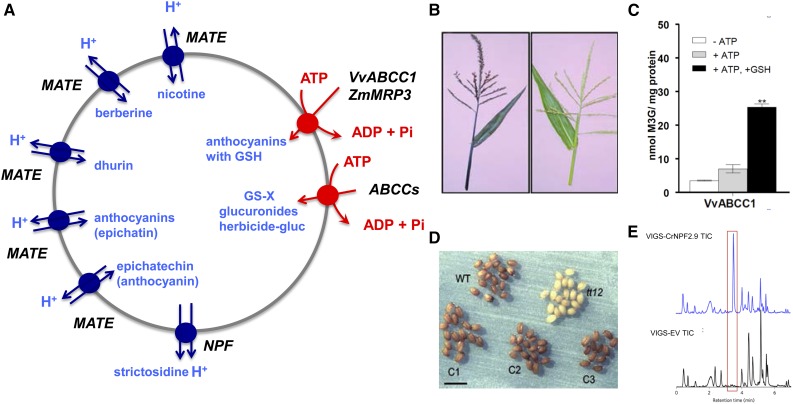
Vacuolar transport of secondary products and xenobiotics. A, Vacuolar pumps (red) and transporters (blue) known to be implicated in delivering or releasing secondary plant products and xenobiotics. B, Phenotypes of a wild-type (left) and a mutant (right) maize in the putative anthocyanin transporter ZmMRP3 (Goodman et al., 2004). C, Transport of anthocyanins requires glutathione (Francisco et al., 2013). D, Color of wild-type (WT), tt12 mutant, corresponding to a mutation in a MATE transporter, and complemented Arabidopsis seeds (Debeaujon et al., 2001). E, Silencing of the vacuolar NPF in Catharathus roseus plants leads to a high accumulation of strictosidine (peak framed in red; Payne et al., 2017).
Figure 3.
Figure 3.
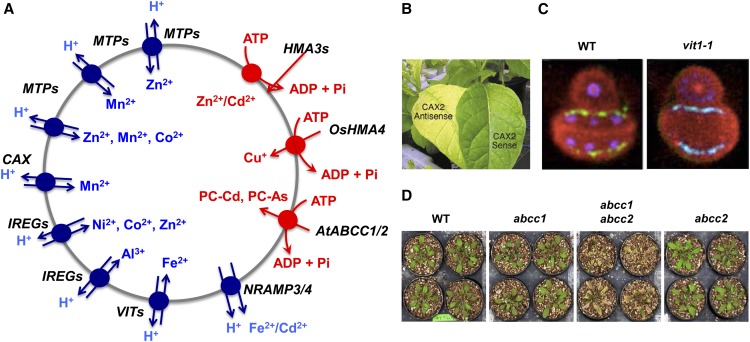
Vacuolar transport of essential and toxic heavy metals. A, Vacuolar pumps (in red) and transporters (blue) known to be implicated in delivering or releasing heavy metals. B, Expression of CAX2 in the antisense or sense orientation results in plants that are more sensitive or more tolerant to manganese (Hirschi, 2001). C, Iron distribution, but not iron total content, is altered in seeds of Arabidopsis mutants for the vacuolar iron transporter VIT1 (Kim et al., 2006). D, In Arabidopsis, the double knockout abcc1 × abcc2 is hypersensitive to arsenic (Song et al., 2010). WT, Wild type.
Figure 4.
Figure 4.
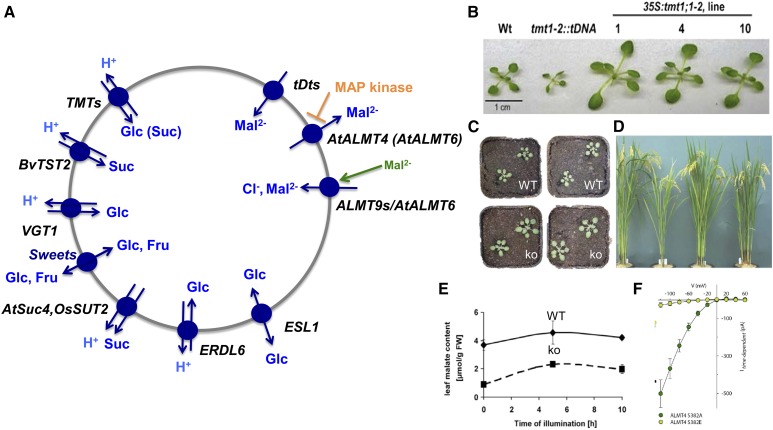
The vacuole as temporary store for sugars and carboxylates. A, Vacuolar transporters known to be implicated in delivering or releasing sugars and carboxylates. For ALMT4, refer to the stomata section. B, Knockout and overexpression of the Glc transporter TMT1 has a large effect on seedling growth (Wingenter et al., 2010). C, Overexpression of the vacuolar SWEET16 results in Arabidopsis plants that grow faster on soil (Klemens et al., 2013). D, Rice plants deficient in the vacuolar Suc exporter OsSUT2 exhibit retarded growth (Eom et al., 2011). E, Arabidopsis plants missing the vacuolar malate transporter AttDT have strongly reduced malate content (Emmerlich et al., 2003). F, The activity of the malate channel ALMT4 is completely inhibited by phosphorylation (Eisenach et al., 2017). FW, Fresh weight; ko, knockout; WT, wild type.
Figure 5.
Figure 5.
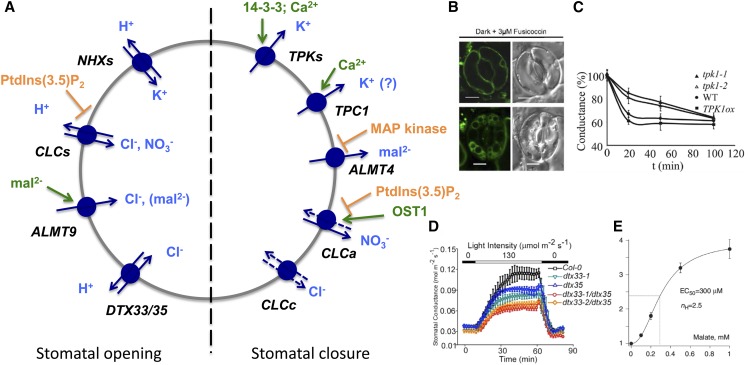
The roles of vacuolar transporters in stomatal movement. A, Vacuolar transporters and channels known to be implicated in stomatal opening (left side) and closure (right side). The proton pumps generating the electrochemical potential are not indicated. Activating factors (green) and inhibiting factors (orange) are shown. B, NHX1 and NHX2 are required for stomata opening (Andrés et al., 2014). Mutants in the vacuolar K+ channel TPK1 have delayed stomatal closure (Gobert et al., 2007). C, Mutants in the vacuolar K+ channel TPK1 have a delayed stomatal closure (Gobert et al.,2007). D, The MATE transporters dtx33 and dtx35 act as vacuolar chloride channels and are required for stomatal opening (Zhang et al., 2017). E, The chloride channel activity of AtALMT9 is strongly stimulated by malate at physiological concentrations (De Angeli et al., 2013). WT, Wild type.

References

    1. Allen GJ, Chu SP, Schumacher K, Shimazaki CT, Vafeados D, Kemper A, Hawke SD, Tallman G, Tsien RY, Harper JF, et al. (2000) Alteration of stimulus-specific guard cell calcium oscillations and stomatal closing in Arabidopsis det3 mutant. Science 289: 2338–2342 - PubMed
    1. Aluri S, Büttner M (2007) Identification and functional expression of the Arabidopsis thaliana vacuolar glucose transporter 1 and its role in seed germination and flowering. Proc Natl Acad Sci USA 104: 2537–2542 - PMC - PubMed
    1. Andrés Z, Pérez-Hormaeche J, Leidi EO, Schlücking K, Steinhorst L, McLachlan DH, Schumacher K, Hetherington AM, Kudla J, Cubero B, et al. (2014) Control of vacuolar dynamics and regulation of stomatal aperture by tonoplast potassium uptake. Proc Natl Acad Sci USA 111: E1806–E1814 - PMC - PubMed
    1. Appelhagen I, Nordholt N, Seidel T, Spelt K, Koes R, Quattrocchio F, Sagasser M, Weisshaar B (2015) TRANSPARENT TESTA 13 is a tonoplast P3A-ATPase required for vacuolar deposition of proanthocyanidins in Arabidopsis thaliana seeds. Plant J 82: 840–849 - PubMed
    1. Bak G, Lee EJ, Lee Y, Kato M, Segami S, Sze H, Maeshima M, Hwang JU, Lee Y (2013) Rapid structural changes and acidification of guard cell vacuoles during stomatal closure require phosphatidylinositol 3,5-bisphosphate. Plant Cell 25: 2202–2216 - PMC - PubMed

MeSH terms

LinkOut - more resources