. 2018 Jan 2;9(1):14.
doi: 10.1038/s41467-017-02514-z.

Metabolic rate evolves rapidly and in parallel with the pace of life history

Affiliations

Metabolic rate evolves rapidly and in parallel with the pace of life history

Sonya K Auer et al. Nat Commun. .

Abstract

Metabolic rates and life history strategies are both thought to set the "pace of life", but whether they evolve in tandem is not well understood. Here, using a common garden experiment that compares replicate paired populations, we show that Trinidadian guppy (Poecilia reticulata) populations that evolved a fast-paced life history in high-predation environments have consistently higher metabolic rates than guppies that evolved a slow-paced life history in low-predation environments. Furthermore, by transplanting guppies from high- to low-predation environments, we show that metabolic rate evolves in parallel with the pace of life history, at a rapid rate, and in the same direction as found for naturally occurring populations. Together, these multiple lines of inference provide evidence for a tight evolutionary coupling between metabolism and the pace of life history.


Conflict of interest statement

The authors declare no competing financial interests.

Figures

Fig. 1
Fig. 1
Metabolic rates differed among populations according to their pace of life history. a Standard metabolic rate (mean ± 1 SE) was lower in naturally occurring populations with a slow (gray) relative to a fast-paced (blue) life history (LMM: P < 0.001) in both the Oropuche (slow: n = 29, fast: n = 28) and Yarra (slow: n = 26, fast: n = 28) River drainages. b Standard metabolic rate (mean ± 1 SE) was also lower in a population transplanted from high- to low-predation sites in 1981 that has since evolved a slow-paced life history (green, n = 22) vs their naturally occurring ancestral population with a fast-paced life history (blue, n = 24) in the Caroni River drainage. Values for standard metabolic rate are standardized to a common body mass of 74 mg (mean across all fish)
Fig. 2
Fig. 2
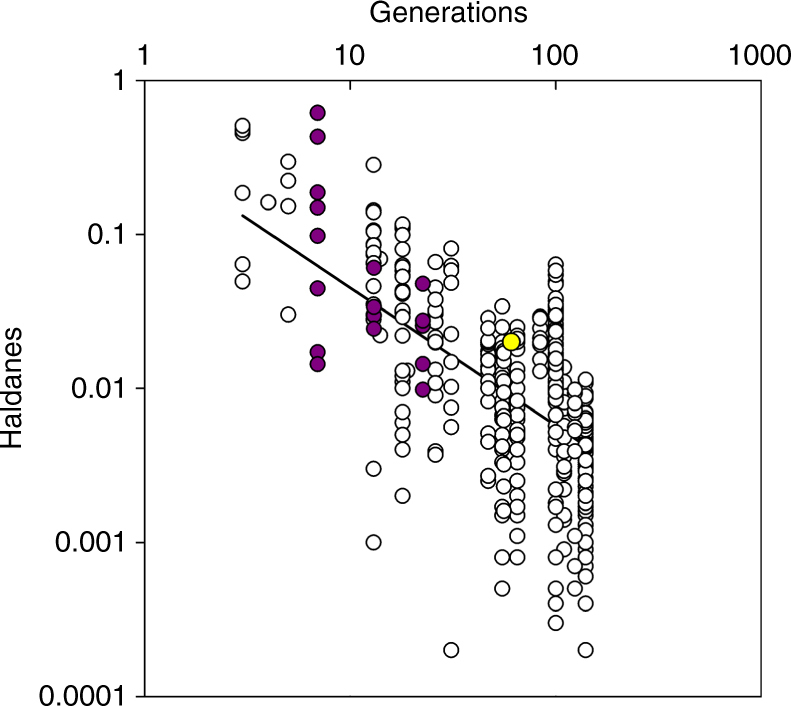
Rates of evolution are slower when measured over longer time intervals. Rates, plotted in haldanes (standard deviations of change per generation), are shown for metabolic rate in guppies from the El Cedro River from this study (yellow, n = 1), previously published estimates for guppy life history traits from the El Cedro River (purple, n = 18), and previously published estimates for life history and morphological traits of other taxa (white, n = 402). All estimates are absolute values of haldanes derived from common garden or quantitative-genetic methods. Note the logarithmic scale on both axes
Fig. 3
Fig. 3
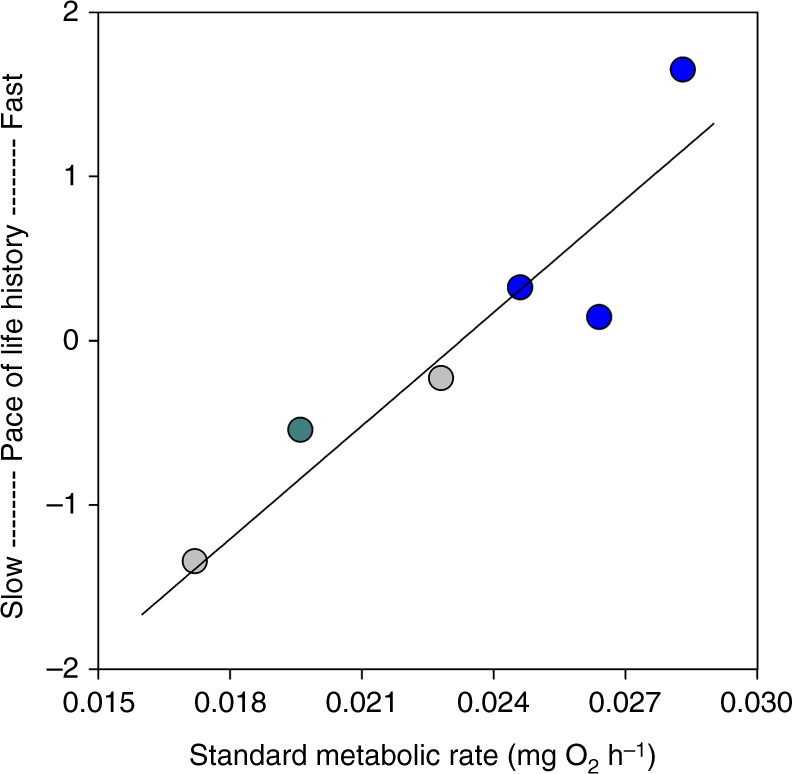
Standard metabolic rate covaries with the pace of life history. Standard metabolic rate was positively correlated with a suite of life history traits across six populations (Pearson correlation: P = 0.007). Included are naturally occurring populations with fast-paced (blue, n = 3) and slow-paced life histories (gray, n = 2) and a population transplanted from a high- to low-predation site 35 years ago that has since evolved a slow-paced life history (green, n = 1). The pace of life history was determined using principal component analysis (PCA) of estimates for the suite of traits including male age and mass at maturity, female age and mass at first parturition, inter-litter interval, and reproductive allotment. The first principle component (plotted on the y axis) had an eigenvalue of 3.70, explained 61% of the variation in life history traits, and differentiated populations with later maturity and lower reproductive investment (lower scores) from those with earlier maturity and higher reproductive investment (higher scores). Values for standard metabolic rate were standardized to a common body mass of 74 mg prior to analysis (mean across all fish)

References

    1. Roff, D. A. Life History Evolution (Sinauer Associates, Sunderland, 2002).
    1. Stearns, S. C. The Evolution of Life Histories (Oxford University Press, Oxford, 1992).
    1. Ricklefs RE. Density dependence, evolutionary optimization, and the diversification of avian life histories. Condor. 2000;102:9–22. doi: 10.1650/0010-5422(2000)102[0009:DDEOAT]2.0.CO;2. - DOI
    1. Blackburn T. Evidence for a ‘fast-slow’ continuum of life-history traits among parasitoid Hymenoptera. Funct. Ecol. 1991;5:65–74. doi: 10.2307/2389556. - DOI
    1. Promislow DE, Harvey PH. Living fast and dying young: a comparative analysis of life‐history variation among mammals. J. Zool. 1990;220:417–437. doi: 10.1111/j.1469-7998.1990.tb04316.x. - DOI

Publication types

LinkOut - more resources