State of equity: childhood immunization in the World Health Organization African Region
- PMID: 29296140
- PMCID: PMC5745948
- DOI: 10.11604/pamj.supp.2017.27.3.12114
State of equity: childhood immunization in the World Health Organization African Region
Abstract
Introduction: In 2010, the Global Vaccine Action Plan called on all countries to reach and sustain 90% national coverage and 80% coverage in all districts for the third dose of diphtheria-tetanus-pertussis vaccine (DTP3) by 2015 and for all vaccines in national immunization schedules by 2020. The aims of this study are to analyze recent trends in national vaccination coverage in the World Health Organization African Region andto assess how these trends differ by country income category.
Methods: We compared national vaccination coverage estimates for DTP3 and the first dose of measles-containing vaccine (MCV) obtained from the World Health Organization (WHO)/United Nations Children's Fund (UNICEF) joint estimates of national immunization coverage for all African Region countries. Using United Nations (UN) population estimates of surviving infants and country income category for the corresponding year, we calculated population-weighted average vaccination coverage by country income category (i.e., low, lower middle, and upper middle-income) for the years 2000, 2005, 2010 and 2015.
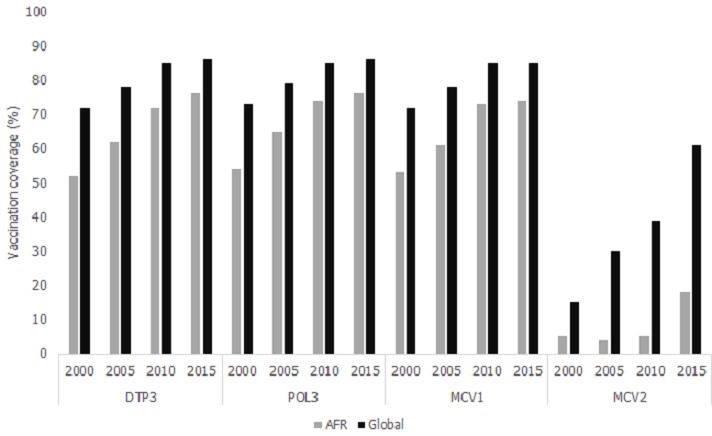
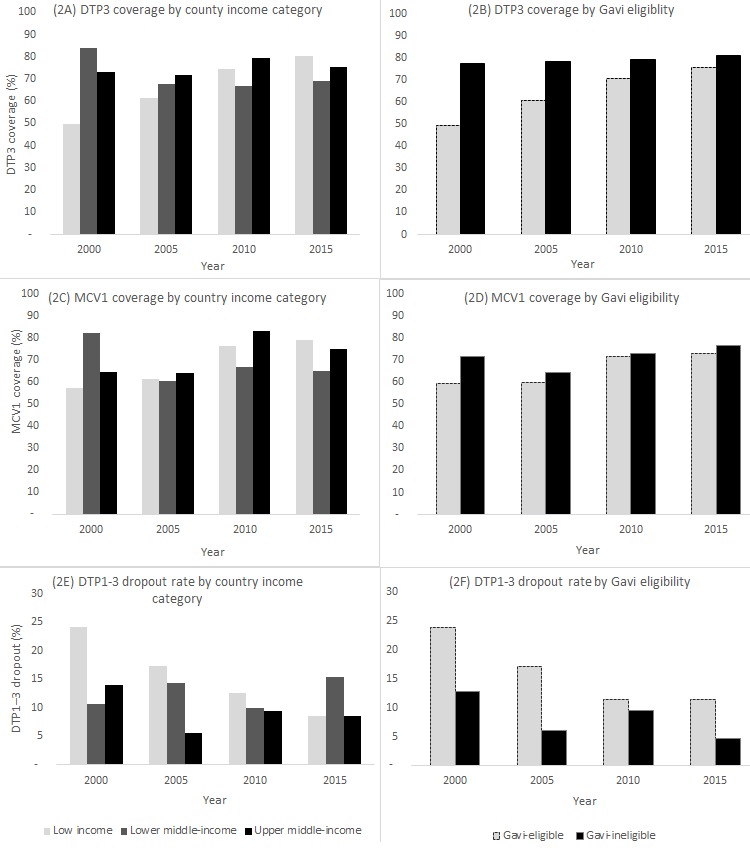
Results: DTP3 coverage in the African Region increased from 52% in 2000 to 76% in 2015,and MCV1 coverage increased from 53% to 74% during the same period, but with considerable differences among countries. Thirty-six African Region countries were low income in 2000 with an average DTP3 coverage of 50% while 26 were low income in 2015 with an average coverage of 80%. Five countries were lower middle-income in 2000 with an average DTP3 coverage of 84% while 12 were lower middle-income in 2015 with an average coverage of 69%. Five countries were upper middle-income in 2000 with an average DTP3 coverage of 73% and eight were upper middle-income in 2015 with an average coverage of 76%.
Conclusion: Disparities in vaccination coverage by country persist in the African Region, with countries that were lower middle-income having the lowest coverage on average in 2015. Monitoring and addressing these disparities is essential for meeting global immunization targets.
Keywords: Vaccination; World Health Organization African region; immunization coverage.
Figures
References
-
- World Health Organization . Global Vaccine Action Plan 2011-2020. Geneva: World Health Organization; 2013.
-
- World Bank . World Bank Country and Lending Groups. 2017. Accessed 23 February 2017.
-
- Saxenian H, Cornejo S, Thorien K, Hecht R, Schwalbe N. An analysis of how The GAVI alliance and low- and middle-income countries can share costs of new vaccines. Health Affairs. 2011;30(6):1122–33. - PubMed
-
- Gavi the Vaccine Alliance . All Countries - Commitments and Disbursements. 2016. Accessed 23 February 2017.
-
- World Health Organization. WHO/UNICEF coverage estimates for 1980-2015. 2016. Accessed 23 February 2017.
MeSH terms
Substances
Grants and funding
LinkOut - more resources
Full Text Sources
Other Literature Sources
Medical