


Improved clinical efficiency in CNS stereotactic radiosurgery using a flattening filter free linear accelerator
- PMID: 29296305
- PMCID: PMC5675468
Improved clinical efficiency in CNS stereotactic radiosurgery using a flattening filter free linear accelerator
Abstract
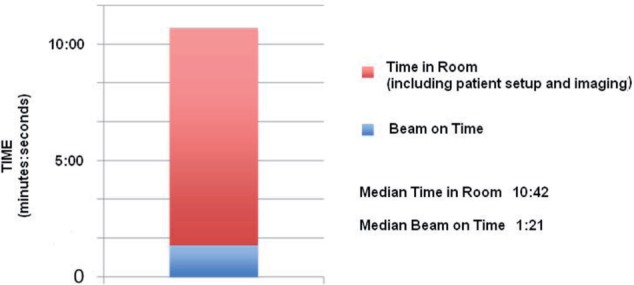
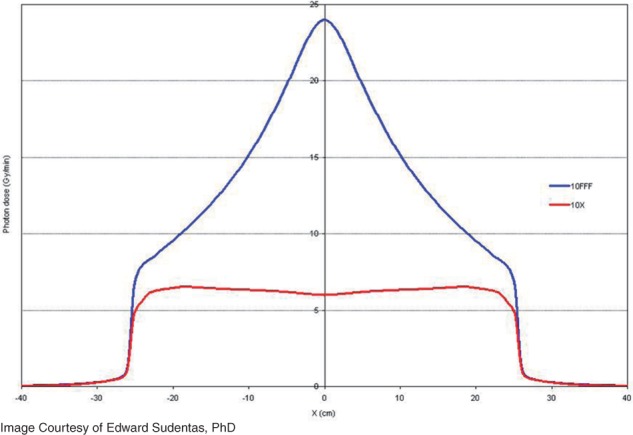
Linear accelerator (linac) based CNS stereotactic radiosurgery (SRS) requires significant time resources. We hypothesized that CNS SRS using a flattening filter free (FFF) linac would reduce treatment time and improve clinical efficiency. A FFF linac was recently commissioned for CNS radiosurgery at the University of Alabama at Birmingham. The efficiency of this linac for CNS SRS was retrospectively reviewed. Beam on time (BOT), time in room (TIR), and clinical dose rate (CDR) were calculated using an integrated treatment planning, record, and verification software platform and are proposed as surrogates for treatment efficiency. Twenty-seven eligible CNS SRS cases consisting of 1-5 fractions of 5 Gy or more per fraction were reviewed. Mean BOT was 1:21 (minutes:seconds; range: 00:36-2:52) and mean TIR was 10:42 (minutes:seconds; range: 6:05-22:56). The mean CDR was 1820 MU/ min (range: 872-2396). On regression analysis the number of alignment images, treatment arcs, targets, monitor units, and presence of intra-fraction imaging were factors significantly (p < 0.05) associated with prolonged TIR. Use of FFF mode in CNS SRS more than triples the CDR and results in shortened BOT and TIR compared to treatment at conventional dose rates. Reduction in clinical treatment times may translate to better target localization due to reduced opportunity for intrafraction motion. Linac-based CNS SRS can be completed in a normal time slot with a high output FFF linac.
Keywords: CNS radiation; FFF; Radiosurgery; SBRT; SRS; treatment efficiency.
Figures
References
-
- Purdie TG, Bissonnette JP, Bezjak A Franks, Payne D, Sie F, Sharpe MB, Jaffray DA. Cone-beam computed tomography for on-line image guidance of lung stereotactic radiotherapy: localization, verification, and intrafraction tumor position. Int J Radiat Oncol Biol Phys. 2007; 68(1): 243–52. - PubMed
-
- Cashmore J. The characterization of unflattened photon beams from a 6 MV linear accelerator. Phys Med Biol. 2009; 53(7): 1933–46. - PubMed
-
- O’Brien PF, Gillies BA, Schwartz M, Young C, Davey P. Radiosurgery with unflattened 6-MV photon beams. Med Phys. 1992; 18(3): 519–21. - PubMed
-
- Stathakis S, Esquivel C, Gutierrez A, Buckey CR, Papanikolaou N. Treatment planning and delivery of IMRT using 6 and 18MV photon beams without flattening filter. Appl Radiat Isot. 2009; 67(9): 1629–37. - PubMed
LinkOut - more resources
Full Text Sources
Research Materials