. 2017 Nov 7;4(12):859-864.
doi: 10.1002/acn3.487. eCollection 2017 Dec.

Neuropathology of childhood-onset basal ganglia degeneration caused by mutation of VAC14

Affiliations

Neuropathology of childhood-onset basal ganglia degeneration caused by mutation of VAC14

Chloe Stutterd et al. Ann Clin Transl Neurol. .

Abstract

Objective: To characterize the clinical features and neuropathology associated with recessive VAC14 mutations.

Methods: Whole-exome sequencing was used to identify the genetic etiology of a rapidly progressive neurological disease presenting in early childhood in two deceased siblings with distinct neuropathological features on post mortem examination.

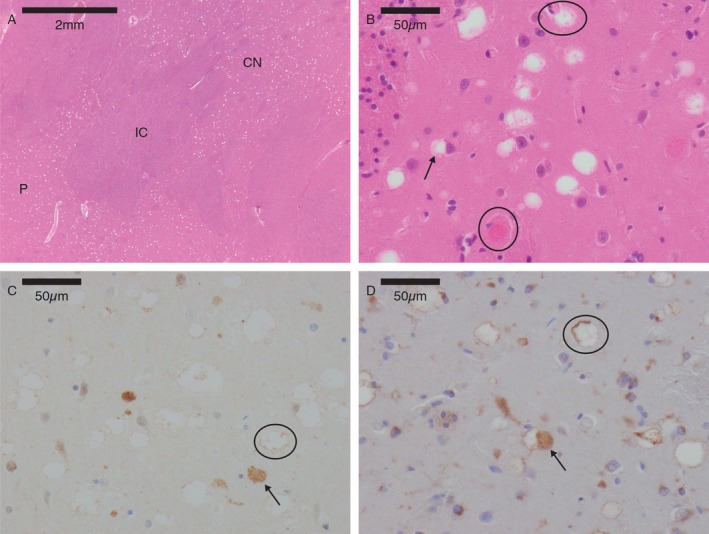
Results: We identified compound heterozygous variants in VAC14 in two deceased siblings with early childhood onset of severe, progressive dystonia, and neurodegeneration. Their clinical phenotype is consistent with the VAC14-related childhood-onset, striatonigral degeneration recently described in two unrelated children. Post mortem examination demonstrated prominent vacuolation associated with degenerating neurons in the caudate nucleus, putamen, and globus pallidus, similar to previously reported ex vivo vacuoles seen in the late-endosome/lysosome of VAC14-deficient neurons. We identified upregulation of ubiquitinated granules within the cell cytoplasm and lysosomal-associated membrane protein (LAMP2) around the vacuole edge to suggest a process of vacuolation of lysosomal structures associated with active autophagocytic-associated neuronal degeneration.

Interpretation: Our findings reveal a distinct clinicopathological phenotype associated with recessive VAC14 mutations.


Figures
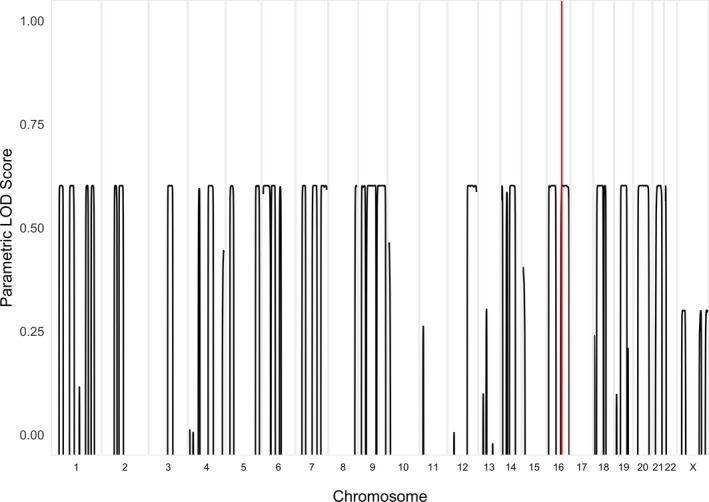
Figure 1
Figure 1
LOD plot. Linkage analysis was performed using SNP genotype calls based on the HapMap database. A recessive genetic model was applied with a 100% penetrance for homozygous carriers and 0% for heterozygous or homozygous reference samples, with an estimated population prevalence of 0.001%. This analysis identified several linkage regions genome‐wide with a near maximal LOD score (~0.6). The two VAC14 mutations were within the chromosome 16 linkage region, highlighted in red.
Figure 2
Figure 2
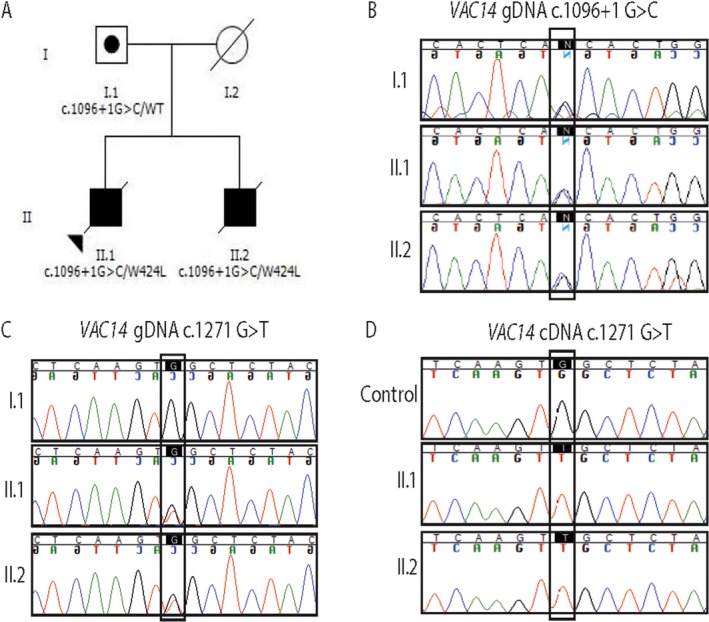
(A) Pedigree with segregation of two allelic VAC14 variants. (B) Sanger sequencing of the paternally inherited c.1096 + 1 G>C variant. (C–D) Comparison of genomic DNA and complementary DNA sequencing of the c.1271 G>T variant; Both alleles are detected in the patients' genomic sequence (C), however, sequencing of the cDNA detected only the allele carrying the c.1271 G>T variant, consistent with loss of the c.1096 + 1 G>C allele due to nonsense‐mediated decay of the mRNA (D).
Figure 3
Figure 3
Neuropathology. (A) Marked vacuolation in the caudate nucleus (CN) and putamen (P), with unremarkable internal capsule (IC). Hematoxylin and Eosin × 4. (B) Vacuoles present in the neuropil could sometimes be seen to extend from the cell body (arrow). Degenerating granular eosinophilic neurons were seen (circles). Putamen, Hematoxylin, and Eosin × 400. (C) Vacuoles showed a fine ubiquitin immunoreactive rim (circle). Granular dense ubiquitin was present in degenerating neurons (arrow). Putamen, ubiquitin immunoperoxidase × 400. (D) Vacuoles within the putamen were lined by LAMP2 immunoreactive membrane (circle). LAMP 2 granular bodies were present in cytoplasmic bodies (arrow). Putamen, LAMP2 immunoperoxidase × 400.

References

    1. Sbrissa D, Ikonomov OC, Fu Z, et al. Core protein machinery for mammalian phosphatidylinositol 3,5‐bisphosphate synthesis and turnover that regulates the progression of endosomal transport. Novel Sac phosphatase joins the ArPIKfyve‐PIKfyve complex. J Biol Chem 2007;282:23878–23891. - PubMed
    1. Schulze U, Vollenbroker B, Braun DA, et al. The Vac14‐interaction network is linked to regulators of the endolysosomal and autophagic pathway. Mol Cell Proteomics 2014;13:1397–1411. - PMC - PubMed
    1. Jin N, Chow CY, Liu L, et al. VAC14 nucleates a protein complex essential for the acute interconversion of PI3P and PI(3,5)P(2) in yeast and mouse. EMBO J 2008;27:3221–3234. - PMC - PubMed
    1. Zhang Y, Zolov SN, Chow CY, et al. Loss of Vac14, a regulator of the signaling lipid phosphatidylinositol 3,5‐bisphosphate, results in neurodegeneration in mice. Proc Natl Acad Sci USA 2007;104:17518–17523. - PMC - PubMed
    1. Lenk GM, Szymanska K, Debska‐Vielhaber G, et al. Biallelic mutations of VAC14 in pediatric‐onset neurological disease. Am J Hum Genet 2016;99:188–194. - PMC - PubMed