


Importance of Active Participation in Obesity Management Through Mobile Health Care Programs: Substudy of a Randomized Controlled Trial
- PMID: 29298749
- PMCID: PMC5772068
- DOI: 10.2196/mhealth.8719
Importance of Active Participation in Obesity Management Through Mobile Health Care Programs: Substudy of a Randomized Controlled Trial
Abstract
Background: Due to the prevalence of the westernized dietary pattern and lack of physical activity, the numbers of overweight or obese individuals are increasing, resulting in a growing health burden because of various related diseases. A lifestyle modification approach has additional advantages compared with pharmacological therapies or bariatric surgery. In our randomized controlled trial conducted in 2015, we successfully used a ubiquitous health care (SmartCare) service for patients with metabolic syndrome to achieve a significant weight loss effect. Various useful apps have been developed for the SmartCare Service, which involves using a mobile phone to manage chronic diseases, minimizing time and space restrictions. Many studies have demonstrated weight loss effects using a SmartCare service, but limited data are available regarding the effect of active participation in relation to weight loss.
Objective: We aimed to assess the weight loss effect achieved after using the SmartCare service in terms of adherence and participation. We divided the intervention group of the previous study according to participation level, and analyzed whether there was a significant difference in the outcome.
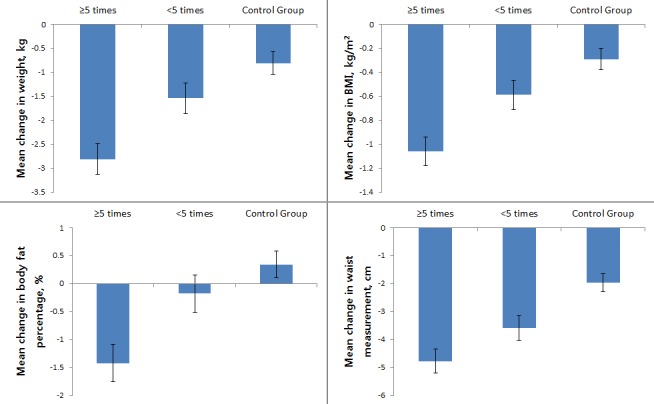
Methods: We classified participants into 3 groups according to their adherence. Within the intervention group using the SmartCare service, the active group comprised those transmitting anthropometric measurement data using a mobile phone 3 or more times per week or who had a health consultation 5 or more times during a 24-week period. The passive group comprised those who did not adhere to these levels of engagement. The control group comprised those who did not use the SmartCare service. We compared changes in body weight, body mass index (BMI), body fat percentage, waist circumference, and lipid profile among the 3 groups.
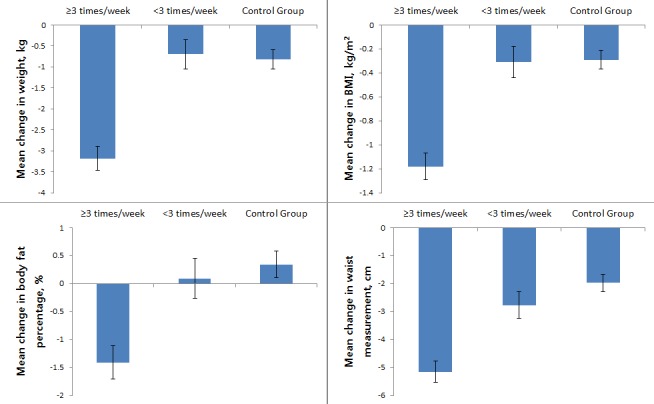
Results: We identified 422 participants and analyzed 405, excluding 17 who were missing necessary data for analysis. The active group consisted of 116 participants, compared with 80 in the passive group and 209 in the control group (without SmartCare service). There was a statistically significant difference in improvements to body weight, BMI, body fat percentage, and waist circumference among active participants compared with less active participants and the control group (P<.05). However, the lipid profile changes did not differ significantly between groups.
Conclusions: The level of participation may be related to improved weight-related outcomes, which may improve health outcomes. To maximize the effectiveness of the SmartCare service, encouraging active participation is important.
Trial registration: Clinicaltrials.gov NCT01344811; https://clinicaltrials.gov/ct2/show/NCT01344811 (Archived by WebCite at http://www.webcitation.org/6alT2MmIB).
Keywords: adherence; concordance; metabolic syndrome; mobile health; physical activity; self-report.
©Bumjo Oh, Ga-Hye Yi, Min Kyu Han, Jong Seung Kim, Chang Hee Lee, Belong Cho, Hee Cheol Kang. Originally published in JMIR Mhealth and Uhealth (http://mhealth.jmir.org), 03.01.2018.
Conflict of interest statement
Conflicts of Interest: None declared.
Figures
References
-
- Finucane MM, Stevens GA, Cowan MJ, Danaei G, Lin JK, Paciorek CJ, Singh GM, Gutierrez HR, Lu Y, Bahalim AN, Farzadfar F, Riley LM, Ezzati M, Global Burden of Metabolic Risk Factors of Chronic Diseases Collaborating Group (Body Mass Index) National, regional, and global trends in body-mass index since 1980: systematic analysis of health examination surveys and epidemiological studies with 960 country-years and 9·1 million participants. Lancet. 2011 Feb 12;377(9765):557–67. doi: 10.1016/S0140-6736(10)62037-5. - DOI - PMC - PubMed
-
- Kim CS, Ko S, Kwon H, Kim NH, Kim JH, Lim S, Choi SH, Song K, Won JC, Kim DJ, Cha B, Taskforce Team of Diabetes Fact Sheet of the Korean Diabetes Association Prevalence, awareness, and management of obesity in Korea: data from the Korea national health and nutrition examination survey (1998-2011) Diabetes Metab J. 2014 Feb;38(1):35–43. doi: 10.4093/dmj.2014.38.1.35. https://e-dmj.org/DOIx.php?id=10.4093/dmj.2014.38.1.35 - DOI - PMC - PubMed
-
- Klein S, Sheard NF, Pi-Sunyer X, Daly A, Wylie-Rosett J, Kulkarni K, Clark NG, American Diabetes Association. North American Association for the Study of Obesity. American Society for Clinical Nutrition Weight management through lifestyle modification for the prevention and management of type 2 diabetes: rationale and strategies: a statement of the American Diabetes Association, the North American Association for the Study of Obesity, and the American Society for Clinical Nutrition. Diabetes Care. 2004 Aug;27(8):2067–73. - PubMed
-
- Yonhap News . S. Korea tops smartphone penetration rate in 2012 Internet. Seoul, South Korea: The Korea Herald; 2013. [2017-12-20]. http://www.koreaherald.com/view.php?ud=20130625000550 6vqaveXSE.
Associated data
LinkOut - more resources
Full Text Sources
Other Literature Sources
Medical
