


Randomized Trial of Chronic Pain Self-Management Program in the Community or Clinic for Low-Income Primary Care Patients
- PMID: 29299814
- PMCID: PMC5910333
- DOI: 10.1007/s11606-017-4244-2
Randomized Trial of Chronic Pain Self-Management Program in the Community or Clinic for Low-Income Primary Care Patients
Abstract
Background: Patients with chronic pain often lack the skills and resources necessary to manage this disease.
Objective: To develop a chronic pain self-management program reflecting community stakeholders' priorities and to compare functional outcomes from training in two settings.
Design: A parallel-group randomized trial.
Participants: Eligible subjects were 35-70 years of age, with chronic non-cancer pain treated with opioids for >2 months at two primary care and one HIV clinic serving low-income Hispanics.
Interventions: In one study arm, the 6-month program was delivered in monthly one-on-one clinic meetings by a community health worker (CHW) trained as a chronic pain health educator, and in the second arm, content experts gave eight group lectures in a nearby library.
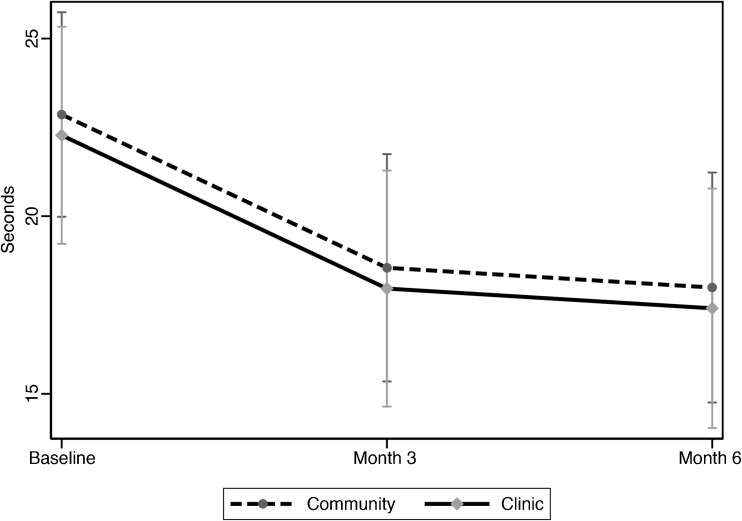
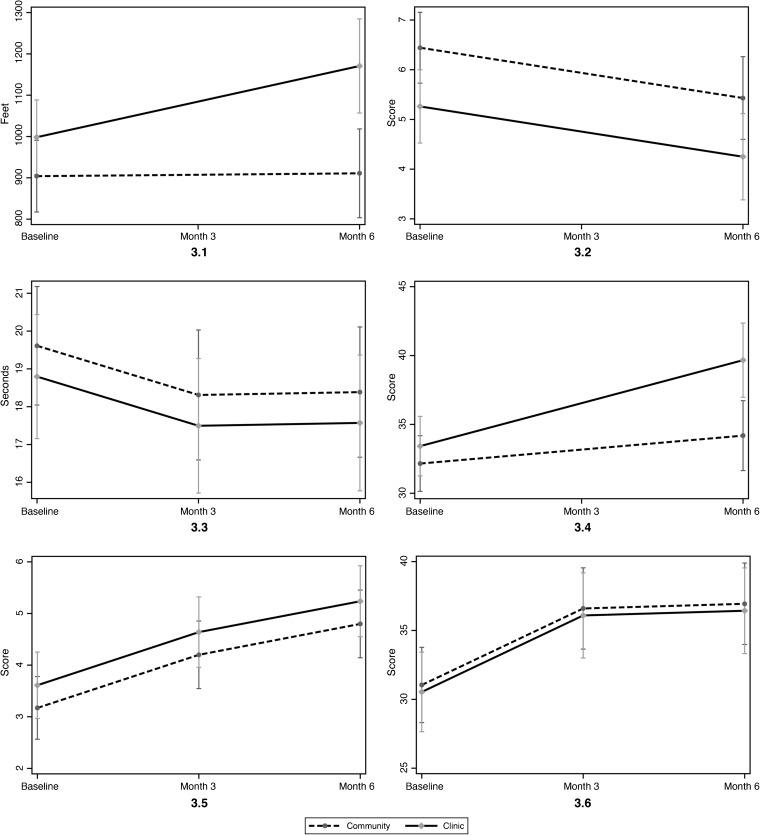
Main measures: Five times Sit-to-Stand test (5XSTS) assessed at baseline and 3 and 6 months. Other reported physical and cognitive measures include the 6-Min Walk (6 MW), Borg Perceived Effort Test (Borg Effort), 50-ft Speed Walk (50FtSW), SF-12 Physical Component Summary (SF-12 PCS), Patient-Specific Functional Scale (PSFS), and Symbol-Digit Modalities Test (SDMT). Intention-to-treat (ITT) analyses in mixed-effects models adjust for demographics, body mass index, maximum pain, study arm, and measurement time. Multiple imputation was used for sensitivity analyses.
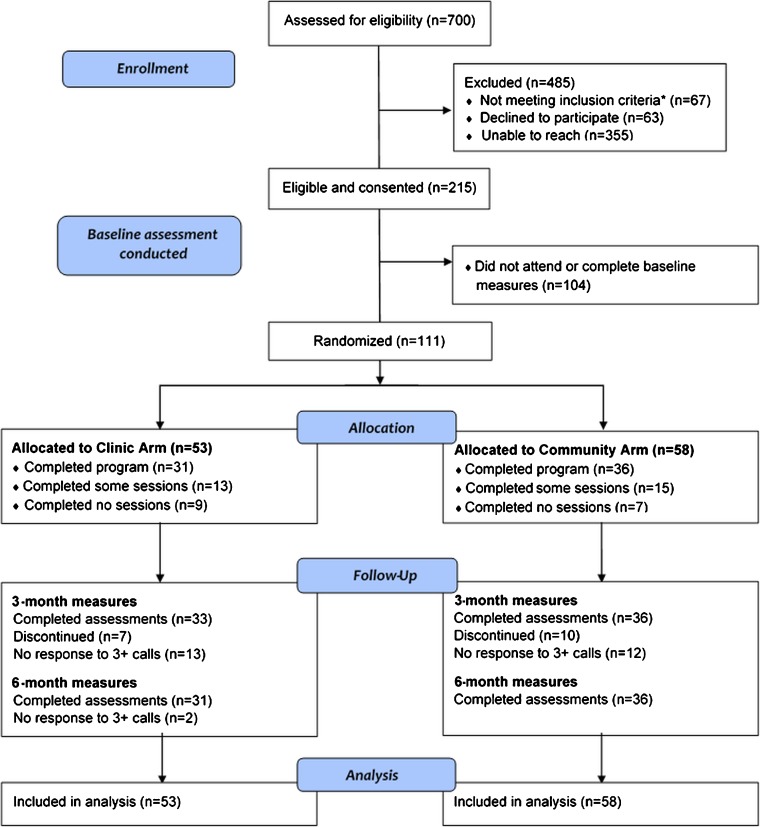
Key results: Among 111 subjects, 53 were in the clinic arm and 58 in the community arm. In ITT analyses at 6 months, subjects in both arms performed the 5XSTS test faster (-4.9 s, P = 0.001) and improved scores on Borg Effort (-1, P = 0.02), PSFS (1.6, P < 0.001), and SDMT (5.9, P < 0.001). Only the clinic arm increased the 6 MW (172.4 ft, P = 0.02) and SF-12 PCS (6.2 points, P < 0.001). 50ftSW did not change (P = 0.15). Results were similar with multiple imputation. Five falls were possible adverse events.
Conclusions: In low-income subjects with chronic pain, physical and cognitive function improved significantly after self-management training from expert lectures in the community and in-clinic meetings with a trained health educator.
Trial registration: ClinicalTrials.gov NCT02906358.
Keywords: Hispanic; chronic pain; low-income populations; patient engagement; self-management.
Conflict of interest statement
Prior Presentations
The results of this study were presented in part as an oral presentation at the Society of General Internal Medicine Annual Meeting, April 19–22, 2017, Washington, DC. Parts of the of the study results were also presented as a poster at the American Pain Society Annual Meeting, May 17–19, 2017, Pittsburgh, PA.
Conflict of Interest
The authors declare that they do not have a conflict of interest.
Figures
Comment in
-
Capsule Commentary on Turner et al., Randomized Trial of Chronic Pain Self-management Program in Community or Clinic for Low-Income Primary Care Patients.J Gen Intern Med. 2018 May;33(5):746. doi: 10.1007/s11606-018-4370-5. J Gen Intern Med. 2018. PMID: 29488160 Free PMC article. No abstract available.
References
Publication types
MeSH terms
Associated data
LinkOut - more resources
Full Text Sources
Other Literature Sources
Medical
