The Korean Influenza National Immunization Program: History and Present Status
- PMID: 29299891
- PMCID: PMC5754334
- DOI: 10.3947/ic.2017.49.4.247
The Korean Influenza National Immunization Program: History and Present Status
Abstract
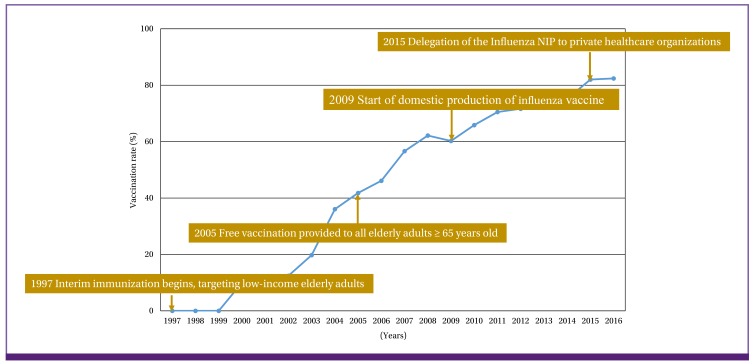
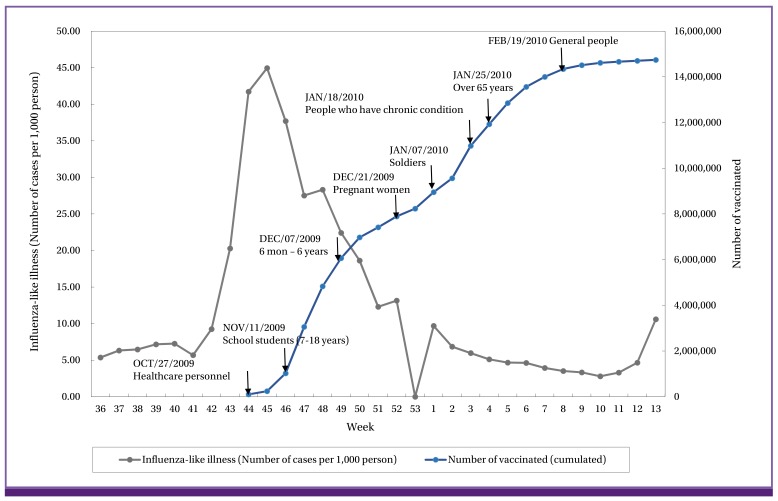
The Korean influenza national immunization program was first established as an interim program in 1997, administering the influenza vaccine to low-income elderly adults. In 2005, the program assumed its present form of providing free influenza vaccination to adults aged ≥65 years. After turning over the influenza vaccination for elderly adults to the private sectors in 2015, the influenza vaccination coverage rate among this population increased to >80%. In addition, after the 2009 H1N1 influenza epidemic crisis, the vaccine was domestically produced. By reaching a 75% vaccination coverage rate in the target groups, it was possible to put an end to the influenza pandemic and fix the shortcomings of the system that existed at that time. The influenza vaccination program, provided free of cost, was extended to include infants aged <12 months in 2016 and ≤59 months in 2017 in order to reduce the influenza burden in these populations. However, the vaccine effectiveness remains low despite the high vaccination rates in elderly adults. Therefore, several areas, such as the adoption of quadrivalent influenza vaccine, adjuvanted influenza vaccine, and high-dose influenza vaccine and the expansion of vaccination target groups, still need to be addressed.
Keywords: History; Immunization; Influenza; Korea; Vaccination.
Copyright © 2017 by The Korean Society of Infectious Diseases and Korean Society for Chemotherapy.
Conflict of interest statement
No conflicts of interest.
Figures
References
-
- Korean Centre for Disease Control and Prevention (KCDC) Immunization Target Infectious Disease Epidemiology and Management Guidelines Ch 21. Influenza. Korean Centre for Disease Control and Prevention; 2017. pp. 435–462.
-
- Organisation for Economic Co-operation and Development (OECD) Health at a glance 2015. [Accessed 25 April 2017]. Available at: http://dx.doi.org/10.1787/health_glance-2015-en. - DOI
-
- Korean National Institute of Health (KNIH) ‘02–’03 Influenza Management Guidelines. Osong: KNIH; 2002.
-
- Korean National Institute of Health (KNIH) ‘03–’04 Influenza Management Guidelines. Osong: KNIH; 2003.
-
- Korean Centre for Disease Control and Prevention (KCDC) 2004–2005 Influenza Management Guidelines. Osong: KCDC; 2004.
Publication types
LinkOut - more resources
Full Text Sources
Other Literature Sources