


Silent Myocardial Infarction and Long-Term Risk of Heart Failure: The ARIC Study
- PMID: 29301615
- PMCID: PMC5757248
- DOI: 10.1016/j.jacc.2017.10.071
Silent Myocardial Infarction and Long-Term Risk of Heart Failure: The ARIC Study
Abstract
Background: Although silent myocardial infarction (SMI) accounts for about one-half of the total number of myocardial infarctions (MIs), the risk of heart failure (HF) among patients with SMI is not well established.
Objectives: The purpose of this study was to examine the association of SMI and clinically manifested myocardial infarction (CMI) with HF, as compared with patients with no MI.
Methods: This analysis included 9,243 participants from the ARIC (Atherosclerosis Risk In Communities) study who were free of cardiovascular disease at baseline (ARIC visit 1: 1987 to 1989). SMI was defined as electrocardiographic evidence of MI without CMI after the baseline until ARIC visit 4 (1996 to 1998). HF events were ascertained starting from ARIC visit 4 until 2010 in individuals free of HF before that visit.
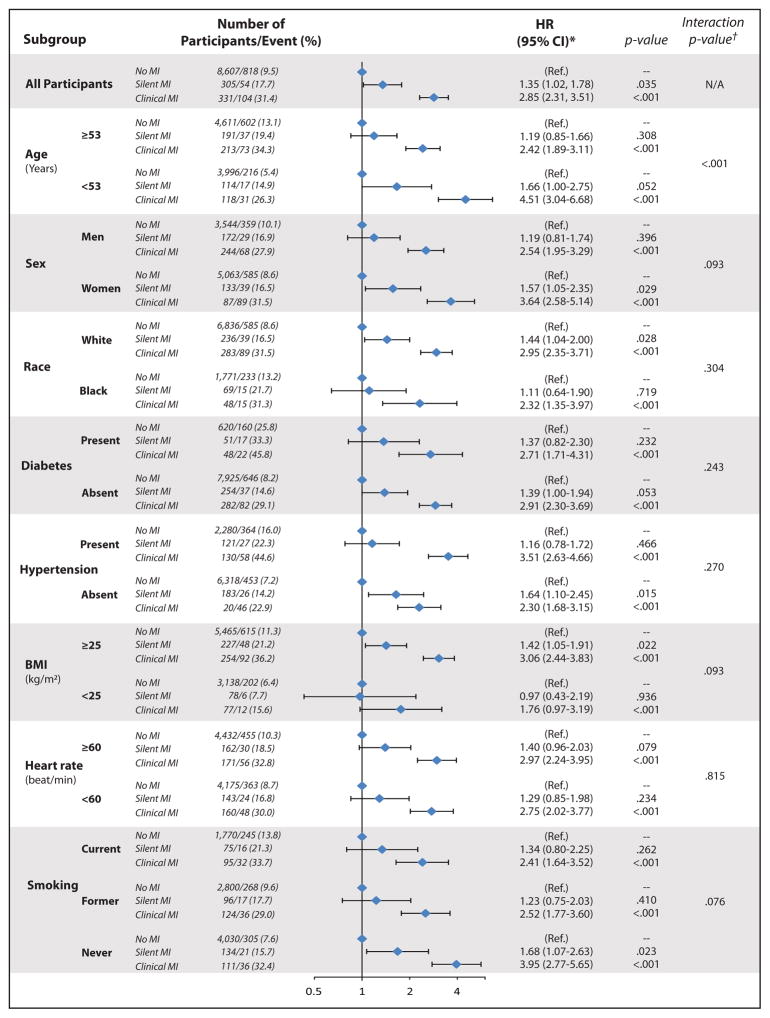
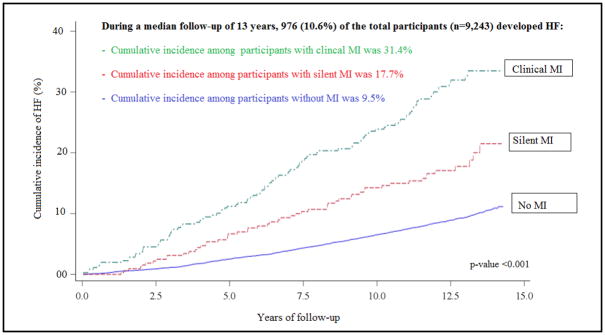
Results: Between ARIC visits 1 and 4, 305 SMIs and 331 CMIs occurred. After ARIC visit 4 and during a median follow-up of 13.0 years, 976 HF events occurred. The incidence rate of HF was higher in both CMI and SMI participants than in those without MI (incidence rates per 1,000 person-years were 30.4, 16.2, and 7.8, respectively; p < 0.001). In a model adjusted for demographics and HF risk factors, both SMI (hazard ratio [HR]: 1.35; 95% confidence interval [CI]: 1.02 to 1.78) and CMI (HR: 2.85; 95% CI: 2.31 to 3.51) were associated with increased risk of HF compared with no MI. These associations were consistent in subgroups of participants stratified by several HF risk predictors. However, the risk of HF associated with SMI was stronger in those younger than the median age (53 years) (HR: 1.66; 95% CI: 1.00 to 2.75 vs. HR: 1.19; 95% CI: 0.85 to 1.66, respectively; overall interaction p by MI type <0.001).
Conclusions: SMI is associated with an increased risk of HF. Future research is needed to examine the cost effectiveness of screening for SMI as part of HF risk assessment, and to identify preventive therapies to improve the risk of HF among patients with SMI.
Keywords: electrocardiogram; heart failure; silent myocardial infarction.
Copyright © 2018 American College of Cardiology Foundation. Published by Elsevier Inc. All rights reserved.
Figures
Comment in
-
Silent Myocardial Infarction: Listen to the Evidence.J Am Coll Cardiol. 2018 Jan 2;71(1):9-11. doi: 10.1016/j.jacc.2017.10.069. J Am Coll Cardiol. 2018. PMID: 29301632 No abstract available.
-
Acute coronary syndromes: Silent myocardial infarction increases the risk of heart failure.Nat Rev Cardiol. 2018 Mar;15(3):136. doi: 10.1038/nrcardio.2018.4. Epub 2018 Jan 25. Nat Rev Cardiol. 2018. PMID: 29368702 No abstract available.
-
Silent myocardial infarction and risk of heart failure.Ann Transl Med. 2018 Nov;6(Suppl 1):S35. doi: 10.21037/atm.2018.09.45. Ann Transl Med. 2018. PMID: 30613610 Free PMC article. No abstract available.
References
-
- Shah RV, Holmes D, Anderson M, et al. Risk of heart failure complication during hospitalization for acute myocardial infarction in a contemporary population: Insights from the National Cardiovascular Data ACTION registry. Circ Heart Fail. 2012;5:693–702. - PubMed
-
- Mocan T, Agoston-Coldea L, Gatfosse M, Rosenstingl S, Mocan LC. Risk factors for heart failure in patients with one prior myocardial infarction episode. Rom J Intern Med. 2008;46:213–221. - PubMed
-
- Zornoff LA, Skali H, Pfeffer MA, et al. Right ventricular dysfunction and risk of heart failure and mortality after myocardial infarction. J Am Coll Cardiol. 2002;39:1450–1455. - PubMed
-
- Cowie MR, Lacey L, Tabberer M. Heart failure after myocardial infarction: A neglected problem. Br J Cardiol. 2005;12:205–208.
Publication types
MeSH terms
Grants and funding
- HHSN268201100012C/HL/NHLBI NIH HHS/United States
- HHSN268201100009I/HL/NHLBI NIH HHS/United States
- HHSN268201100010C/HL/NHLBI NIH HHS/United States
- HHSN268201100008C/HL/NHLBI NIH HHS/United States
- HHSN268201100005G/HL/NHLBI NIH HHS/United States
- HHSN268201100008I/HL/NHLBI NIH HHS/United States
- HHSN268201100007C/HL/NHLBI NIH HHS/United States
- HHSN268201100011I/HL/NHLBI NIH HHS/United States
- HHSN268201100011C/HL/NHLBI NIH HHS/United States
- HHSN268201100006C/HL/NHLBI NIH HHS/United States
- HHSN268201100005I/HL/NHLBI NIH HHS/United States
- HHSN268201100009C/HL/NHLBI NIH HHS/United States
- HHSN268201100005C/HL/NHLBI NIH HHS/United States
- HHSN268201100007I/HL/NHLBI NIH HHS/United States
LinkOut - more resources
Full Text Sources
Other Literature Sources
Medical
Research Materials
Miscellaneous
