


Developmental and behavioural problems in children with severe acute malnutrition in Malawi: A cross-sectional study
- PMID: 29302321
- PMCID: PMC5735778
- DOI: 10.7189/jogh.07.020416
Developmental and behavioural problems in children with severe acute malnutrition in Malawi: A cross-sectional study
Abstract
Background: Early childhood development provides an important foundation for the development of human capital. Although there is a clear relation between stunting and child development outcomes, less information is available about the developmental and behavioural outcomes of children with severe acute malnutrition (SAM). Particularly an important research gap exists in Sub-Saharan Africa where there is a high prevalence of SAM and a high rate of co-occurring HIV (human immune deficiency virus) infection. Our first objective was to assess the prevalence and severity of developmental and behavioural disorders on a cohort of children admitted to an inpatient nutritional rehabilitation centre in Malawi. Our second objective was to compare the developmental and behavioural profiles of children with the two main phenotypes of SAM: kwashiorkor and marasmus.
Methods: This was a cross-sectional observational study including all children hospitalized with complicated SAM in Blantyre, Malawi over an 8-month period from February to October 2015. At discharge, children were assessed with the well-validated Malawi Developmental Assessment Tool (MDAT) for gross motor, fine motor, language and social development. In children ≥24 months, emotional and behavioural problems were measured using the Strengths and Difficulties Questionnaire (SDQ).
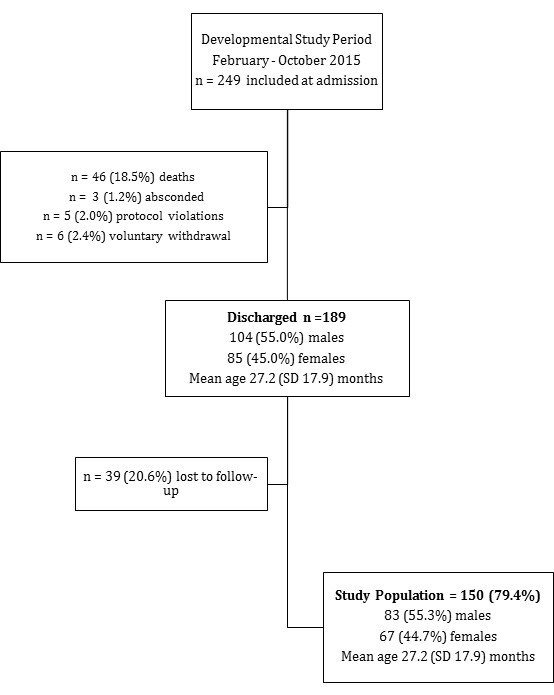
Results: 150 children (55% boys) with SAM were recruited; mean age of 27.2 months (standard deviation 17.9), 27 children (18%) had pre-existing neurodisabilities (ND) and 34 (23%) had a co-occurring human immune deficiency virus (HIV) infection. All children with SAM experienced profound delays in the gross and fine motor, language and social domains. Linear regression analysis demonstrated that children with kwashiorkor scored 0.75 standard deviations lower (95% confidence interval -1.43 to -0.07) on language MDAT domain than children with marasmus when adjusted for covariates. The prosocial behaviour score of the SDQ was low in children with SAM, indicating a lack of sensitive behaviour in social interactions.
Conclusions: Children with SAM have severe developmental delays after a hospital admission. Our results indicate that there might be a significant difference in developmental attainment between children with kwashiorkor and with marasmus. Future studies exploring longer-term outcomes and testing possible intervention strategies are urgently needed.
Conflict of interest statement
Competing interests: The authors have completed the Unified Competing Interest form at www.icmje.org/coi_disclosure.pdf (available on request from the corresponding author) and declare no conflict of interest.
Figures
References
-
- United Nations. Open working group proposal for sustainable development. Available: https://sustainabledevelopment.un.org/content/documents/1579SDGs Proposa.... Accessed: 27 October 2016.
MeSH terms
LinkOut - more resources
Full Text Sources
Medical
Miscellaneous