


The development of a localised HIV epidemic and the associated excess mortality burden in a rural area of South Africa
- PMID: 29302331
- PMCID: PMC5738674
- DOI: 10.1017/gheg.2016.3
The development of a localised HIV epidemic and the associated excess mortality burden in a rural area of South Africa
Abstract
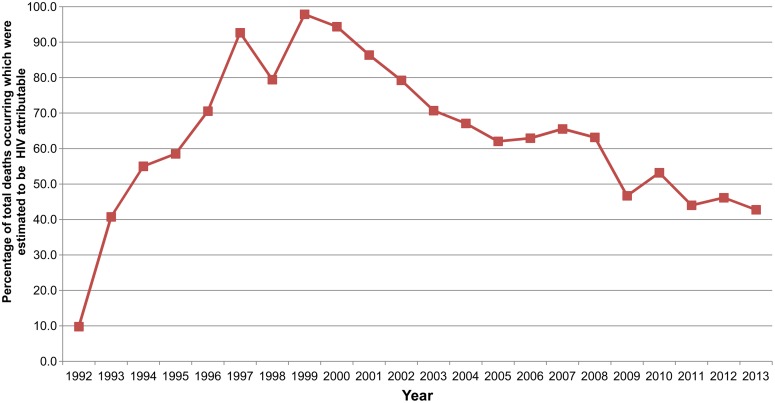
The human immunodeficiency virus (HIV) epidemic in South Africa rapidly developed into a major pandemic. Here we analyse the development of the epidemic in a rural area of the country. The data used were collected between 1992 and 2013 in a longitudinal population survey, the Agincourt Health and Demographic Surveillance Study, in the northeast of the country. Throughout the period of study mortality rates were similar in all villages, suggesting that there were multiple index cases evenly spread geographically. These were likely to have been returning migrant workers. For those aged below 39 years the HIV mortality rate was higher for women, above this age it was higher for men. This indicates the protective effect of greater access to HIV testing and treatment among older women. The recent convergence of mortality rates for Mozambicans and South Africans indicates that the former refugee population are being assimilated into the host community. More than 60% of the deaths occurring in this community between 1992 and 2013 could be attributed directly or indirectly to HIV. Recently there has been an increasing level of non-HIV mortality which has important implications for local healthcare provision. This study demonstrates how evidence from longitudinal analyses can support healthcare planning.
Keywords: AIDS; Agincourt; HIV; South Africa; epidemic; epidemiology; mortality.
Figures
References
-
- De Cock KM, Jaffe HW, Curran JW. The evolving epidemiology of HIV/AIDS. Aids 2012; 26: 1205–1213. - PubMed
-
- Piot P, Taelman H, Bila Minlangu K, Mbendi N, Ndangi K, Kalambayi K, Bridts C, Quinn T, Feinsod F, Wobin O. Acquired immunodeficiency syndrome in a heterosexual population in Zaire. Lancet 1984; 324: 65–69. - PubMed
-
- Van de Perre P, Lepage P, Kestelyn P, Hekker A, Rouvroy D, Bogaerts J, Kayihigi J, Butzler J-P, Clumeck N. Acquired immunodeficiency syndrome in Rwanda. Lancet 1984; 324: 62–65. - PubMed
-
- AVERT – History of HIV & AIDS in Africa – (http://www.avert.org/history-hiv-aids-africa.htm) – accessed 31 July 2015.
-
- Sankoh O, Arthur SS, Nyide B, Weston M. The history and impact of HIV&AIDS. A decade of INDEPTH research. HIV & AIDS Review 2014; 13: 78–84.
LinkOut - more resources
Full Text Sources
Other Literature Sources