


Environmental Risk Factors for Developing Type 2 Diabetes Mellitus: A Systematic Review
- PMID: 29304014
- PMCID: PMC5800177
- DOI: 10.3390/ijerph15010078
Environmental Risk Factors for Developing Type 2 Diabetes Mellitus: A Systematic Review
Abstract
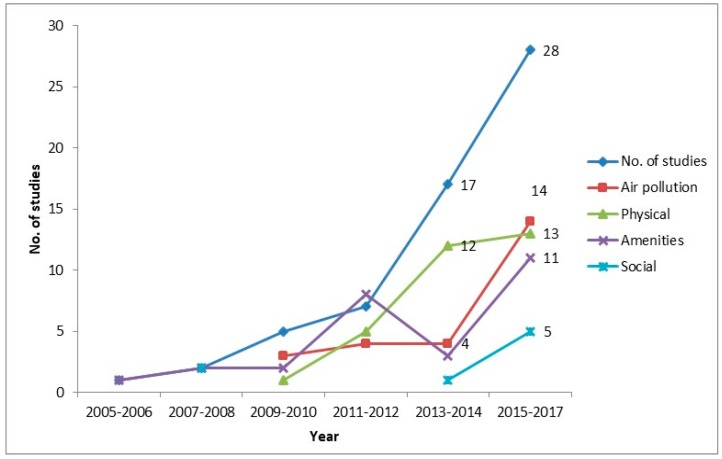
Different elements of the environment have been posited to influence type 2 diabetes mellitus (T2DM). This systematic review summarizes evidence on the environmental determinants of T2DM identified in four databases. It proposes a theoretical framework illustrating the link between environment and T2DM, and briefly discusses some methodological challenges and potential solutions, and opportunities for future research. Walkability, air pollution, food and physical activity environment and roadways proximity were the most common environmental characteristics studied. Of the more than 200 reported and extracted relationships assessed in 60 studies, 82 showed significant association in the expected direction. In general, higher levels of walkability and green space were associated with lower T2DM risk, while increased levels of noise and air pollution were associated with greater risk. Current evidence is limited in terms of volume and study quality prohibiting causal inferences. However, the evidence suggests that environmental characteristics may influence T2DM prevention, and also provides a reasonable basis for further investigation with better quality data and longitudinal studies with policy-relevant environmental measures. This pursuit of better evidence is critical to support health-orientated urban design and city planning.
Keywords: air pollution; environment; green space; noise; type 2 diabetes mellitus; walkability.
Conflict of interest statement
The authors declare no conflict of interest.
Figures


References
-
- International Diabetes Federation IDF Diabetes Atlas Seventh Edition. [(accessed on 15 November 2017)];2015 Available online: http://www.diabetesatlas.org/resources/2017-atlas.html.
-
- World Health Organization Global Report on Diabetes. [(accessed on 15 November 2017)];2016 Available online: http://www.who.int/diabetes/global-report/en/
Publication types
MeSH terms
LinkOut - more resources
Full Text Sources
Other Literature Sources
Medical
Molecular Biology Databases
