. 2018 Feb 23;69(5):1199-1206.
doi: 10.1093/jxb/erx439.

Root type matters: measurement of water uptake by seminal, crown, and lateral roots in maize

Affiliations

Root type matters: measurement of water uptake by seminal, crown, and lateral roots in maize

Mutez Ali Ahmed et al. J Exp Bot. .

Abstract

The ability of plants to take up water from the soil depends on both the root architecture and the distribution and evolution of the hydraulic conductivities among root types and along the root length. The mature maize (Zea mays L.) root system is composed of primary, seminal, and crown roots together with their respective laterals. Our understanding of root water uptake of maize is largely based on measurements of primary and seminal roots. Crown roots might have a different ability to extract water from the soil, but their hydraulic function remains unknown. The aim of this study was to measure the location of water uptake in mature maize and investigate differences between seminal, crown, and lateral roots. Neutron radiography and injections of deuterated water were used to visualize the root architecture and water transport in 5-week-old maize root systems. Water was mainly taken up by crown roots. Seminal roots and their laterals, which were the main location of water uptake in younger plants, made a minor contribution to water uptake. In contrast to younger seminal roots, crown roots were also able to take up water from their most distal segments. The greater uptake of crown roots compared with seminal roots is explained by their higher axial conductivity in the proximal parts and by the fact that they are connected to the shoot above the seminal roots, which favors the propagation of xylem tension along the crown roots. The deeper water uptake of crown roots is explained by their shorter and fewer laterals, which decreases the dissipation of water potential along the roots.


Figures
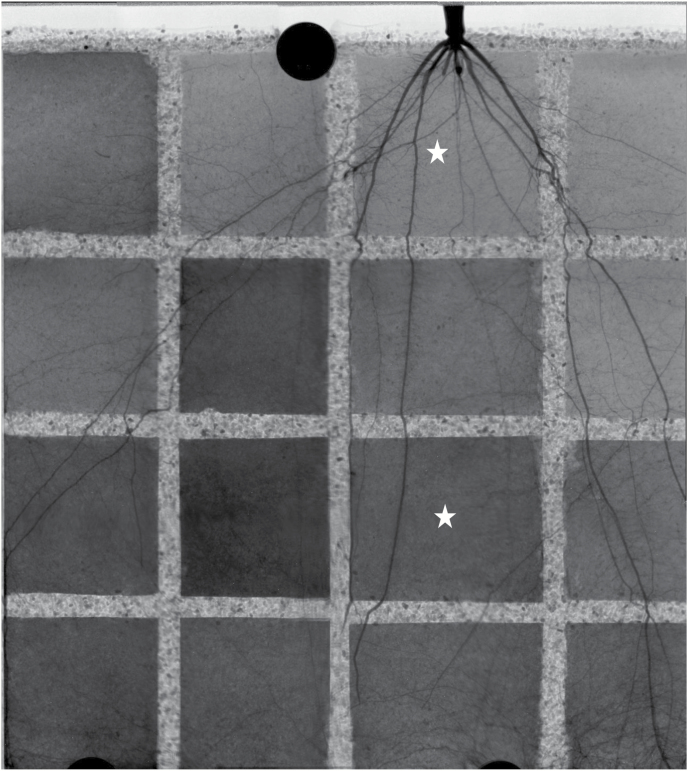
Fig. 1.
Fig. 1.
Reconstructed image of one sample before the injection of deuterated water (D2O). The figure shows the roots of 5-week-old maize (Zea mays L) and the soil water distribution. The gray scales are proportional to the water content. The darker the image, the higher the soil water content. This image was obtained from stitching together 12 radiographs with an original field of view of 13.3 × 16 cm. The stars show two compartments in which we injected D2O and monitored its transport into soil and roots.
Fig. 2.
Fig. 2.
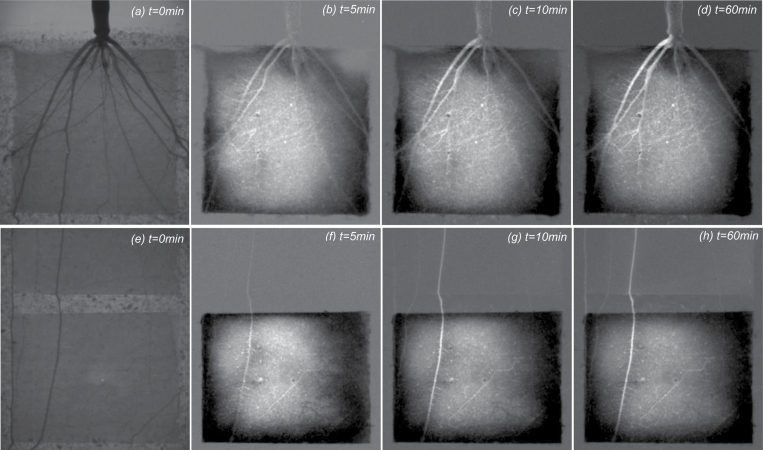
Neutron radiographs of deuterated water (D2O) injection in the upper (a–d) and lower (e–h) compartment during the day. (a) The sample before injection (t=0). (b–d) The difference between the actual radiograph at time t and that before injection (t=0). Brighter colors in (b–d) indicate a lower neutron attenuation and higher D2O:H2O ratio. Conversely, the dark areas show accumulation of H2O after D2O injection. After injection, the crown roots turned bright immediately, which indicated that D2O had entered them faster than the seminal roots and their laterals. (e) The sample before injection. (f–h)The difference between the actual radiograph at time t and that before injection (t=0). The compartment included the distal parts of a crown root where the laterals had not emerged yet. In contrast to the seminal roots, the crown roots were able to take up water from their most distal part.
Fig. 3.
Fig. 3.
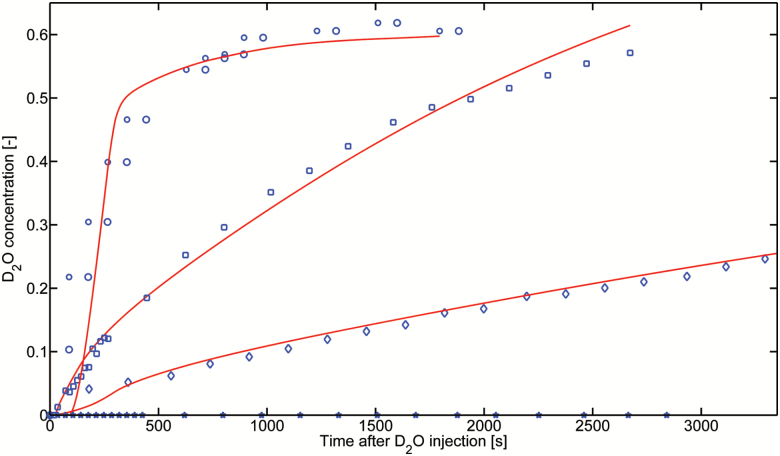
Increase of D2O concentration inside the seminal root segments, proximal and distal segments of crown roots, and their laterals measured during the night-time. The concentrations were averaged along the segments immersed in D2O. The experiments were simulated, solving numerically the model illustrated in Supplementary Fig. S1 at JXB online assuming no convection. The best fits are plotted as solid lines. (This figure is available in color at JXB online.)
Fig. 4.
Fig. 4.
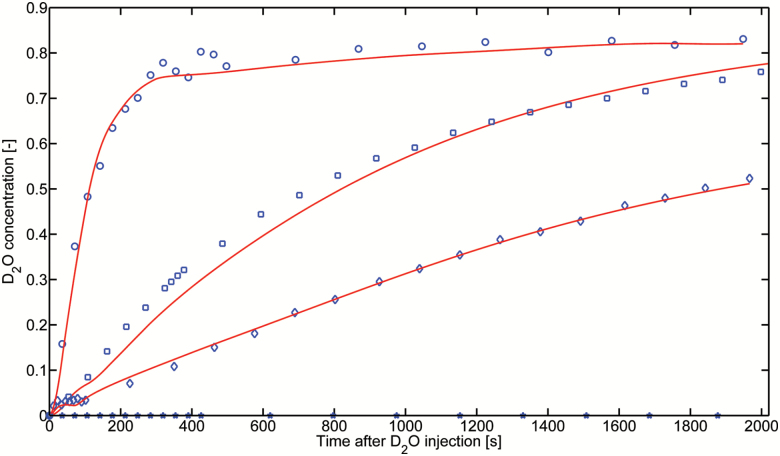
Increase of D2O concentration inside the proximal and distal segments of crown and lateral roots during the daytime. The concentrations were averaged along the root segments immersed in D2O. The concentrations were fitted assuming that the diffusion coefficient was constant during the day and night and using the convective fluxes as fitting parameters (see text for details). The best fits are plotted as solid lines. (This figure is available in color at JXB online.)
Fig. 5.
Fig. 5.
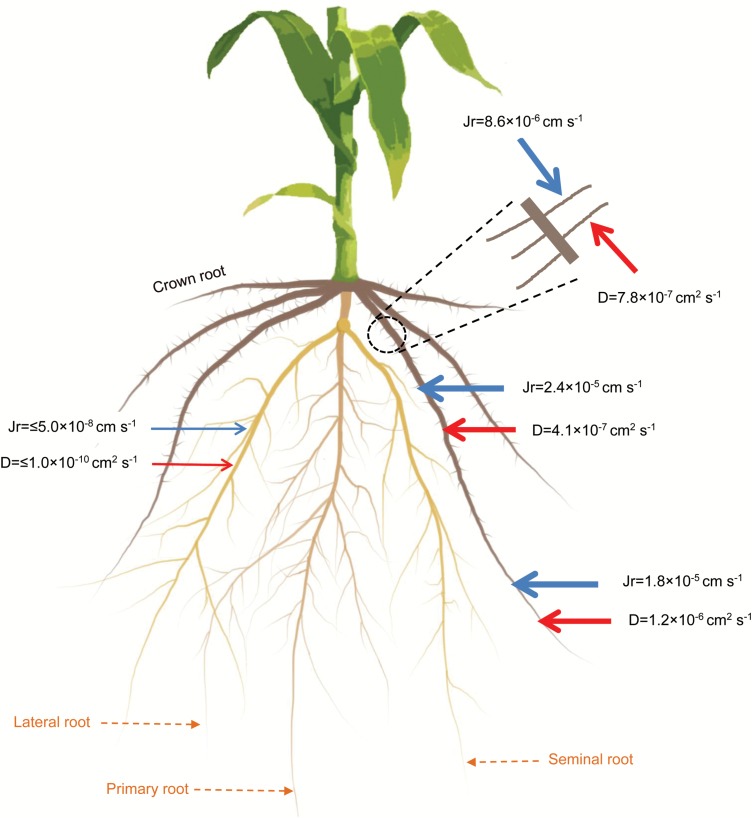
Summary of the results. The figure shows 5-week-old maize with primary, seminal, crown, and lateral roots. The red and blue arrows correspond to the diffusion coefficient and radial fluxes of the different root segments, respectively.
Fig. 6.
Fig. 6.
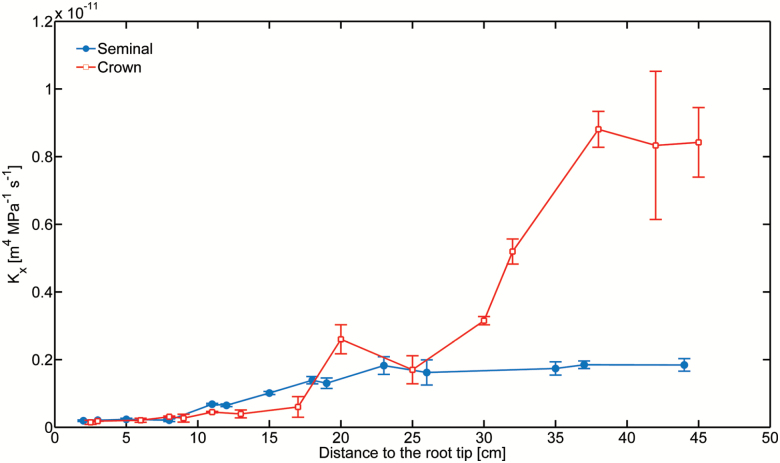
The axial hydraulic conductivity of seminal and crown roots in 5-week-old maize. The conductivities were similar in the most distal (younger) segments. Crown roots started to show higher conductivity at a distance of 18–30 cm from the root tip. Further away from the root tip (distance >30 cm), the crown roots were increasingly more conductive than the seminals. Data represent the mean ±SD (n=7). (This figure is available in color at JXB online.)

References

    1. Ahmed MA, Zarebanadkouki M, Kaestner A, Carminati A. 2016. Measurements of water uptake of maize roots: the key function of lateral roots. Plant and Soil 398, 59–77.
    1. Bishopp A, Lynch JP. 2015. The hidden half of crop yields. Nature Plants 1, 15117. - PubMed
    1. Bramley H, Turner NC, Turner DW, Tyerman SD. 2009. Roles of morphology, anatomy, and aquaporins in determining contrasting hydraulic behavior of roots. Plant Physiology 150, 348–364. - PMC - PubMed
    1. Caldeira CF, Jeanguenin L, Chaumont F, Tardieu F. 2014. Circadian rhythms of hydraulic conductance and growth are enhanced by drought and improve plant performance. Nature Communications 5, 5365. - PMC - PubMed
    1. Chaumont F, Tyerman SD. 2014. Aquaporins: highly regulated channels controlling plant water relations. Plant Physiology 164, 1600–1618. - PMC - PubMed

Publication types