. 2018 Jan 4;102(1):156-174.
doi: 10.1016/j.ajhg.2017.12.008.

Genomic DNA Methylation Signatures Enable Concurrent Diagnosis and Clinical Genetic Variant Classification in Neurodevelopmental Syndromes

Affiliations

Genomic DNA Methylation Signatures Enable Concurrent Diagnosis and Clinical Genetic Variant Classification in Neurodevelopmental Syndromes

Erfan Aref-Eshghi et al. Am J Hum Genet. .

Abstract

Pediatric developmental syndromes present with systemic, complex, and often overlapping clinical features that are not infrequently a consequence of Mendelian inheritance of mutations in genes involved in DNA methylation, establishment of histone modifications, and chromatin remodeling (the "epigenetic machinery"). The mechanistic cross-talk between histone modification and DNA methylation suggests that these syndromes might be expected to display specific DNA methylation signatures that are a reflection of those primary errors associated with chromatin dysregulation. Given the interrelated functions of these chromatin regulatory proteins, we sought to identify DNA methylation epi-signatures that could provide syndrome-specific biomarkers to complement standard clinical diagnostics. In the present study, we examined peripheral blood samples from a large cohort of individuals encompassing 14 Mendelian disorders displaying mutations in the genes encoding proteins of the epigenetic machinery. We demonstrated that specific but partially overlapping DNA methylation signatures are associated with many of these conditions. The degree of overlap among these epi-signatures is minimal, further suggesting that, consistent with the initial event, the downstream changes are unique to every syndrome. In addition, by combining these epi-signatures, we have demonstrated that a machine learning tool can be built to concurrently screen for multiple syndromes with high sensitivity and specificity, and we highlight the utility of this tool in solving ambiguous case subjects presenting with variants of unknown significance, along with its ability to generate accurate predictions for subjects presenting with the overlapping clinical and molecular features associated with the disruption of the epigenetic machinery.

Keywords: ATRX syndrome; CHARGE syndrome; Claes-Jensen syndrome; Floating Harbor syndrome; Kabuki syndrome; Sotos syndrome; epigenomic machinery; machine learning; molecular diagnosis; pediatric developmental disorders.


Figures

Figure 1
Figure 1
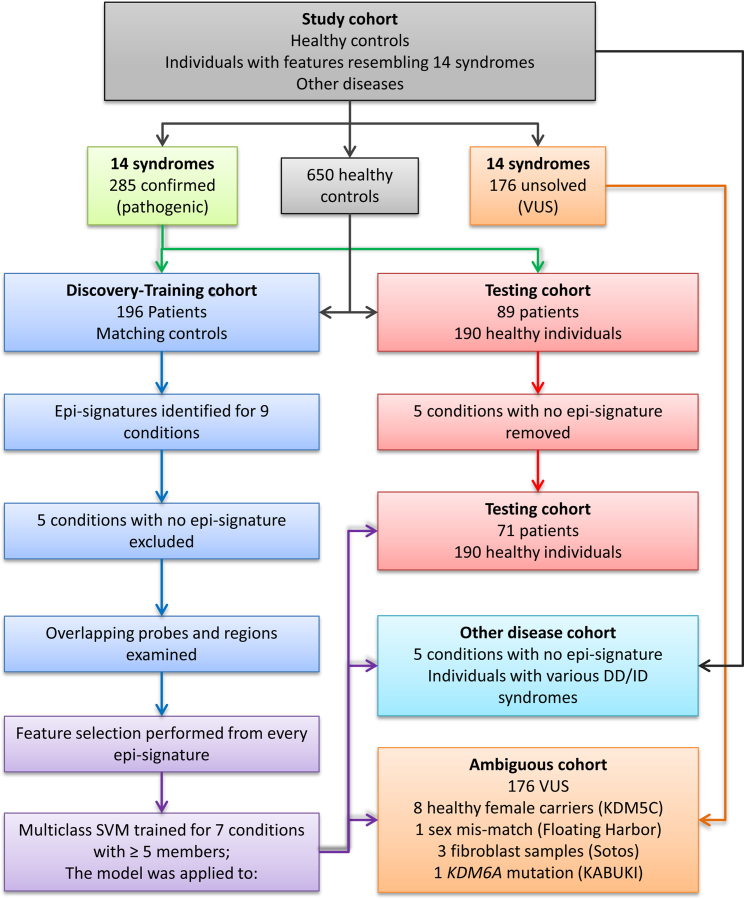
Flowchart of the Study
Figure 2
Figure 2
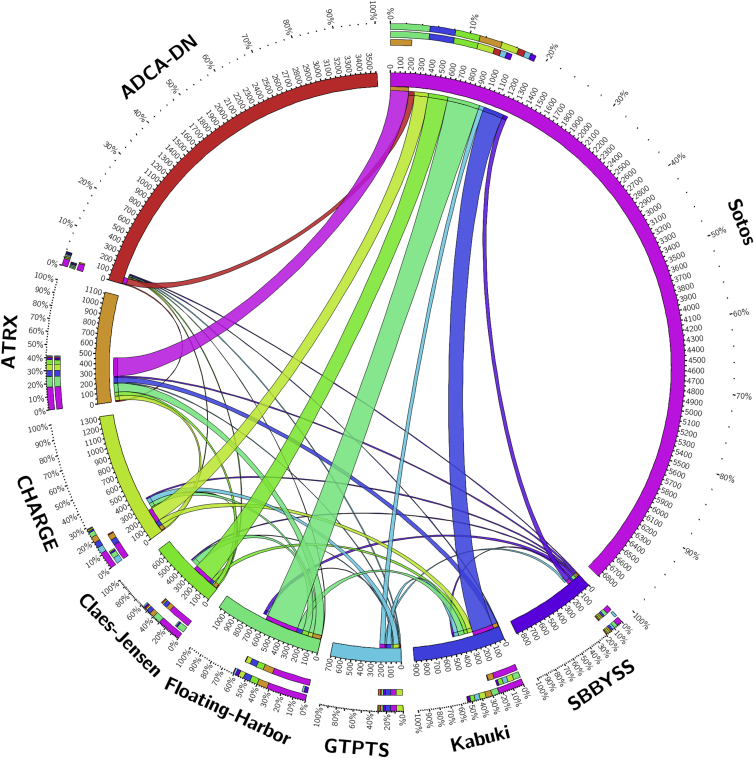
Quantity of Probes from the Epi-signatures of Every Nine Conditions that Are Shared with Each Other Thickness of the bonds represents the number of the shared probes by every two diseases as shown by digits on the circumference of the plot. This plot does not visualize the 217 probes that are shared by more than two conditions.
Figure 3
Figure 3
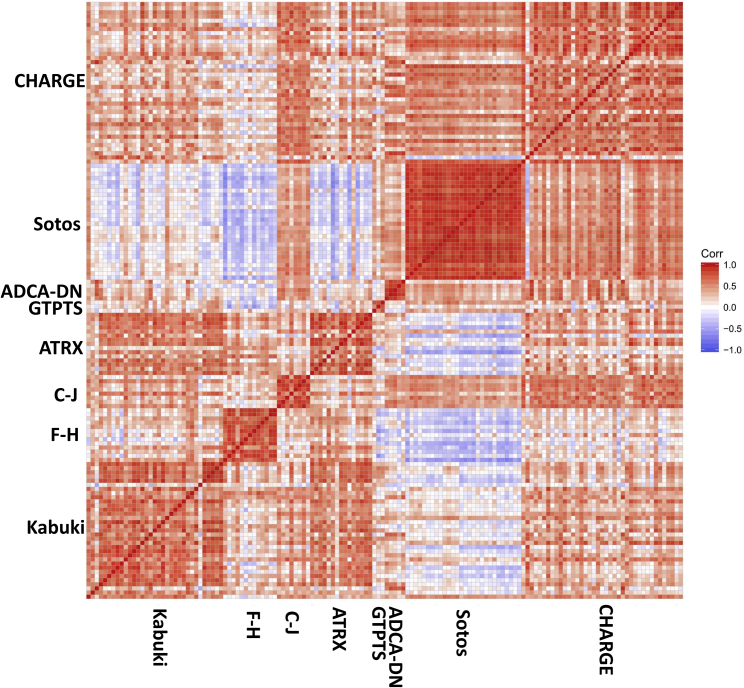
Pairwise Correlation between Samples with Different Conditions using the Methylation Values of Ten Probes that Are Shared by More than Three Conditions Red represents positive and blue represents negative correlation. Every visible square represents the correlations of one subject on x axis with its correspondence on y axis. Abbreviations: F-H, Floating-Harbor; C-J, Cales-Jensen
Figure 4
Figure 4
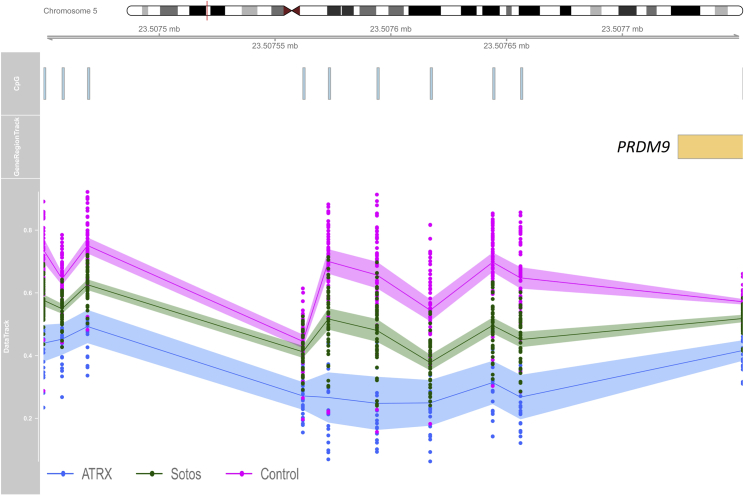
Hypomethylation of the 5′ UTR of PRDM9 in Both Sotos-Affected and ATRX-Affected Subjects The figure illustrates a 302-base pair region containing 10 CpG probes overlapping 5′ UTR of PRDM9. From top to bottom: chromosome ideogram, CpG probes, gene region, and methylation level data. Blue, ATRX; green, Sotos; pink, controls; line, average methylation; shadow, 95% confidence interval; dots, methylation values from every single sample (0-1).
Figure 5
Figure 5
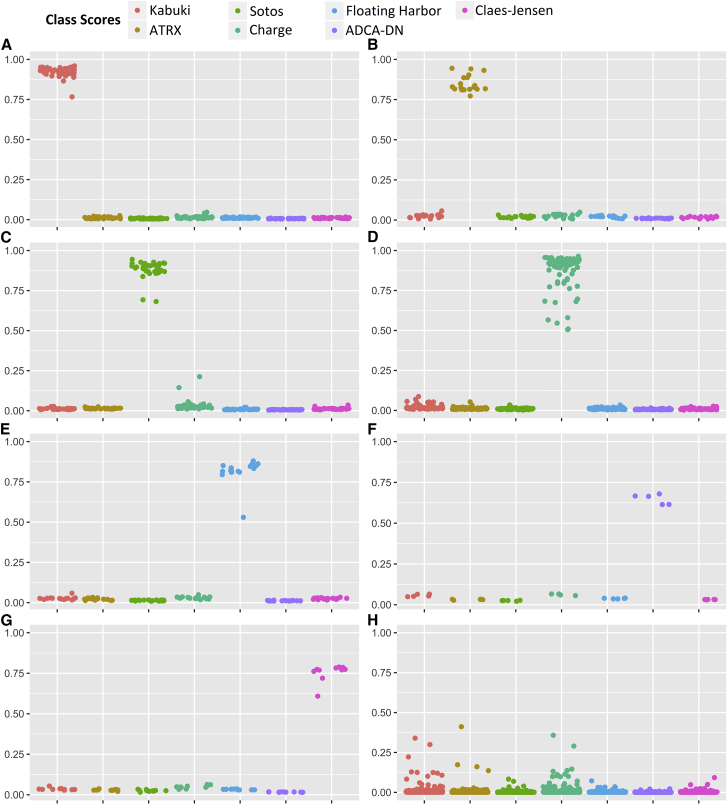
Probability Scores Generated by the Classification Model A 7-disease SVM classifier concurrently generates seven scores for every subject as the probability of having a DNA methylation profile similar to any of the seven diseases with a confirmed DNA methylation signature. y axis represents scores 0-1, with higher scores indicating a higher chance of carrying a methylation profile related to any of the seven conditions. x axis represents the seven classification scores generated for the same group of tested subjects. These include the probability of having a similar DNA methylation profile to Kabuki syndrome, ATRX, Sotos syndrome, CHARGE syndrome, Floating-Harbor syndrome, ADCA-DN, and Claes-Jensen, respectively. By default, the SVM classifier defines a cut-off of 0.5 for predicting the class; however, the vast majority of the tested individuals received a score close to 0 or 1. Therefore, for the purpose of better visualization, the points are jittered. Every point represents the probability score received for a single sample. This figure represents scores obtained by both the subjects in the training and testing cohorts. Shown are probability scores for belonging to any of the seven classes for: 44 subjects with Kabuki syndrome (A); 19 subjects with ATRX syndrome (B), 38 subjects with Sotos syndrome (C), 79 subjects with CHARGE syndrome (D), 17 subjects with Floating-Harbor syndrome (E), 5 subjects with ADCA-DN (F), and 10 subjects with intellectual disability due to KDM5C (G). The last panel (H) shows the probabilities of belonging to any of the seven disease groups for 436 subjects with other conditions presenting with DD/ID including diseases of epigenomic machinery for which no epi-signature was found, multiple chromosomal aberrations, Down syndrome, various forms of RASopathies, autism spectrum disorders, and imprinting defect conditions, together with 190 healthy control subjects which were not used in any previous step in the study.
Figure 6
Figure 6
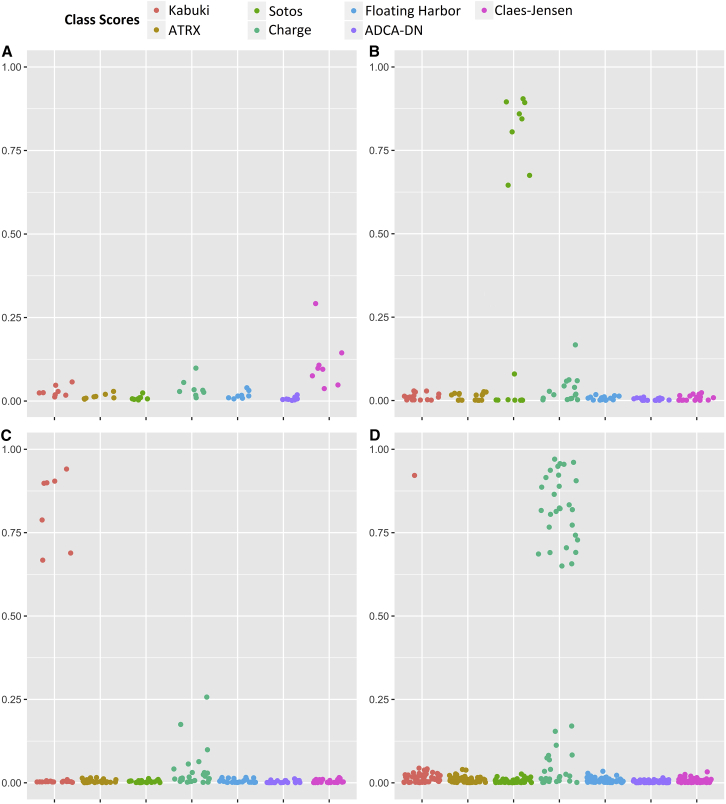
Probability Scores Generated by the Classification Model for Case Subjects with Uncertain Diagnosis Carrying Benign or VUS Variants and Healthy Carriers A 7-disease SVM classifier concurrently generates seven scores for every subject as the probability of having a DNA methylation profile similar to any of the seven diseases with a confirmed DNA methylation signature. y axis represents scores 0-1, with higher scores indicating a higher chance of carrying a methylation profile related to any of the seven conditions. x axis represents the seven classification scores generated for the same group of tested subjects. These include the probability of having a similar DNA methylation profile to Kabuki syndrome, ATRX, Sotos syndrome, CHARGE syndrome, Floating-Harbor syndrome, ADCA-DN, and Claes-Jensen, respectively. Every point represents the probability score obtained for a single sample. Shown are probability scores for belonging to any of the seven classes for: 8 healthy female carriers with pathogenic mutations in KDM5C (A), 16 subjects with VUS variants in NSD1 (B), 36 subjects with VUS and benign variants in KMT2D (C), and 55 subjects with similar features to CHARGE syndrome but no sequence data available or with VUS variants in CHD7 (D).

References

    1. Fahrner J.A., Bjornsson H.T. Mendelian disorders of the epigenetic machinery: tipping the balance of chromatin states. Annu. Rev. Genomics Hum. Genet. 2014;15:269–293. - PMC - PubMed
    1. Bjornsson H.T. The Mendelian disorders of the epigenetic machinery. Genome Res. 2015;25:1473–1481. - PMC - PubMed
    1. Berdasco M., Esteller M. Genetic syndromes caused by mutations in epigenetic genes. Hum. Genet. 2013;132:359–383. - PubMed
    1. Cedar H., Bergman Y. Linking DNA methylation and histone modification: patterns and paradigms. Nat. Rev. Genet. 2009;10:295–304. - PubMed
    1. Hood R.L., Schenkel L.C., Nikkel S.M., Ainsworth P.J., Pare G., Boycott K.M., Bulman D.E., Sadikovic B. The defining DNA methylation signature of Floating-Harbor syndrome. Sci. Rep. 2016;6:38803. - PMC - PubMed

Publication types

Substances

LinkOut - more resources