


New national outcome data on fresh versus cryopreserved donor oocytes
- PMID: 29304839
- PMCID: PMC5755289
- DOI: 10.1186/s13048-017-0378-4
New national outcome data on fresh versus cryopreserved donor oocytes
Abstract
Background: Improvements in oocyte cryopreservation techniques and establishment of cryopreserved donor oocyte banks have led to improved access to and lower cost of donor oocytes, upending the traditional practice of fresh oocyte donation. The objective of this study was to examine national trends in utilization and live birth rates with fresh versus cryopreserved donor oocytes.
Methods: A retrospective analysis of 2013 through 2015 aggregate U.S. national data reported by the Society for Assisted Reproductive Technology which included 30,160 IVF cycles with either fresh or cryopreserved donor oocytes was performed.
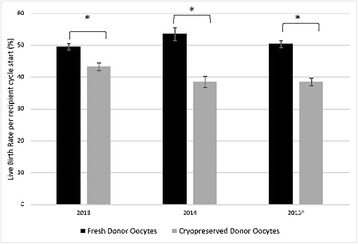
Results: During the study period utilization of fresh oocyte donations rapidly declined by 32.9%, while cryopreserved oocyte donation increased by 44.4%. Fresh donor oocytes produced significantly higher live birth rates per recipient cycle start than cryopreserved donor oocytes (51.1% vs. 39.7%). Over the three-year study period fresh donor oocytes produced stable live birth rates per recipient cycle start while those with cryopreserved oocytes significantly declined year-by-year.
Conclusion: Despite rising popularity of cryopreserved donor oocytes, prospective patients should be counselled that fresh donor oocytes still represent standard of care due to higher live birth rates.
Keywords: Cryopreservation; In vitro fertilization; Oocyte donation; Vitrification.
Conflict of interest statement
Ethics approval and consent to participate
Because this study investigated only publicly available anonymized data, it received expedited IRB approval.
Consent for publication
Not applicable.
Competing interests
V.A.K. previously served as a consultant to the CDC. The Center for Human Reproduction (CHR) annually routinely reports IVF outcome data to CDC and SART. N.G., D.H.B., and V.A.K. are listed as co-owners of several already awarded and still pending U.S. patents, none related to the topic of this manuscript. N.G. is a shareholder in Fertility Nutraceuticals, LLC and owner of the CHR. N.G. and D.H.B. receive patent royalties from Fertility Nutraceuticals, LLC. N.G., and D.H.B have received research support, travel funding and lecture fees from various Pharma and medical device companies, none, in any way related to this manuscript.
Publisher’s Note
Springer Nature remains neutral with regard to jurisdictional claims in published maps and institutional affiliations.
Figures
References
-
- Society for Assisted Reproductive Technology, National Data Summary [Internet]. [cited 2017 May 10]. Available from: https://www.sartcorsonline.com/rptCSR_PublicMultYear.aspx?reportingYear=...
-
- Kushnir VA, Darmon SK, Shapiro AJ, Albertini DF, Barad DH, Gleicher N. Utilization of third-party in vitro fertilization in the United States. Am J Obstet Gynecol. 2016;216(3):266–2e1. - PubMed
MeSH terms
Grants and funding
LinkOut - more resources
Full Text Sources
Other Literature Sources
Medical
