


Synonymous Codon Usage Controls Various Molecular Aspects
- PMID: 29307137
- PMCID: PMC5769864
- DOI: 10.5808/GI.2017.15.4.123
Synonymous Codon Usage Controls Various Molecular Aspects
Abstract
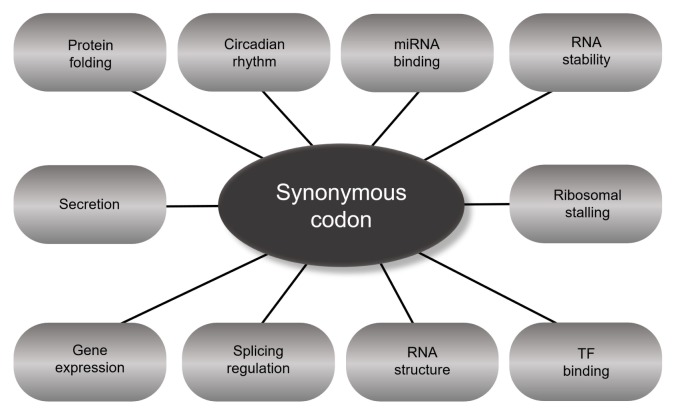
Synonymous sites are generally considered to be functionally neutral. However, there are recent contradictory findings suggesting that synonymous alleles might have functional roles in various molecular aspects. For instance, a recent study demonstrated that synonymous single nucleotide polymorphisms have a similar effect size as nonsynonymous single nucleotide polymorphisms in human disease association studies. Researchers have recognized synonymous codon usage bias (SCUB) in the genomes of almost all species and have investigated whether SCUB is due to random nucleotide compositional bias or to natural selection of any functional exposure generated by synonymous mutations. One of the most prominent observations on the non-neutrality of synonymous codons is the correlation between SCUB and levels of gene expression, such that highly expressed genes tend to have a higher preference toward so-called optimal codons than lowly expressed genes. In relation, it is known that amounts of cognate tRNAs that bind to optimal codons are significantly higher than the amounts of cognate tRNAs that bind to non-optimal codons in genomes. In the present paper, we review various functions that synonymous codons might have other than regulating expression levels.
Keywords: optimal codon; single nucleotide polymorphism; synonymous codon usage bias.
Figures
References
-
- Barreiro LB, Laval G, Quach H, Patin E, Quintana-Murci L. Natural selection has driven population differentiation in modern humans. Nat Genet. 2008;40:340–345. - PubMed
-
- Nei M, Gojobori T. Simple methods for estimating the numbers of synonymous and nonsynonymous nucleotide substitutions. Mol Biol Evol. 1986;3:418–426. - PubMed
-
- King JL, Jukes TH. Non-Darwinian evolution. Science. 1969;164:788–798. - PubMed
-
- Yang Z. PAML 4: phylogenetic analysis by maximum likelihood. Mol Biol Evol. 2007;24:1586–1591. - PubMed
Publication types
LinkOut - more resources
Full Text Sources
Other Literature Sources