


Associations between fast food and physical activity environments and adiposity in mid-life: cross-sectional, observational evidence from UK Biobank
- PMID: 29307385
- PMCID: PMC5764749
- DOI: 10.1016/S2468-2667(17)30212-8
Associations between fast food and physical activity environments and adiposity in mid-life: cross-sectional, observational evidence from UK Biobank
Abstract
Background: The built environment might be associated with development of obesity and related disorders. We examined whether neighbourhood exposure to fast-food outlets and physical activity facilities were associated with adiposity in UK adults.
Methods: We used cross-sectional observational data from UK Biobank. Participants were aged 40-70 years and attended 21 assessment centres between 2006 and 2010. Using linked data on environments around each participant's residential address, we examined whether density of physical activity facilities and proximity to fast-food outlets were associated with waist circumference, body-mass index (BMI), and body fat percentage. We used multilevel linear regression models adjusted for potential confounders, and conducted several sensitivity analyses.
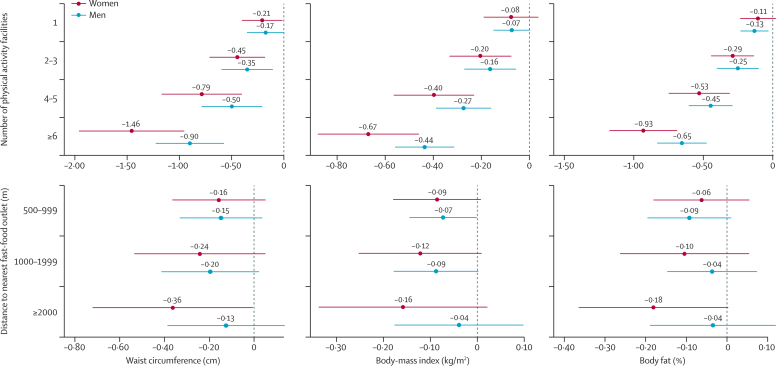
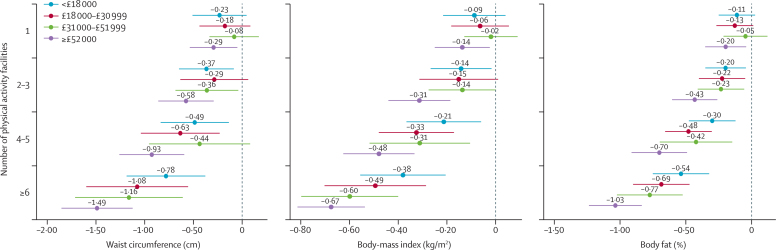
Findings: Complete case sample sizes were 401 917 (waist circumference models), 401 435 (BMI), and 395 640 (body fat percentage). Greater density of physical activity facilities within 1000 m of home was independently associated with smaller waist circumference and lower BMI and body fat percentage. Compared with people with no nearby facilities, those with at least six facilities close to home had 1·22 cm smaller waist circumference (95% CI -1·64 to -0·80), 0·57 kg/m2 lower BMI (-0·74 to -0·39), and 0·81 percentage points lower body fat (-1·03 to -0·59). Living further from a fast-food outlet was weakly associated with waist circumference and BMI, mostly among women. Compared with people living fewer than 500 m from a fast-food outlet, those living at least 2000 m away had 0·26 cm smaller waist circumference (-0·52 to 0·01).
Interpretation: This study shows strong associations between high densities of physical activity facilities and lower adiposity for adults in mid-life. We observed weaker associations for access to fast food, but these are likely to be underestimated owing to limitations of the food environment measure. Policy makers should consider interventions aimed at tackling the obesogenic built environment.
Funding: Commonwealth Scholarship Commission, Wellcome Trust Institutional Strategic Support Fund.
Copyright © 2018 The Author(s). Published by Elsevier Ltd. This is an Open Access article under the CC BY 4.0 license. Published by Elsevier Ltd.. All rights reserved.
Figures
Comment in
-
The built environment and obesity in UK Biobank: right project, wrong data?Lancet Public Health. 2018 Jan;3(1):e4-e5. doi: 10.1016/S2468-2667(17)30237-2. Epub 2017 Dec 13. Lancet Public Health. 2018. PMID: 29307387 No abstract available.
References
-
- Dobbs R, Sawers C, Thompson F. McKinsey & Company; London: 2014. Overcoming obesity: an initial economic analysis.
-
- The Lancet Diabetes & Endocrinology Urbanisation, inequality, and non-communicable disease risk. Lancet Diabetes Endocrinol. 2017;5:313. - PubMed
-
- Black JL, Macinko J. Neighborhoods and obesity. Nutr Rev. 2008;66:2–20. - PubMed
Publication types
MeSH terms
Grants and funding
LinkOut - more resources
Full Text Sources
Other Literature Sources
