Review
. 2018 Apr:517:157-163.
doi: 10.1016/j.virol.2017.12.024. Epub 2018 Jan 4.

An "Old" protein with a new story: Coronavirus endoribonuclease is important for evading host antiviral defenses

Affiliations
Review

An "Old" protein with a new story: Coronavirus endoribonuclease is important for evading host antiviral defenses

Xufang Deng et al. Virology. 2018 Apr.

Abstract

Here we review the evolving story of the coronavirus endoribonuclease (EndoU). Coronavirus EndoU is encoded within the sequence of nonstructural protein (nsp) 15, which was initially identified as a component of the viral replication complex. Biochemical and structural studies revealed the enzymatic nature of nsp15/EndoU, which was postulated to be essential for the unique replication cycle of viruses in the order Nidovirales. However, the role of nsp15 in coronavirus replication was enigmatic as EndoU-deficient coronaviruses were viable and replicated to near wild-type virus levels in fibroblast cells. A breakthrough in our understanding of the role of EndoU was revealed in recent studies, which showed that EndoU mediates the evasion of viral double-stranded RNA recognition by host sensors in macrophages. This new discovery of nsp15/EndoU function leads to new opportunities for investigating how a viral EndoU contributes to pathogenesis and exploiting this enzyme for therapeutics and vaccine design against pathogenic coronaviruses.

Keywords: Antiviral defense; Coronavirus; Double-stranded RNA; Endoribonuclease; Host recognition; Interferon; Nsp15.


Figures

Fig. 1
Fig. 1
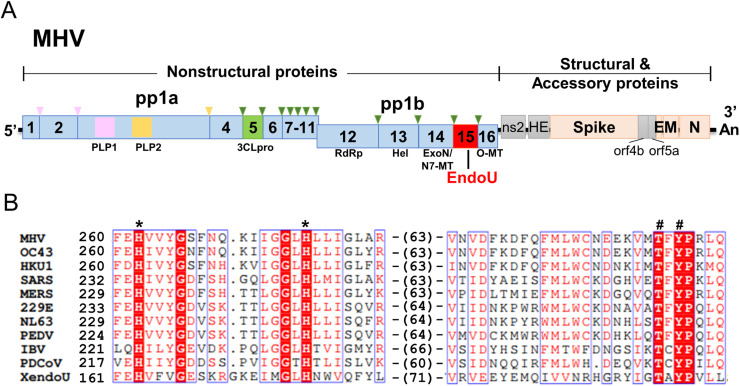
Coronavirus nsp15 is an endoribonuclease. (A) Schematic diagram of MHV-A59 genome. Triangles indicate cleavage sites recognized by three viral proteases: papain-like proteases PLP1 (pink) and PLP2 (yellow), and 3C-like protease (3CLpro, green). RdRp, RNA-dependent RNA polymerase; Hel, helicase; ExoN, exoribonuclease; N7-MT, guanosine-N7-methyltransferase; EndoU, endoribonuclease; O-MT, O-methyltransferase; HE, Hemagglutinin-Esterase; E, envelope; M, matrix; N, nucleocapsid. (B) Alignment of the core domains of CoV EndoU and XendoU of X. laevis. Putative residues involved in catalysis (*) or substrate specificity (#). Abbreviations: MHV, mouse hepatitis virus; OC43, human CoV OC43; HKU1, human CoV HKU1; SARS, severe acute respiratory syndrome CoV; 229E, human CoV 229E; NL63, human CoV NL63; PEDV, porcine epidemic diarrhea virus; IBV, infectious bronchitis virus; PDCoV, porcine delta CoV; XendU, endoribonuclease of X. laevis.
Fig. 2
Fig. 2
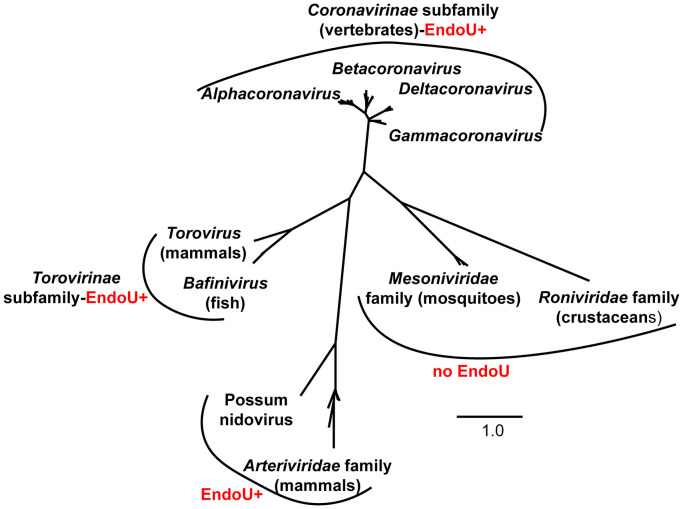
Virus-encoded endoribonuclease is a genetic signature of nidoviruses that infect vertebrates. A phylogenic tree of 32 representative nidoviruses was generated based on a conserved region of RdRp (Sequnces and Genbank Assession numbers are available upon request). Multiple sequence alignment and phylogeny analyses were conducted with the programs MUSCLE and PhyML, respectively (available at http://www.phylogeny.fr/). The phylogenic tree was generated using Dendroscope software version 3 with default parameters.
Fig. 3
Fig. 3
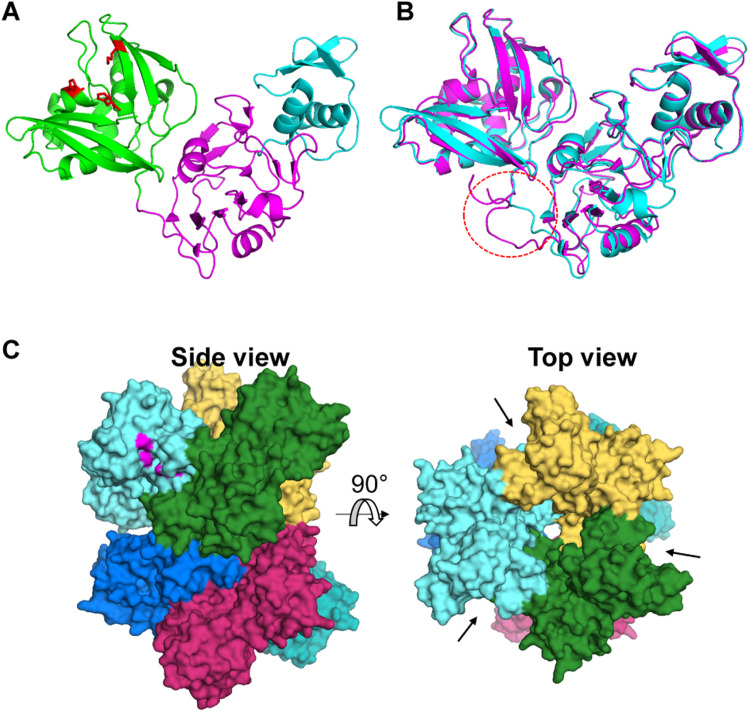
Structural features of nsp15. (A) The three domains of the SARS-CoV nsp15 monomer (Protein Data Bank code: 2H85): N-terminal domain (cyan), middle domain (magenta), and C-terminal domain (green). Catalytic residues are shown in red. (B) Structural comparison of SARS-CoV nsp15 (cyan) and MHV nsp15 (magenta, 2GTH). A flexible loop encoded by the packaging signal sequence of MHV nsp15 is circled. (C) Hexamer of SARS-CoV nsp15 (2RHB). The catalytic residues of one monomer are highlighted in magenta (left); the catalytic pockets of a hexamer are indicated by arrows (right).

References

    1. Athmer J. In situ tagged nsp15 reveals interactions with coronavirus replication/transcription complex-associated proteins. MBio. 2017;8(1) (e02320-16) - PMC - PubMed
    1. Barber G. The dsRNA-dependent protein kinase, PKR and cell death. Cell Death Differ. 2005;12:563–570. - PubMed
    1. Becares M. Mutagenesis of coronavirus nsp14 reveals its potential role in modulation of the innate immune response. J. Virol. 2016;90(11):5399–5414. - PMC - PubMed
    1. Beura L.K. Porcine reproductive and respiratory syndrome virus nonstructural protein 1beta modulates host innate immune response by antagonizing IRF3 activation. J. Virol. 2010;84(3):1574–1584. - PMC - PubMed
    1. Bhardwaj K. Structural and functional analyses of the severe acute respiratory syndrome coronavirus endoribonuclease Nsp15. J. Biol. Chem. 2008;283(6):3655–3664. - PMC - PubMed

Publication types

MeSH terms

Substances