


Thrombocytopenia in Critically Ill Patients: Clinical and Laboratorial Behavior and Its Correlation with Short-term Outcome during Hospitalization
- PMID: 29307969
- PMCID: PMC5752797
- DOI: 10.4103/ijccm.IJCCM_279_17
Thrombocytopenia in Critically Ill Patients: Clinical and Laboratorial Behavior and Its Correlation with Short-term Outcome during Hospitalization
Abstract
Background: Thrombocytopenia, being among the most common laboratory abnormality, found in Intensive Care Unit (ICU) patients is commonly associated with sepsis and disseminated intravascular coagulation. Declining platelet counts are associated with higher mortality rates. Thus, thrombocytopenia can be used as a prognostic marker in critically ill patients.
Methodology: A prospective observational study was conducted on patients fulfilling the inclusion criteria and were evaluated for complete medical history, clinical, and laboratorial examination. Short-term outcome of the patient was correlated with thrombocytopenia.
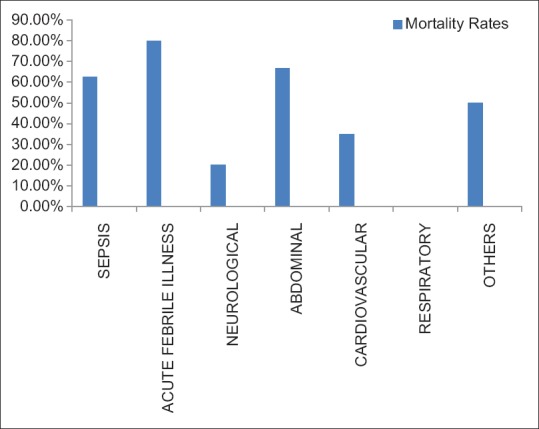
Results: The incidence of thrombocytopenia in ICU patients was 37.57%, and mortality was 44%. Higher mortality rate was found among patients with acute febrile illnesses, respiratory diseases, and sepsis (P = 0.08, 0.22, 0.41 respectively). The mortality was higher in patients with platelet counts <100,000/μl (P = 0.0008) and whose platelet levels declined on day 3 or 5 (P = 0.0001).
Conclusions: Low as well as declining platelet counts are markers of severity of critical patients and are directly related to prognosis and mortality of patients in ICU.
Keywords: Critically ill patients; prognostic marker; thrombocytopenia.
Conflict of interest statement
There are no conflicts of interest.
Figures
References
-
- Elgohary TS, Zaghla HE, Azab AM, Hagag T. Role of thrombocytopenia as an independent prognostic marker in the critically ill patients with multiorganfailure. Med J Cairo Univ. 2011;79:1–9.
-
- Chakraverty R, Davidson S, Peggs K, Stross P, Garrard C, Littlewood TJ, et al. The incidence and cause of coagulopathies in an intensive care population. Br J Haematol. 1996;93:460–3. - PubMed
-
- Stéphan F, Hollande J, Richard O, Cheffi A, Maier-Redelsperger M, Flahault A, et al. Thrombocytopenia in a surgical ICU. Chest. 1999;115:1363–70. - PubMed
-
- Crowther MA, Cook DJ, Meade MO, Griffith LE, Guyatt GH, Arnold DM, et al. Thrombocytopenia in medical-surgical critically ill patients: Prevalence, incidence, and risk factors. J Crit Care. 2005;20:348–53. - PubMed
-
- Akca S, Haji-Michael P, de Mendonça A, Suter P, Levi M, Vincent JL, et al. Time course of platelet counts in critically ill patients. Crit Care Med. 2002;30:753–6. - PubMed
LinkOut - more resources
Full Text Sources
Other Literature Sources