


Etiology of chronic urticaria: the Ecuadorian experience
- PMID: 29308115
- PMCID: PMC5753451
- DOI: 10.1186/s40413-017-0181-0
Etiology of chronic urticaria: the Ecuadorian experience
Abstract
Background: The purpose of this study was to identify chronic urticaria (CU) etiologies and treatment modalities in Ecuador. We propose that the sample distribution fits the expected one, and that there is an association between the etiology and its treatment.
Methods: We performed a retrospective study involving 112 patients diagnosed with CU using a Checklist for a complete chronic urticaria medical history. Demographic and clinical variables were collected. The etiology of CU was classified using the EAACI/GA2LEN/EDF/WAO guideline. Descriptive analyses were performed for demographical and clinical variables. Chi square tests were applied to analyze the fit of distribution and the independence of variables. P values less than 0.05 were considered significant.
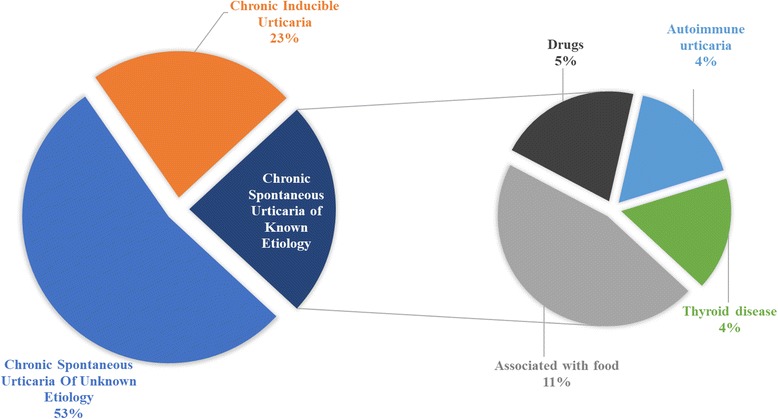
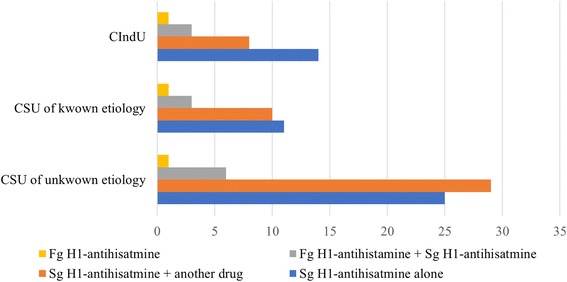
Results: Among all the patients, 76.8% were diagnosed with chronic spontaneous urticaria (CSU), of which 22.3% had a known etiology or possible exacerbating condition. Food allergy was identified as the most common accompanying condition in patients with CSU (10.7%) (p < 0.01).. On the other hand, 23.2% inducible urticarias (CIndU) were indentified; dermographism was the most common (10.7%) (p < 0.01).Regarding treatment regimens, sg-H1-antihistamines alone represented the highest proportion (44.6%). The combination of any H1-antihistamine plus other drug was a close second (42.0%) (p < 0.01). Almost 48% of CSUs of unknown etiology were treated with any antihistamine plus another drug. In patients with known etiology, sg-antihistamines alone (44.0%) was the most common management. In addition, 53.8% of CIndUs were treated with sg-antihistamines alone. Though, these associations were not statistically significant.
Conclusion: CSU is the most frequent subtype of CU. Modern non-sedating antihistamines in licensed doses are the drug of choice. Nevertheless, a great proportion of patients require the addition of another type of medication.
Keywords: Antihistamine; Autoimmune thyroid diseases; Chronic inducible urticaria; Chronic spontaneous urticaria; Chronic urticaria; Urticarial vasculitis.
Conflict of interest statement
The study was approved by Ethics Committee of Hospital Clinica Kennedy Guayaquil, Ecuador.Not applicable.The authors declare that they have no competing interests.Springer Nature remains neutral with regard to jurisdictional claims in published maps and institutional affiliations.
Figures
References
-
- Sanchez-Borges M, Asero R, Ansotegui IJ, Baiardini I, Bernstein JA, Canonica GW, Gower R, Kahn DA, Kaplan AP, Katelaris C, et al. Diagnosis and treatment of urticaria and angioedema: a worldwide perspective. World Allergy Organ J. 2012;5:125–147. doi: 10.1097/WOX.0b013e3182758d6c. - DOI - PMC - PubMed
-
- Zuberbier T, Aberer W, Asero R, Bindslev-Jensen C, Brzoza Z, Canonica GW, Church MK, Ensina LF, Gimenez-Arnau A, Godse K, et al. The EAACI/GA(2) LEN/EDF/WAO guideline for the definition, classification, diagnosis, and management of urticaria: the 2013 revision and update. Allergy. 2014;69:868–887. doi: 10.1111/all.12313. - DOI - PubMed
LinkOut - more resources
Full Text Sources
Other Literature Sources
