. 2017 Jun:4:79-87.
doi: 10.1016/j.cotox.2017.07.003. Epub 2017 Aug 2.

Quantitative systems toxicology

Affiliations

Quantitative systems toxicology

Peter Bloomingdale et al. Curr Opin Toxicol. 2017 Jun.

Abstract

The overarching goal of modern drug development is to optimize therapeutic benefits while minimizing adverse effects. However, inadequate efficacy and safety concerns remain to be the major causes of drug attrition in clinical development. For the past 80 years, toxicity testing has consisted of evaluating the adverse effects of drugs in animals to predict human health risks. The U.S. Environmental Protection Agency recognized the need to develop innovative toxicity testing strategies and asked the National Research Council to develop a long-range vision and strategy for toxicity testing in the 21st century. The vision aims to reduce the use of animals and drug development costs through the integration of computational modeling and in vitro experimental methods that evaluates the perturbation of toxicity-related pathways. Towards this vision, collaborative quantitative systems pharmacology and toxicology modeling endeavors (QSP/QST) have been initiated amongst numerous organizations worldwide. In this article, we discuss how quantitative structure-activity relationship (QSAR), network-based, and pharmacokinetic/pharmacodynamic modeling approaches can be integrated into the framework of QST models. Additionally, we review the application of QST models to predict cardiotoxicity and hepatotoxicity of drugs throughout their development. Cell and organ specific QST models are likely to become an essential component of modern toxicity testing, and provides a solid foundation towards determining individualized therapeutic windows to improve patient safety.


Figures
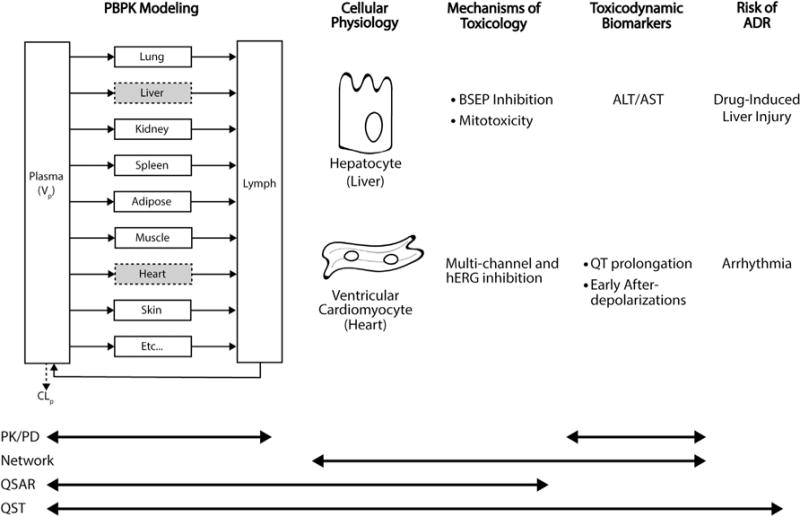
Fig. 1
Fig. 1
Overview of quantitative systems toxicology (QST) model structure. QST models contain the characterization of pharmacokinetics (PBPK modeling), a quantitative understanding of cellular physiological processes, mechanisms of toxicity, toxicodynamic biomarkers, and projected risk of an adverse drug reaction (ADR). For hepatotoxicity, drug concentrations at hepatocytes drive cellular pathophysiological changes and liver toxicodynamic biomarkers, aspartate transaminase (AST) and alanine transaminase (ALT). Liver enzyme dynamics can be used to predict the risk of DILI. For cardiotoxicity, drug concentrations at cardiomyocytes modulate ion channels, potentially resulting in QT prolongation and EADs. These toxicodynamic biomarkers can be used as surrogate markers to predict arrhythmias. Multiscale mechanism-based QST models include a vast range of pharmacological and physiological components, which enables a broad applicability. Whereas the scope of other modeling approaches, PK/PD, network-based, and QSAR, are often limited due to their empirical nature.
Fig. 2
Fig. 2
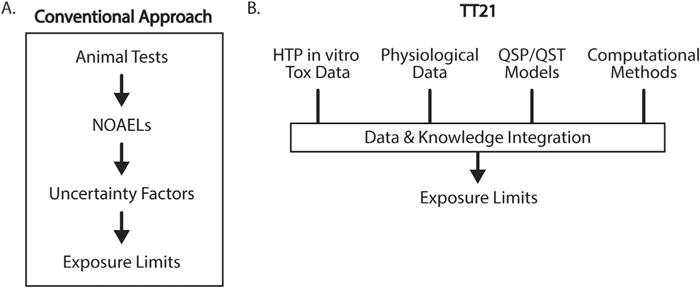
Comparison of conventional and TT21 approaches to the prediction of toxicity thresholds in humans. Historically, toxicity testing has relied on animal testing and experimental NOAELs. The NOAELs were used to determine exposure limits in humans via the application of multiple “rule of thumb” uncertainty factors, which were not informed by knowledge of toxicity mechanism or mathematical models of tissue dosimetry. By contrast, TT21 integrates knowledge and data from a variety of sources, including physiological and in vitro toxicity data. Extrapolation from in vitro systems to humans is performed using mathematical models, which allow in vitro data to be used in the context of cellular exposure. Computational methods are then applied to the model to account for physiological variability (inter- and intra-individual) and model or data uncertainty. The resulting exposure limit predictions are thus based on understanding of the underlying mechanism of toxicity, as well as knowledge of physiological variability in the target population.
Fig. 3
Fig. 3
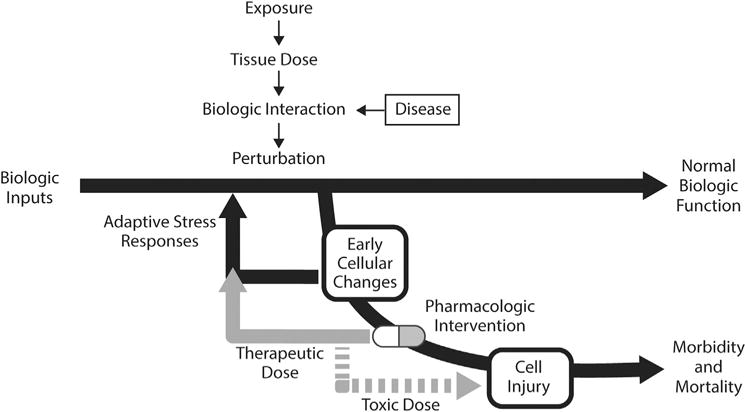
Interpretation of toxicity as a perturbation of normal biological function, and the effect of pharmacologic intervention. TT21 posits that exposure to toxic levels of chemicals induces changes in cellular biology. At low level, the cells’ innate adaptive stress responses can drive the cell back to normal biologic function. Similarly, disease can induce early changes in cellular function. Pharmacologic intervention at therapeutic doses can help return the cell to a state of normal biologic function. At toxic drug doses, however, the perturbation increase to a state of cell injury and potential morbidity or mortality.
Fig. 4
Fig. 4
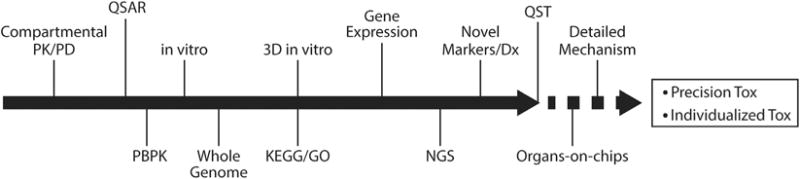
A vision for the convergence of technologies toward the future of QST. Starting with classical compartmental PK/PD, and continuing through the introduction of advanced in vitro test systems and genomic, high-volume data, toxicity testing has evolved greatly over the last few decades. At present, sophisticated models are being used to further elucidate the understanding the variety of toxicity mechanisms which lead to failed drugs and environmental risk. As the acquisition of patient-specific genomic and specialized diagnostics become more available, QST models will enable precise, individualized predictions of toxicity.

References

    1. Schardein JL, Schwetz BA, Kenel MF. Species sensitivities and prediction of teratogenic potential. Environ Health Perspect. 1985;61:55–67. - PMC - PubMed
    1. Sorger PK, et al. An NIH white paper by the QSP workshop group. NIH; Bethesda:
    1. Cros A. Action de l’alcool amylique sur l’organisme. 1863
    1. Meyer H. Zur theorie der alkoholnarkose. Naunyn-Schmiedeberg’s Arch Pharmacol. 1899;42:109–118.
    1. Overton CE. Studien über die Narkose zugleich ein Beitrag zur allgemeinen Pharmakologie. Fischer; 1901.

LinkOut - more resources