Temporary persistence of conduction block after prolonged kilohertz frequency alternating current on rat sciatic nerve
- PMID: 29309274
- PMCID: PMC6035886
- DOI: 10.1088/1741-2552/aa89a4
Temporary persistence of conduction block after prolonged kilohertz frequency alternating current on rat sciatic nerve
Abstract
Objective: Application of kilohertz frequency alternating current (KHFAC) waveforms can result in nerve conduction block that is induced in less than a second. Conduction recovers within seconds when KHFAC is applied for about 5-10 min. This study investigated the effect of repeated and prolonged application of KHFAC on rat sciatic nerve with bipolar platinum electrodes.
Approach: Varying durations of KHFAC at signal amplitudes for conduction block with intervals of no stimulus were studied. Nerve conduction was monitored by recording peak Gastrocnemius muscle force utilizing stimulation electrodes proximal (PS) and distal (DS) to a blocking electrode. The PS signal traveled through the block zone on the nerve, while the DS went directly to the motor end-plate junction. The PS/DS force ratio provided a measure of conduction patency of the nerve in the block zone.
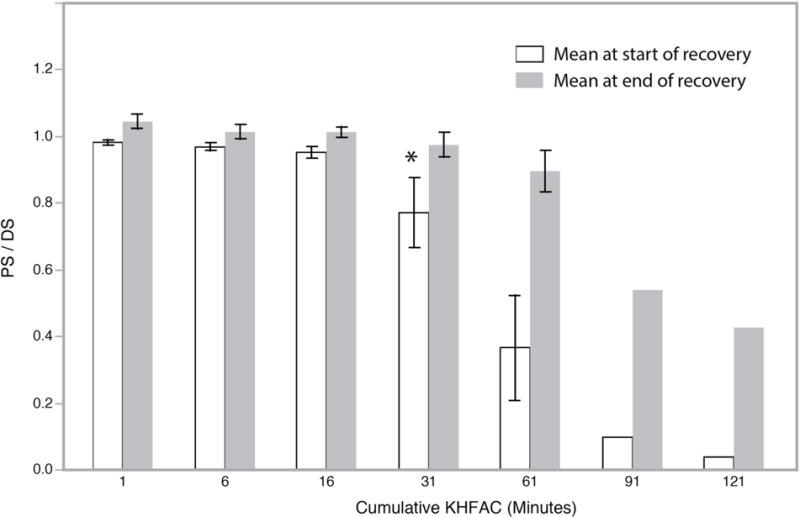
Main results: Conduction recovery times were found to be significantly affected by the cumulative duration of KHFAC application. Peak stimulated muscle force returned to pre-block levels immediately after cessation of KHFAC delivery when it was applied for less than about 15 min. They fell significantly but recovered to near pre-block levels for cumulative stimulus of 50 ± 20 min, for the tested On/Off times and frequencies. Conduction recovered in two phases, an initial fast one (60-80% recovery), followed by a slower phase. No permanent conduction block was seen at the end of the observation period during any experiment.
Significance: This carry-over block effect may be exploited to provide continuous conduction block in peripheral nerves without continuous application of KHFAC.
Conflict of interest statement
Kevin Kilgore and Niloy Bhadra have equity ownership in Neuros Medical Inc.
Figures



References
-
- Bhadra N, Kilgore KL. High-frequency electrical conduction block of mammalian peripheral motor nerve. Muscle Nerve. 2005;32(6):782–790. - PubMed
-
- Bhadra N, Vrabec T, Bhadra N, Kilgore KL. Response of peripheral nerve to highfrequency alternating current (HFAC) nerve block applied for long durations. Paper presented at Neural Interface Conference; Salt Lake City, UT, USA. 2012.
-
- Boger A, Bhadra N, Gustafson KJ. Bladder voiding by combined high frequency electrical pudendal nerve block and sacral root stimulation. Neurourol Urodyn. 2008;27(5):435–439. - PubMed
-
- Cuellar JM, Alataris K, Walker A, Yeomans DC, Antognini JF. Effect of High-Frequency Alternating Current on Spinal Afferent Nociceptive Transmission. Neuromodulation: Technology at the Neural Interface. 2013;16(4):318–327. - PubMed
Grants and funding
LinkOut - more resources
Full Text Sources
Other Literature Sources