Trends in Severe Obesity Among Children Aged 2 to 4 Years Enrolled in Special Supplemental Nutrition Program for Women, Infants, and Children From 2000 to 2014
- PMID: 29309485
- PMCID: PMC5885862
- DOI: 10.1001/jamapediatrics.2017.4301
Trends in Severe Obesity Among Children Aged 2 to 4 Years Enrolled in Special Supplemental Nutrition Program for Women, Infants, and Children From 2000 to 2014
Abstract
Importance: Severe obesity in childhood is associated with negative health consequences. A previous study examined trends in severe obesity among preschool-aged children in low-income families during 1998 to 2010. No recent trends have been reported.
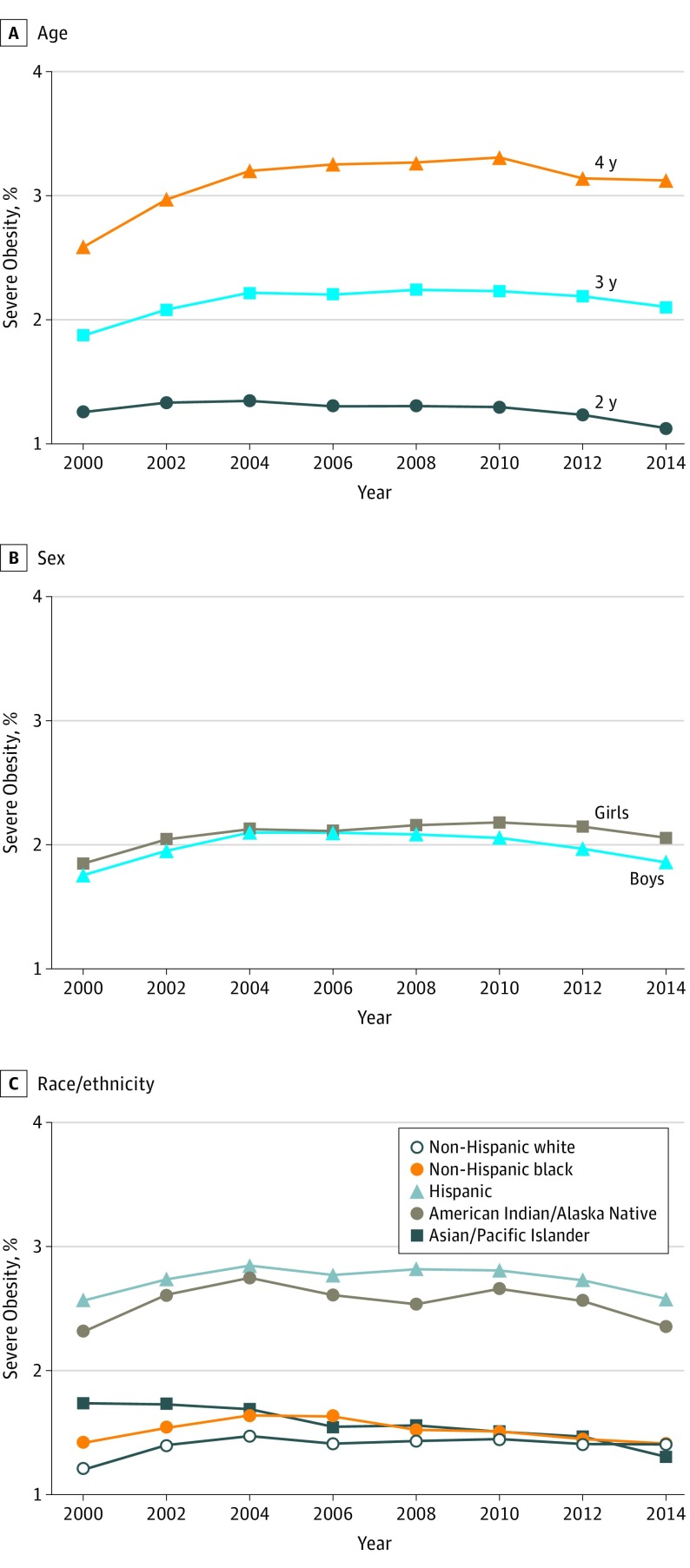
Objective: To examine trends in severe obesity by age, sex, and race/ethnicity among enrollees in the Special Supplemental Nutrition Program for Women, Infants, and Children (WIC) aged 2 to 4 years during 2000 to 2014.
Design, setting, and participants: Serial cross-sectional data from 22.6 million young children enrolled in WIC from 50 states, the District of Columbia, and 5 US territories from 2000 to 2014. Data analysis was conducted from February 16, 2017, to March 9, 2017.
Main outcomes and measures: Prevalence of severe obesity. Severe obesity was defined as a sex-specific body mass index-for-age 120% or more of the 95th percentile on the 2000 Centers for Disease Control and Prevention growth charts. Children's weights and heights were measured. Children whose sex, weight, height, or body mass index was missing or biologically implausible were excluded.
Results: The prevalence of severe obesity was 1.96% in 2014. During 2000 to 2004, the prevalence increased significantly overall from 1.80% to 2.11% (adjusted prevalence difference [APD], 0.26%) and among all the age, sex, and racial/ethnic groups except for Asian/Pacific Islander (APD, 0.05%-0.54% across groups with increases). The largest relative increase occurred in children aged 4 years (adjusted prevalence ratio [APR], 1.21) and non-Hispanic white (APR, 1.22) and American Indian/Alaska Native children (APR, 1.19). During 2004 to 2010, the prevalence decreased significantly overall (APD, -0.05%), among boys, children aged 2 and 3 years, and non-Hispanic black and Asian/Pacific Islander children (APD, -0.05% to -0.18%). During 2010 to 2014, the prevalence decreased significantly overall from 2.12% to 1.96% (APD, -0.14%) and among all demographic groups (APD, -0.04% to -0.30% across groups). The largest relative decrease occurred in children aged 2 years (APR, 0.88) and Hispanic (APR, 0.92), American Indian/Alaska Native (APR, 0.89), and Asian/Pacific Islander (APR, 0.87) children.
Conclusions and relevance: This study provides updated prevalence and trends of severe obesity among young children enrolled in WIC and reports recent modest declines in severe obesity in all subgroups. Ongoing surveillance can assess whether declines continue into the future among low-income children.
Conflict of interest statement
Figures
Comment in
-
Obesity: Early severe obesity in children.Nat Rev Endocrinol. 2018 Apr;14(4):194-196. doi: 10.1038/nrendo.2018.15. Epub 2018 Feb 16. Nat Rev Endocrinol. 2018. PMID: 29449688 No abstract available.
-
Special Supplemental Nutrition Program for Women, Infants, and Children Program, a Social Experiment on Effective Strategies to Prevent Severe Obesity Among Preschool Children.JAMA Pediatr. 2018 Jul 1;172(7):704. doi: 10.1001/jamapediatrics.2018.1019. JAMA Pediatr. 2018. PMID: 29813160 No abstract available.
References
-
- Freedman DS; Centers for Disease Control and Prevention (CDC) . Obesity—United States, 1988-2008. MMWR Suppl. 2011;60(1)(suppl):73-77. - PubMed
-
- Pan L, Freedman DS, Sharma AJ, et al. Trends in obesity among participants aged 2-4 years in the Special Supplemental Nutrition Program for Women, Infants, and Children—United States, 2000-2014. MMWR Morb Mortal Wkly Rep. 2016;65(45):1256-1260. - PubMed
-
- Freedman DS, Mei Z, Srinivasan SR, Berenson GS, Dietz WH. Cardiovascular risk factors and excess adiposity among overweight children and adolescents: the Bogalusa Heart Study. J Pediatr. 2007;150(1):12-17.e2. - PubMed
MeSH terms
LinkOut - more resources
Full Text Sources
Other Literature Sources
Medical
Miscellaneous