


The Poorest of Poor Suffer the Greatest Burden From Smokeless Tobacco Use: A Study From 140 Countries
- PMID: 29309692
- PMCID: PMC6454457
- DOI: 10.1093/ntr/ntx276
The Poorest of Poor Suffer the Greatest Burden From Smokeless Tobacco Use: A Study From 140 Countries
Abstract
Background: The full extent of global smokeless tobacco (SLT) use and its association with key demographic factors such as gender, place of residence, and household or country income status is not yet known.
Methods: The global burden of SLT use among adults was estimated using nationally representative data of 140 countries by gender and country income group. Countries were grouped in Group 1 (low and low-middle income countries combined) and Group 2 (upper middle and high income countries combined). The number of male and female SLT users was calculated using prevalence and population estimates of corresponding age groups.
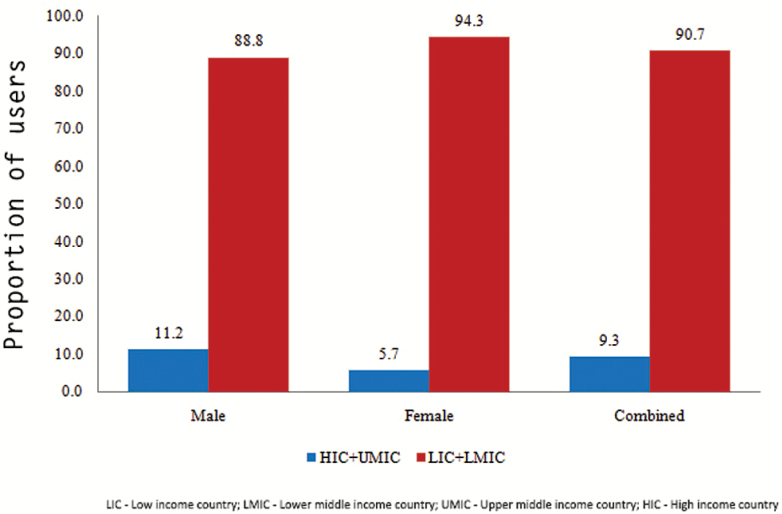
Results: Nearly one in 10 males and one in 20 females used SLT in some form. SLT use prevalence was significantly higher among males (p < .001) and females (p < .001) in Group 1 countries compared with their counterparts in Group 2 countries. However, for both Group 1 (p < .01) and Group 2 (p < .01), males were more likely to use SLT than females. Nearly 91% of a total 356 million adult SLT users resided in Group 1 countries, with 81.6% in countries of WHO South-East Asia region (SEAR). In SEAR and African region, SLT use was higher in rural areas and poorest communities.
Conclusion: The majority of the burden of SLT use is on lower and lower middle income countries with the greatest burden on the poorest segments of the population in these countries.
Implications: This study brings the comprehensive information on epidemiology of SLT use among adults at global level. Ninety percent of SLT burden is in low and low-middle income group of countries and more specifically among the poorest group in such countries. These countries need to have strategies to implement different provisions of the WHO Framework Convention on Tobacco Control. The program in such countries should be targeted towards the poorest communities for effective SLT control.
Figures
References
-
- Sinha DN, Suliankatchi RA, Gupta PC et al. Global burden of all-cause and cause-specific mortality due to smokeless tobacco use: systematic review and meta-analysis. Tob Control. 2018;27(1):35–42. - PubMed
-
- Sinha DN, Rizwan SA, Aryal KK, Karki KB, Zaman MM, Gupta PC. Trends of smokeless tobacco use among adults (aged 15-49 years) in Bangladesh, India and Nepal. Asian Pac J Cancer Prev. 2015;16(15):6561–6568. - PubMed
-
- Sinha DN, Bhartiya D, Kumar A et al. Men in Myanmar submerged in tobacco: Women following. Nicotine Tob Res. 2016;pii:ntw314. - PubMed
-
- Ministry of Health and Family Welfare, Government of India, New Delhi. Executive Summary-Economic Burden of Tobacco Related Disease, updated 2011 http://www.searo.who.int/india/topics/tobacco/economic_burden_of_tobacco.... Accessed November 25, 2016.
Publication types
MeSH terms
Grants and funding
LinkOut - more resources
Full Text Sources
Other Literature Sources
Medical
