


The impact of mild, moderate, and severe visual field loss in glaucoma on patients' quality of life measured via the Glaucoma Quality of Life-15 Questionnaire: A meta-analysis
- PMID: 29310323
- PMCID: PMC5728724
- DOI: 10.1097/MD.0000000000008019
The impact of mild, moderate, and severe visual field loss in glaucoma on patients' quality of life measured via the Glaucoma Quality of Life-15 Questionnaire: A meta-analysis
Abstract
Background: We performed a meta-analysis to determine the impact of mild, moderate, and severe visual field loss on quality of life (QoL) in patients with glaucoma.
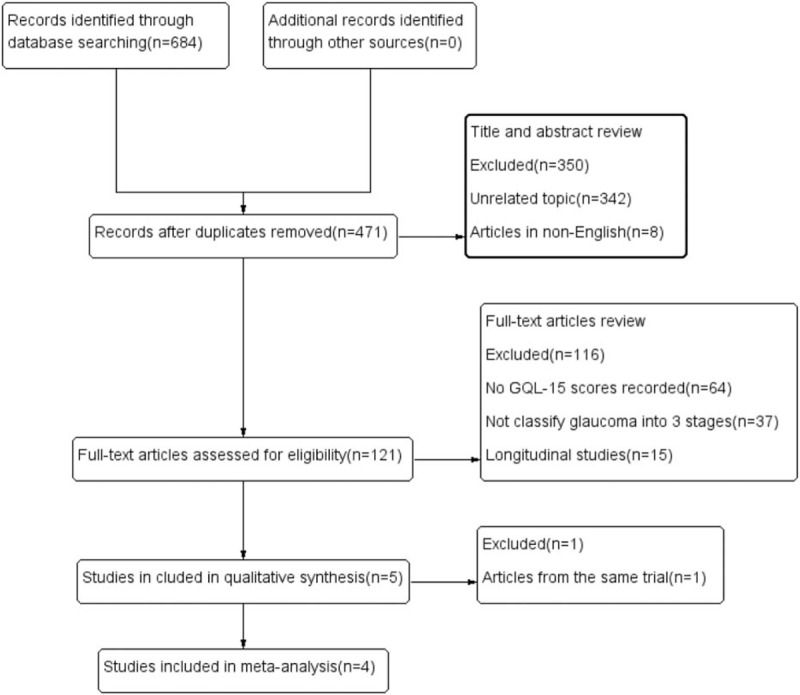
Methods: A comprehensive literature search was performed using the PubMed, Excerpta Medica dateBASE and China National Knowledge Infrastructure databases to identify relevant articles published before June 30, 2016. Patients' QoL was measured using the Glaucoma Quality of Life-15 Questionnaire (GQL-15).
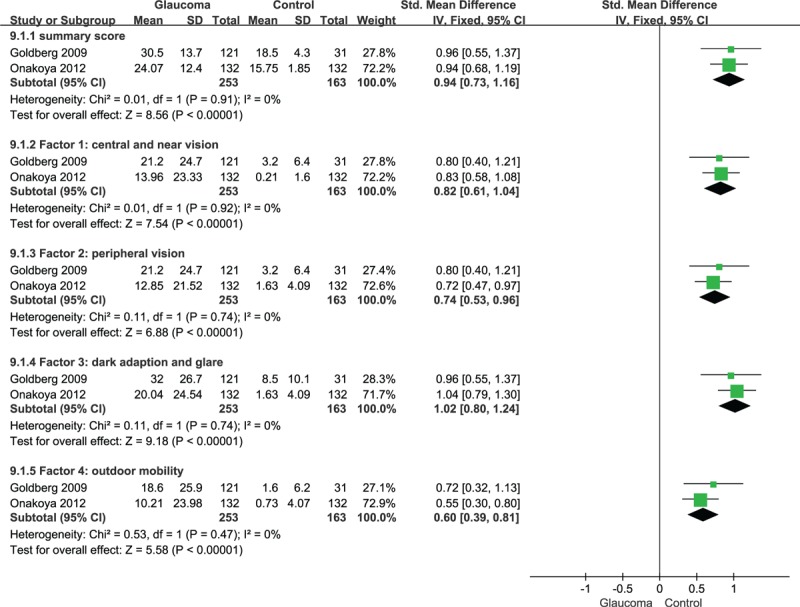
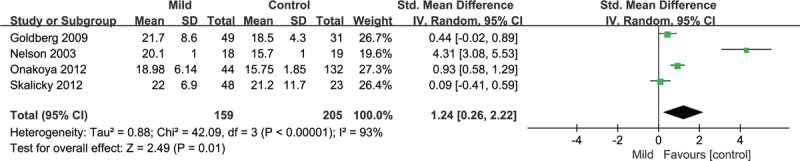
Results: In total, 401 patients with glaucoma and 205 patients without glaucoma participated in 4 experiments. The GQL-15 summary scores are statistically different between patients with and without glaucoma (standard mean difference [SMD] = 0.94, 95% confidence interval [CI]: 0.73-1.16, P < .01). GQL-15 summary scores for patients with mild, moderate, and severe visual field loss all differed significantly from those of patients without glaucoma; the SMDs for their summary scores were as follows: mild: 1.24, 95% CI: 0.26 to 2.22, P = .01; moderate: 2.05, 95% CI: 0.91 to 3.19, P < .001; and severe: 2.57, 95% CI: 1.44 to 3.71, P < .001. Two factor scores for central and near vision (SMD = -0.35, 95% CI: -1.01 to 0.30, P = .29) and glare and dark adaptation (SMD = -0.36, 95% CI: -1.01 to 0.30, P = .28) did not differ significantly between patients with mild and moderate visual field loss. However, summary scores and 2 factor scores (peripheral vision and outdoor mobility) differed significantly between patients with mild and moderate glaucoma. In addition, summary scores and all 4 factor scores differed significantly between patients with mild and severe glaucoma. Moreover, summary scores and 3 factor scores (peripheral vision, glare and dark adaptation, and outdoor mobility) differed significantly between patients with moderate and severe glaucoma. However, scores for 1 factor (central and near vision) did not differ significantly between any of the patient groups (SDM = -0.53, 95% CI = -1.33 to 0.27, P = .19).
Conclusions: Glaucoma patients with visual field loss showed significantly poorer QoL relative to that of patients without glaucoma. Patients' QoL decreased as their glaucoma severity increased.
Conflict of interest statement
The authors have no funding and conflicts of interest to disclose.
Figures
References
-
- Sawada H, Fukuchi T, Abe H. Evaluation of the relationship between quality of vision and the visual function index in Japanese glaucoma patients. Graefes Arch Clin Exp Ophthalmol 2011;249:1721–7. - PubMed
-
- Orta AÖ, Öztürker ZK, Erkul SÖ, et al. The correlation between glaucomatous visual field loss and vision-related quality of life. J Glaucoma 2015;24:e121–7. - PubMed
-
- Sun Y, Lin C, Waisbourd M, et al. The impact of visual field clusters on performance-based measures and vision-related quality of life in patients with glaucoma. Am J Ophthalmol 2016;163:45–52. - PubMed
-
- Ringsdorf L, Mcgwin GJ, Owsley C. Visual field defects and vision-specific health-related quality of life in African Americans and Whites with glaucoma. J Glaucoma 2006;15:414–8. - PubMed
Publication types
MeSH terms
LinkOut - more resources
Full Text Sources
Other Literature Sources
Medical
