. 2018 Jan 8;6(1):5.
doi: 10.1186/s40478-017-0503-z.

Iatrogenic Creutzfeldt-Jakob disease with Amyloid-β pathology: an international study

Affiliations

Iatrogenic Creutzfeldt-Jakob disease with Amyloid-β pathology: an international study

Ignazio Cali et al. Acta Neuropathol Commun. .

Abstract

The presence of pathology related to the deposition of amyloid-β (Aβ) has been recently reported in iatrogenic Creutzfeldt-Jakob disease (iCJD) acquired from inoculation of growth hormone (GH) extracted from human cadaveric pituitary gland or use of cadaveric dura mater (DM) grafts.To investigate this phenomenon further, a cohort of 27 iCJD cases - 21 with adequate number of histopathological sections - originating from Australia, France, Italy, and the Unites States, were examined by immunohistochemistry, amyloid staining, and Western blot analysis of the scrapie prion protein (PrPSc), and compared with age-group matched cases of sporadic CJD (sCJD), Alzheimer disease (AD) or free of neurodegenerative diseases (non-ND).Cases of iCJD and sCJD shared similar profiles of proteinase K-resistant PrPSc with the exception of iCJD harboring the "MMi" phenotype. Cerebral amyloid angiopathy (CAA), either associated with, or free of, Thioflavin S-positive amyloid core plaques (CP), was observed in 52% of 21 cases of iCJD, which comprised 37.5% and 61.5% of the cases of GH- and DM-iCJD, respectively. If only cases younger than 54 years were considered, Aβ pathology affected 41%, 2% and 0% of iCJD, sCJD and non-ND, respectively. Despite the patients' younger age CAA was more severe in iCJD than sCJD, while Aβ diffuse plaques, in absence of Aβ CP, populated one third of sCJD. Aβ pathology was by far most severe in AD. Tau pathology was scanty in iCJD and sCJD.In conclusion, (i) despite the divergences in the use of cadaveric GH and DM products, our cases combined with previous studies showed remarkably similar iCJD and Aβ phenotypes indicating that the occurrence of Aβ pathology in iCJD is a widespread phenomenon, (ii) CAA emerges as the hallmark of the Aβ phenotype in iCJD since it is observed in nearly 90% of all iCJD with Aβ pathology reported to date including ours, and it is shared by GH- and DM-iCJD, (iii) although the contributions to Aβ pathology of other factors, including GH deficiency, cannot be discounted, our findings increase the mounting evidence that this pathology is acquired by a mechanism resembling that of prion diseases.

Keywords: Amyloid-β; Cerebral amyloid angiopathy; Pathology; Thioflavin S; iCJD.


Conflict of interest statement

Ethics approval and consent to participate

All patient protocols were approved by the Institutional Review Boards of the University Hospitals Case Medical Center of Cleveland (# 05–14-09). The Australian National CJD Registry has ethical approval for its surveillance operations from The University of Melbourne Human Research Ethics Committee (#1341074.4). In all cases, according to the French regulation, the next of kin provided informed, signed consent in the name of the patient to permit an autopsy and neuropathological investigation. The national computerized registry of objection to autopsy was systematically consulted. PRNP had been analyzed pre-mortem with the signed consent of the France patient’s family. Data collection of clinically suspected cases is an integral part of the National CJD surveillance study, which was approved by the Ethic Committee of the Istituto Superiore di Sanità (CE-ISS 09/266 on 29 may 2009).

Consent for publication

Not applicable.

Competing interests

The authors declare that they have no competing interests.

Publisher’s Note

Springer Nature remains neutral with regard to jurisdictional claims in published maps and institutional affiliations.

Figures

Fig. 1
Fig. 1
Ring doughnut charts visualizing distributions of codon 129 genotypes, resPrPSc types and disease phenotypes among iCJD and sCJD cases examined. a whole iCJD cohort; inner circle: percent distribution of codon 129 genotype (MM, MV, VV); intermediate circle: distribution of resPrPSc types (T1, T2, Ti, Ti ± 2, T1 + 2); outer circle: distribution of histopathological phenotype. b GH-iCJD, legend as a; c DM-iCJD, legend as a; d sCJD. T1: type 1; Ti: type intermediate; T2: type 2; Ti + 2: type i + 2; T1 + 2: type 1 + 2; n: number of cases; na: not available; Atyp.: atypical; Undet.: undetermined. Percentages refer to the distribution of codon 129 genotype
Fig. 2
Fig. 2
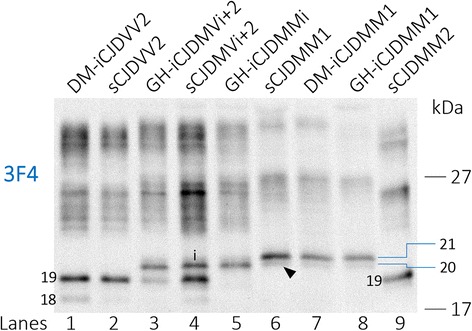
WB profile of resPrPSc from iCJD and sCJD controls using high resolution gel electrophoresis. BHs from the frontal cortex (lanes 8 and 9) and cerebellum (lanes 1–7) treated with 100 U/ml PK (~2000 μg/ml) were probed with 3F4. PrP bands were resolved in a 15% Tris–HCl, 20 cm-long gel, and visualized with the near-infrared LI-COR system. The resPrPSc profiles from iCJD (lanes 1, 3, 5, 7 and 8) and matching sCJD subtypes (lanes 2, 4 and 6) are similar as shown by the co-migration of the unglycosylated resPrPSc type 2 (19) (lanes 1–4) and type 1 (21) (lanes 6–8). The different thickness of the type 2 (19) band is within the variability range for this subtype. The unglycosylated resPrPSc band of ~20 kDa, also identified as type i (i), is visible in GH-iCJDMVi + 2 (lane 3), sCJDMVi + 2 (lane 4) and GH-iCJDMMi case (lane 5); a thin band of ~20 kDa (arrowhead) is also present in CJDMM1. An ~18 kDa fragment (18) is also present in CJDVV2 and CJDMVi + 2
Fig. 3
Fig. 3
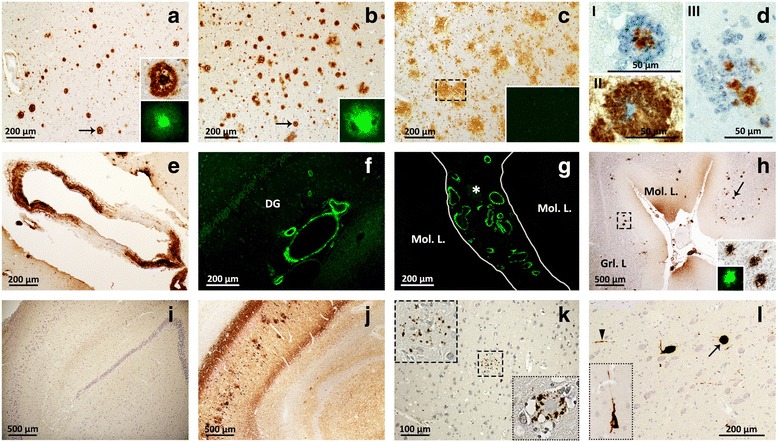
Aβ and tau pathology of iCJD, sCJD and AD. a and b typical Aβ CP (arrows) from the frontal cortex of iCJD (a) and AD (b); inset a: Aβ CP at higher magnification immunoprobed for Aβ (top) or stained with Thioflavin S (bottom); inset b: Thioflavin S-positive Aβ CP. c diffuse plaques from the frontal cortex of a case of sCJD; inset: Thioflavin S-negative staining of plaques (dashed rectangle). d co-localization of Aβ (cyan dye) and PrP (brown dye) immunoreactivity in the same plaque from cerebral (I and III) and cerebellar (II) cortices of iCJD. I: plaque exhibiting a PrP-positive core surrounded by an Aβ immunoreactive crown; II-III: plaques showing either the immunostaining opposite to that of I, with Aβ-positive core and a PrP immunoreactive crown (II), or random distribution of PrP- and Aβ-reactive aggregates (III). e-g Aβ deposits (e) and Thioflavin S-positive staining (f and g) of vessels in frontal cortex (e), hippocampus (f) and cerebellum (g) in iCJD; f: DG, Dentate gyrus; g: asterisk, Aβ CAA in the subarachnoid space between two cerebellar folia. h Aβ CP predominantly affecting the granular layer (Grl. L) and Purkinje layer of the cerebellum in iCJD (case 9, Table 1); arrow indicates Aβ CP; large and small insets: enlargements of Aβ CP identified by the dashed rectangle in the main figure and a Thioflavin S-positive Aβ CP, respectively. i-j hippocampus free of tau pathology in iCJD (i) but severely affected in AD (j). k Tau-positive DN associated with an Aβ CP in frontal cortex of iCJD (case 8, Table 1) (dashed square); top inset: enlargement of tau reactive DN identified in dashed square; bottom inset: DN associated with a PrP kuru plaque in iCJD (occipital cortex, case 9, Table 1). l globose NFT (arrow) and neuropil threads (arrowhead) in the nucleus basalis of Meynert of iCJD (case 6, Table 1); inset: flame-shaped NFT in the temporal neocortex of the same iCJD case. Abs: 3F4 (d), 4G8 (a-e, h) and AT8 (i-l) to PrP, Aβ and phosphorylated tau, respectively; Thioflavin S to Aβ (a-c, f-h)
Fig. 4
Fig. 4
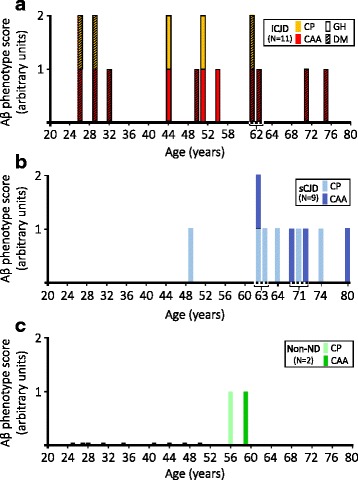
Aβ phenotype and age distribution in Aβ-positive iCJD and control cases. a: iCJD (N = 11); b: sCJD (N = 9); c: non-ND (N = 2). Scores for the Aβ phenotype is relative to the presence of either Aβ CP or CAA (score 1), or combinations of both (score 2). Brackets below dotted line in the X-axis underline cases of the same age; GH: growth hormone; DM: dura mater
Fig. 5
Fig. 5
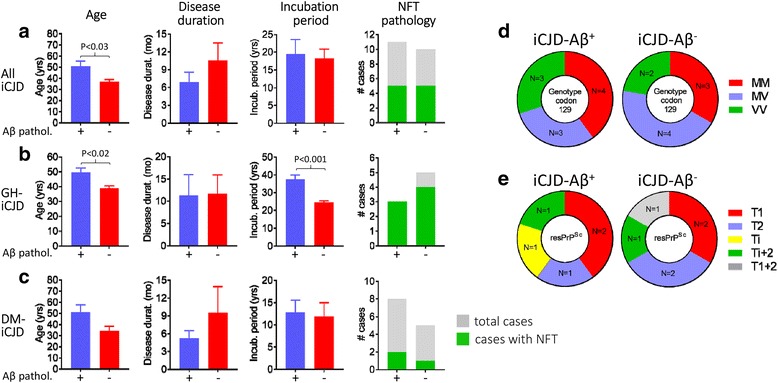
Graphic representation of demographic data, NFT pathology, codon 129 genotype and resPrPSc type in iCJD with (+) and without (−) Aβ pathology. a-c age, disease duration, incubation period, and NFT pathology relative to All iCJD (a), GH-iCJD (b) and DM-iCJD (c); yrs.: years; mo: months. d and e ring doughnut charts visualizing genotype frequency at codon 129 (d) and resPrPSc type distribution (e) in iCJD with (iCJD-Aβ+) and without (iCJD-Aβ) Aβ pathology; M: methionine; V: valine; T1: type 1; T2: type 2; Ti: type intermediate; Ti + 2: types intermediate +2; T1 + 2: types 1 + 2
Fig. 6
Fig. 6
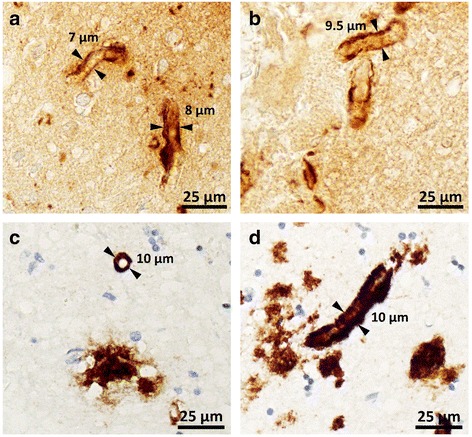
Type 1 or capillary CAA in one iCJD (a and b) and one AD (c and d). a-d Aβ deposits along the basement membrane of capillaries in the parahippocampal gyrus (a), molecular layer of the cerebellum (b) and hippocampus (c and d). The mean diameter of capillaries in longitudinal sections resulted from three (a and b) and six (d) measurements along the capillary whereas the diameter of the capillary in cross-section in c is the mean diameter calculated by the software (Image-Pro Plus)

References

    1. Abrams JY, Schonberger LB, Belay ED, Maddox RA, Leschek EW, Mills JL, Wysowski DK, Fradkin JE. Lower risk of Creutzfeldt-Jakob disease in pituitary growth hormone recipients initiating treatment after 1977. J Clin Endocrinol Metab. 2011;96:E1666–E1669. doi: 10.1210/jc.2011-1357. - DOI - PubMed
    1. Belay ED, Schonberger LB. The public health impact of prion diseases. Annu Rev Public Health. 2005;26:191–212. doi: 10.1146/annurev.publhealth.26.021304.144536. - DOI - PubMed
    1. Blossom DB, Maddox RA, Beavers SF, Church KA, Thoroughman DA, Schonberger LB, Belay ED. A case of Creutzfeldt-Jakob disease associated with a dura mater graft in the United States. Infect Control Hosp Epidemiol. 2007;28:1396–1397. doi: 10.1086/523862. - DOI - PubMed
    1. Bonda DJ, Manjila S, Mehndiratta P, Khan F, Miller BR, Onwuzulike K, Puoti G, Cohen ML, Schonberger LB, Cali I. Human prion diseases: surgical lessons learned from iatrogenic prion transmission. Neurosurg Focus. 2016;41:E10. doi: 10.3171/2016.5.FOCUS15126. - DOI - PMC - PubMed
    1. Braak H, Braak E. Staging of Alzheimer’s disease-related neurofibrillary changes. Neurobiol Aging. 1995;16:271–278. doi: 10.1016/0197-4580(95)00021-6. - DOI - PubMed

Publication types

MeSH terms

Supplementary concepts