


Co-occurrence and Severity of Neurodevelopmental Burden (Cognitive Impairment, Cerebral Palsy, Autism Spectrum Disorder, and Epilepsy) at Age Ten Years in Children Born Extremely Preterm
- PMID: 29310907
- PMCID: PMC5803305
- DOI: 10.1016/j.pediatrneurol.2017.11.002
Co-occurrence and Severity of Neurodevelopmental Burden (Cognitive Impairment, Cerebral Palsy, Autism Spectrum Disorder, and Epilepsy) at Age Ten Years in Children Born Extremely Preterm
Abstract
Background: This study aims to determine the prevalence of neurodevelopmental impairments at age ten years among children born extremely preterm (less than 28 weeks gestational age) and to offer a framework for categorizing neurological limitations.
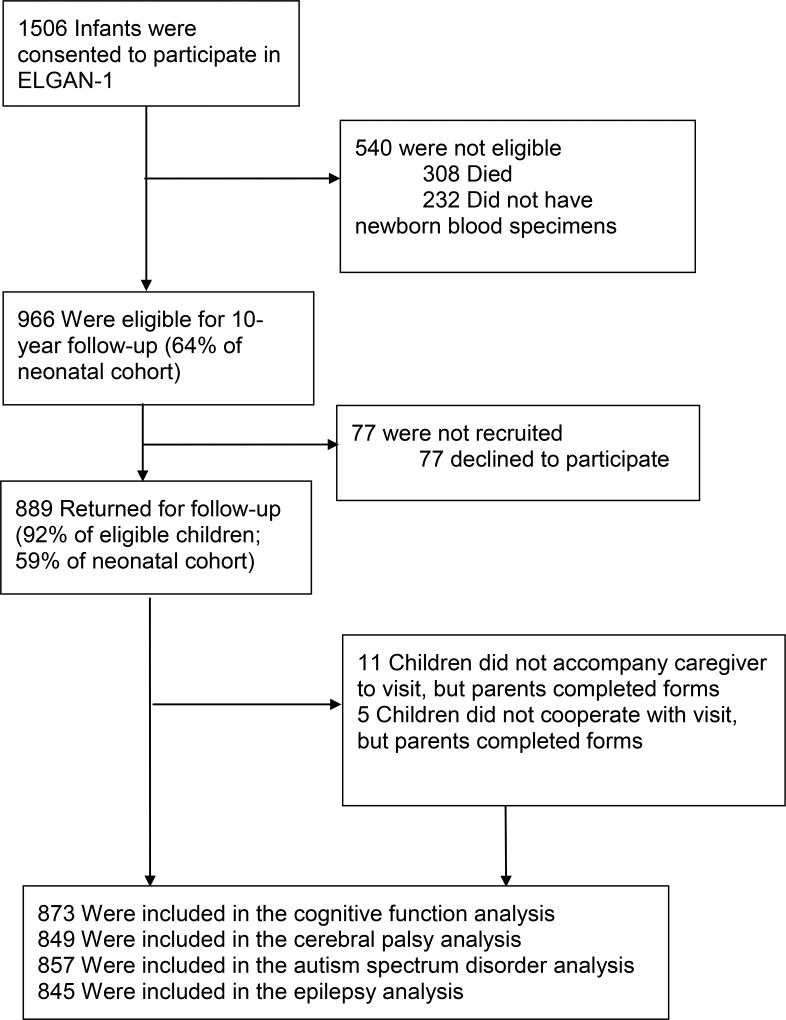
Methods: A multicenter, prospective cohort follow-up study recruited 889 ten-year-old children born from 2002 to 2004. We assessed prevalence of cognitive impairment, measured by intelligent quotient and tests of executive function, cerebral palsy (CP), autism spectrum disorder (ASD), and epilepsy singly and in combination. The three levels of impairment severity were: category I-no major neurodevelopmental impairment; category II-normal cognitive ability with CP, ASD, and/or epilepsy; and category III-children with cognitive impairment.
Results: A total 214 of 873 children (25%) had cognitive impairment, 93 of 849 children (11%) had CP, 61 of 857 children (7%) had ASD, and 66 of 888 children (7%) had epilepsy. Further, 19% of all children had one diagnosis, 10% had two diagnoses, and 3% had three diagnoses. Decreasing gestational age was associated with increasing number of impairments (P < 0.001). Half the children with cognitive impairment and one third of children with CP, ASD, or epilepsy had a single impairment. Six hundred one (68% [95% CI, 64.5%-70.7%]) children were in category I, 74 (8% [95% CI, 6.6%-10.3%]) were in category II, and 214 (24% [95% CI 21.7%-27.4%]) were in category III.
Conclusions: Three quarters of children had normal intellect at age ten years; nearly 70% were free of neurodevelopmental impairment. Forty percent of children with impairments had multiple diagnoses.
Keywords: extremely preterm; follow-up; multiple disabilities; neurological.
Copyright © 2017 Elsevier Inc. All rights reserved.
Conflict of interest statement
References
-
- Johnson S, Fawke J, Hennessy E, et al. Neurodevelopmental disability through 11 years of age in children born before 26 weeks of gestation. Pediatrics. 2009;124(2):e249–257. - PubMed
-
- Holsti A, Adamsson M, Serenius F, Hagglof B, Farooqi A. Two-thirds of adolescents who received active perinatal care after extremely preterm birth had mild or no disabilities. Acta Paediatr. 2016;105(11):1288–1297. - PubMed
-
- Stahlmann N, Eisemann N, Thyen U, Herting E, Rapp M. Long-term health outcomes and health-related quality of life in adolescents from a cohort of extremely premature infants born at less than 27 weeks of gestation in northern Germany. Neuropediatrics. 2016;47(6):388–398. - PubMed
-
- Stahlmann N, Rapp M, Herting E, Thyen U. Outcome of extremely premature infants at early school age: health-related quality of life and neurosensory, cognitive, and behavioral outcomes in a population-based sample in northern Germany. Neuropediatrics. 2009;40(3):112–119. - PubMed
Publication types
MeSH terms
Grants and funding
LinkOut - more resources
Full Text Sources
Other Literature Sources
Medical
Miscellaneous
