In Vitro and In Vivo Evaluation of the Antifungal Activity of APX001A/APX001 against Candida auris
- PMID: 29311065
- PMCID: PMC5826120
- DOI: 10.1128/AAC.02319-17
In Vitro and In Vivo Evaluation of the Antifungal Activity of APX001A/APX001 against Candida auris
Abstract
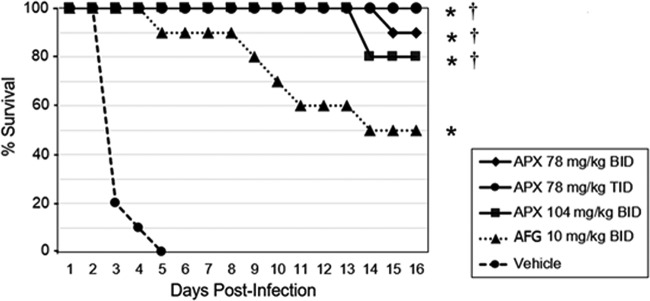
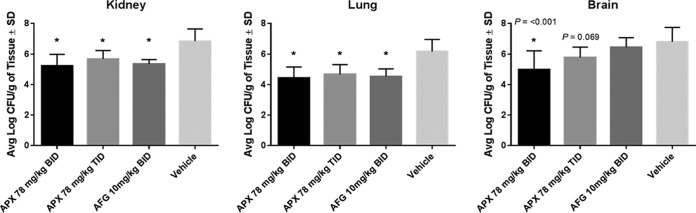
Candida auris is an emerging multidrug-resistant yeast that has been responsible for invasive infections associated with high morbidity and mortality. C. auris strains often demonstrate high fluconazole and amphotericin B MIC values, and some strains are resistant to all three major antifungal classes. We evaluated the susceptibility of 16 C. auris clinical strains, isolated from a wide geographical area, to 10 antifungal agents, including APX001A, a novel agent that inhibits the fungal protein Gwt1 (glycosylphosphatidylinositol-anchored wall transfer protein 1). APX001A demonstrated significantly lower MIC50 and MIC90 values (0.004 and 0.031 μg/ml, respectively) than all other agents tested. The efficacy of the prodrug APX001 was evaluated in an immunocompromised murine model of disseminated C. auris infection. Significant efficacy (80 to 100% survival) was observed in all three APX001 treatment groups versus 50% survival for the anidulafungin treatment group. In addition, APX001 showed a significant log reduction in CFU counts in kidney, lung, and brain tissue (1.03 to 1.83) versus the vehicle control. Anidulafungin also showed a significant log reduction in CFU in the kidneys and lungs (1.5 and 1.62, respectively) but did not impact brain CFU. These data support further clinical evaluation of this new antifungal agent.
Keywords: APX001; APX001A; Candida auris; antifungal susceptibility testing; brain penetration; efficacy; infection model; survival; susceptibility testing; yeast.
Copyright © 2018 Hager et al.
Figures
References
-
- Vallabhaneni S, Kallen A, Tsay S, Chow N, Welsh R, Kerins J, Kemble SK, Pacilli M, Black SR, Landon E, Ridgway J, Palmore TN, Zelzany A, Adams EH, Quinn M, Chaturvedi S, Greenko J, Fernandez R, Southwick K, Furuya EY, Calfee DP, Hamula C, Patel G, Barrett P, Lafaro P, Berkow EL, Moulton-Meissner H, Noble-Wang J, Fagan RP, Jackson BR, Lockhart SR, Litvintseva AP, Chiller TM. 2016. Investigation of the first seven reported cases of Candida auris, a globally emerging invasive, multidrug-resistant fungus: United States, May 2013-August 2016. MMWR Morb Mortal Wkly Rep 65:1234–1237. doi: 10.15585/mmwr.mm6544e1. - DOI - PubMed
-
- Lockhart SR, Etienne KA, Vallabhaneni S, Farooqi J, Chowdhary A, Govender NP, Colombo AL, Calvo B, Cuomo CA, Desjardins CA, Berkow EL, Castanheira M, Magobo RE, Jabeen K, Asghar RJ, Meis JF, Jackson B, Chiller T, Litvintseva AP. 2017. Simultaneous emergence of multidrug-resistant Candida auris on three continents confirmed by whole-genome sequencing and epidemiological analyses. Clin Infect Dis 64:134–140. doi: 10.1093/cid/ciw691. - DOI - PMC - PubMed
Publication types
MeSH terms
Substances
LinkOut - more resources
Full Text Sources
Other Literature Sources
Medical
Research Materials