. 2018 Jan 23;115(4):E574-E583.
doi: 10.1073/pnas.1711234115. Epub 2018 Jan 8.

Freshwater salinization syndrome on a continental scale

Affiliations

Freshwater salinization syndrome on a continental scale

Sujay S Kaushal et al. Proc Natl Acad Sci U S A. .

Abstract

Salt pollution and human-accelerated weathering are shifting the chemical composition of major ions in fresh water and increasing salinization and alkalinization across North America. We propose a concept, the freshwater salinization syndrome, which links salinization and alkalinization processes. This syndrome manifests as concurrent trends in specific conductance, pH, alkalinity, and base cations. Although individual trends can vary in strength, changes in salinization and alkalinization have affected 37% and 90%, respectively, of the drainage area of the contiguous United States over the past century. Across 232 United States Geological Survey (USGS) monitoring sites, 66% of stream and river sites showed a statistical increase in pH, which often began decades before acid rain regulations. The syndrome is most prominent in the densely populated eastern and midwestern United States, where salinity and alkalinity have increased most rapidly. The syndrome is caused by salt pollution (e.g., road deicers, irrigation runoff, sewage, potash), accelerated weathering and soil cation exchange, mining and resource extraction, and the presence of easily weathered minerals used in agriculture (lime) and urbanization (concrete). Increasing salts with strong bases and carbonates elevate acid neutralizing capacity and pH, and increasing sodium from salt pollution eventually displaces base cations on soil exchange sites, which further increases pH and alkalinization. Symptoms of the syndrome can include: infrastructure corrosion, contaminant mobilization, and variations in coastal ocean acidification caused by increasingly alkaline river inputs. Unless regulated and managed, the freshwater salinization syndrome can have significant impacts on ecosystem services such as safe drinking water, contaminant retention, and biodiversity.

Keywords: anthropocene; carbon cycle; drinking water; emerging contaminants; land use.


Conflict of interest statement

The authors declare no conflict of interest.

Figures
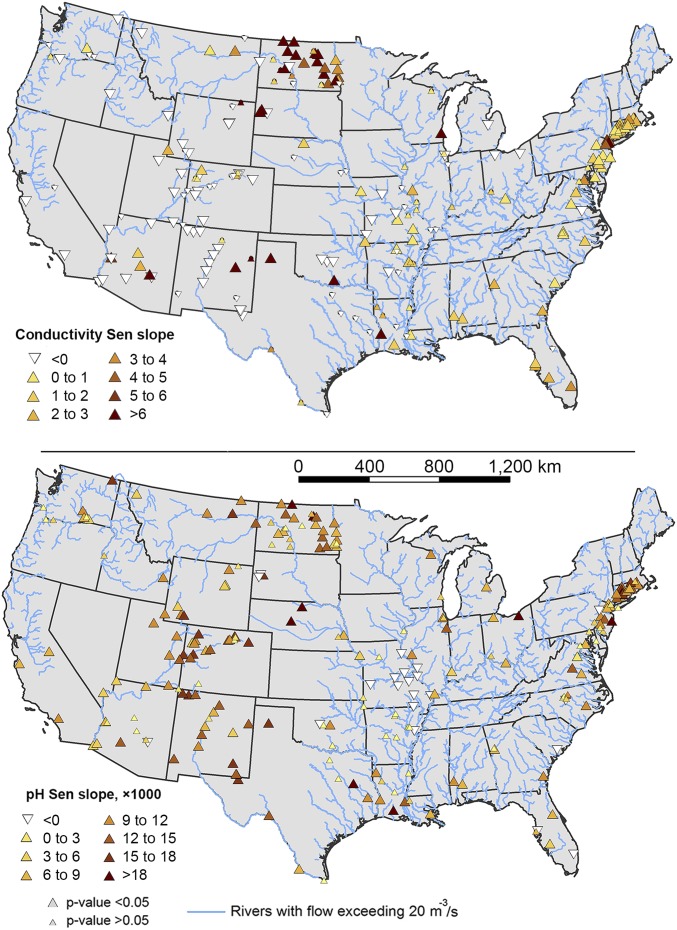
Fig. 1.
Fig. 1.
Maps showing locations of increasing, decreasing, and/or no trends in specific conductance and pH in stream water throughout the continental United States. Streamlines represent all conterminous US rivers with mean annual discharge exceeding 20 m3/s (47).
Fig. 2.
Fig. 2.
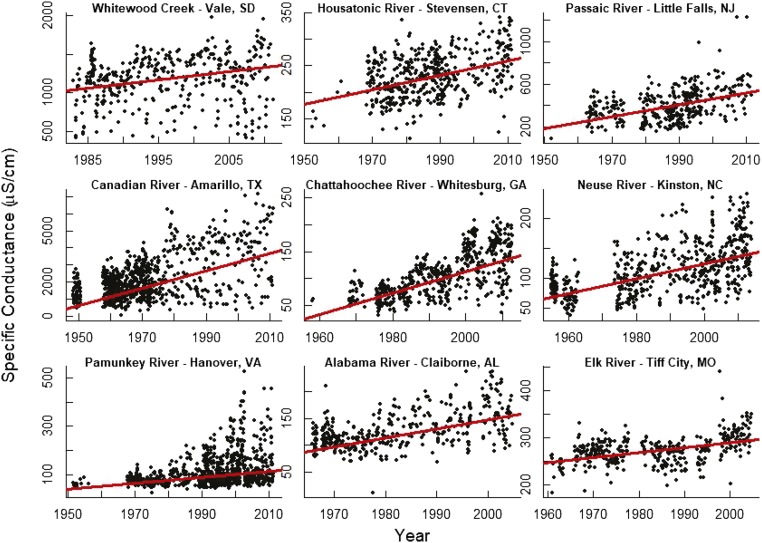
Examples of increasing trends in conductance in stream water throughout the continental United States, which are characteristic of ranges in their respective regions. Please note that vertical axes differ.
Fig. 3.
Fig. 3.
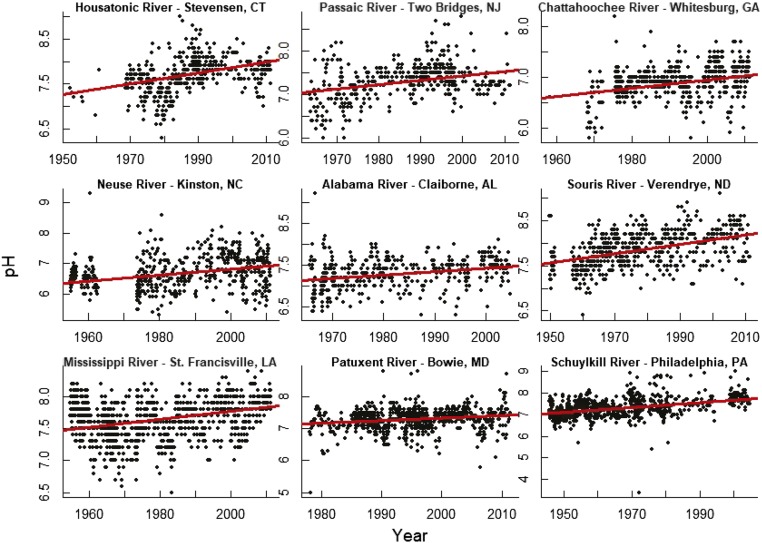
Examples of increasing trends in pH in stream water throughout the continental United States. The pH decreased at some sites following US Clean Air Act Amendments in 1990, which targeted reductions in acidic deposition. Please note that vertical axes differ.
Fig. 4.
Fig. 4.
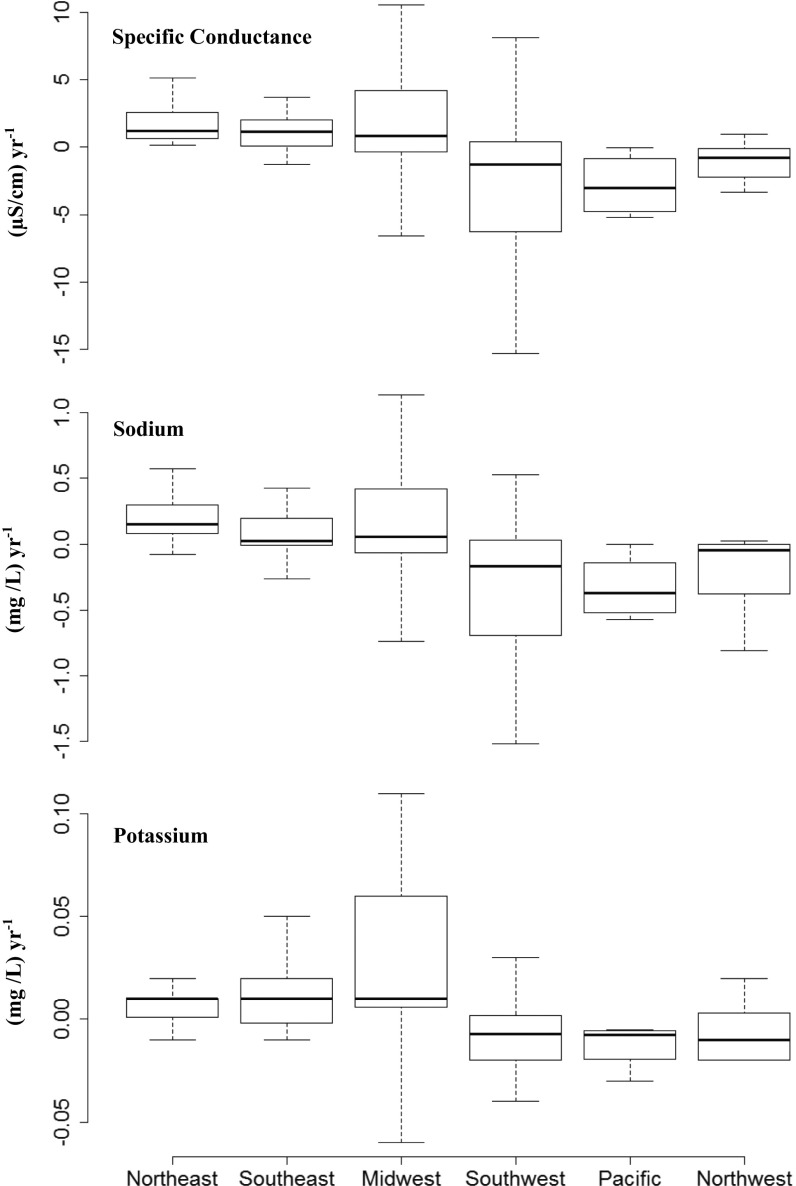
Differences in trends in specific conductance and sodium and potassium concentrations in stream and river sites across different regions of the United States. The center vertical lines of the box and whisker plots indicate the median of the sample. The length of each whisker shows the range within which the central 50% of the values fall. Box edges indicate the first and third quartiles. Outliers were excluded and were primarily in the southwestern US region.
Fig. 5.
Fig. 5.
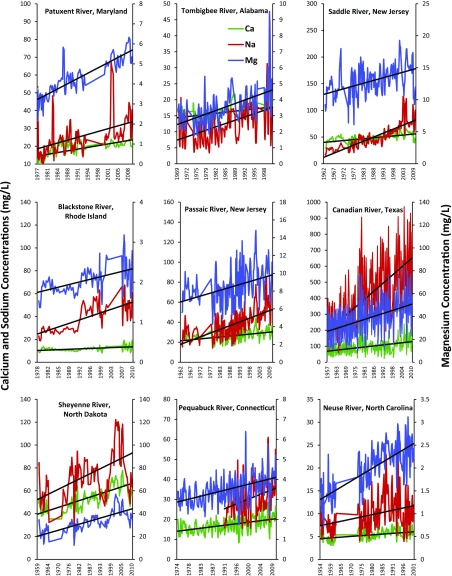
Examples of increasing trends in base cations (sodium, calcium, and magnesium) in stream water throughout the continental United States. Time series were smoothed as moving averages over every three data points/observations. Please note that vertical axes differ.
Fig. 6.
Fig. 6.
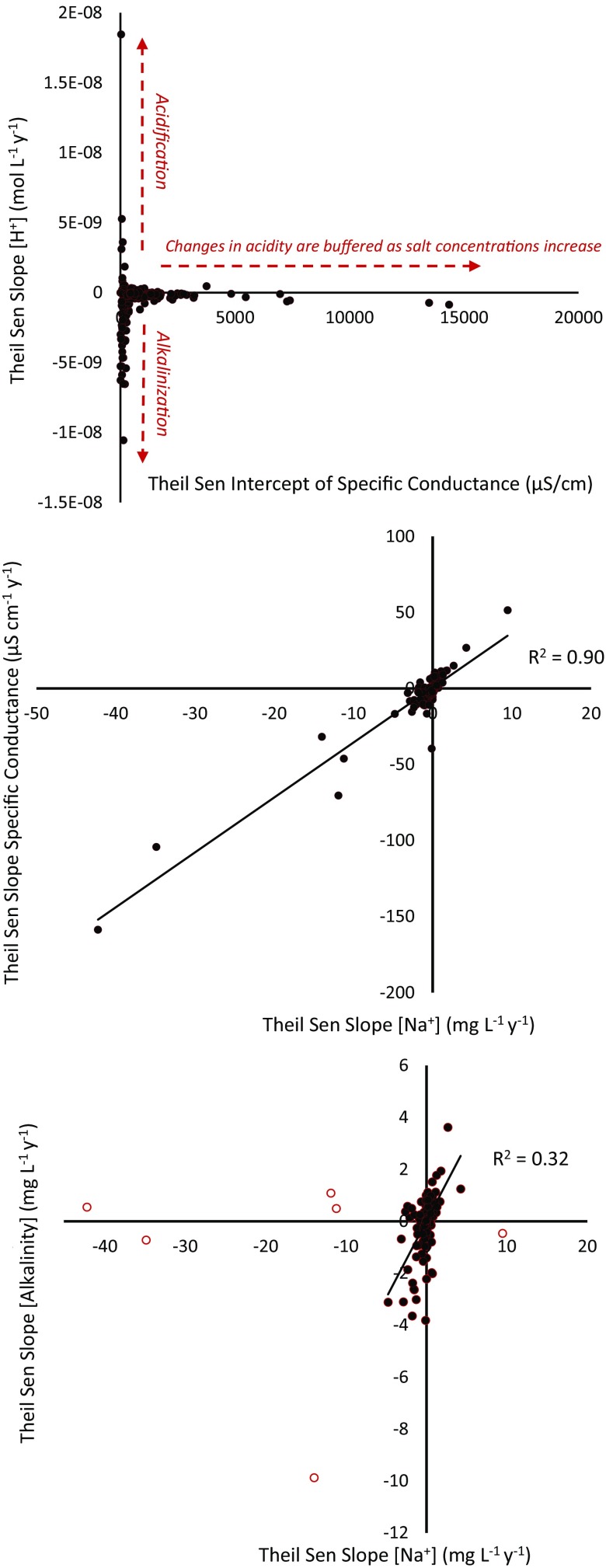
Rates of change in acidity of stream water (Theil–Sen slopes) are related to initial specific conductance of stream water (y intercept of slopes) throughout the continental United States. Rates of change in sodium concentrations (Theil–Sen slopes) over time are also strongly related to rates of changes in specific conductance (Theil–Sen slopes) over time. Rates of change in sodium concentrations (Theil–Sen slopes) are related to rates of change in alkalinity concentrations (Theil–Sen slopes) except for 6 out of 232 sites with the most extreme rates of change in sodium concentrations (open circles).
Fig. 7.
Fig. 7.
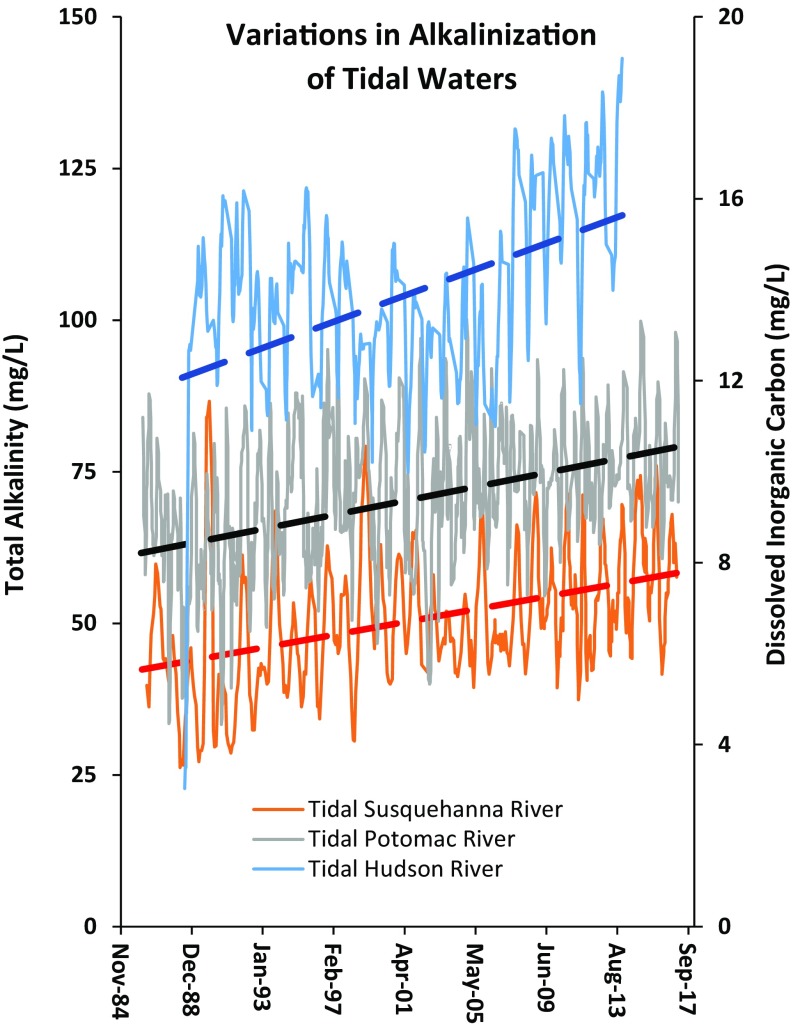
Examples of significant increasing trends (P < 0.05) in alkalinity and dissolved inorganic carbon in tidal waters of the US East Coast. Time series were smoothed as moving averages over every three data points/observations. Alkalinity concentrations are shown for the tidal Potomac and Susquehanna Rivers, and dissolved inorganic carbon concentrations are shown for the tidal Hudson River. Please note that vertical axes differ in scale.
Fig. 8.
Fig. 8.
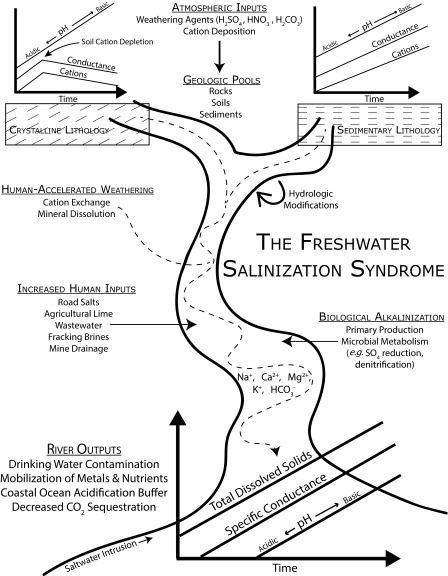
A conceptual model of the freshwater salinization syndrome, illustrating potential drivers and changes in increased salinization and alkalinization of fresh water. At least three sets of process contribute to the freshwater salinization syndrome, and they are listed in a hypothetical order from upstream to downstream including: (i) accelerated weathering in headwaters and throughout the drainage network; (ii) human salt inputs from developed landscapes; and (iii) increased biological alkalinization in larger-order streams with increased light and nutrient availability. Crystalline and sedimentary lithology results in different starting points in headwaters based on the potential for chemical weathering. Weathering process such as dissolution and cation exchange in soils and sediments generate alkalinity, bicarbonate, and base cations along drainage networks (accelerated weathering is represented by the dashed line extending throughout the drainage network). The relative importance of accelerated weathering may change with increasing disturbances along stream order, as salt and nutrient pollution increases further downstream and/or in response to hydrologic modifications. The terminus of the freshwater salinization syndrome varies based on climate, land use and management, saltwater intrusion, and underlying geology but can potentially extend into tidal waters.

References

    1. Jackson RB, et al. Water in a changing world. Ecol Appl. 2001;11:1027–1045.
    1. Oki T, Kanae S. Global hydrological cycles and world water resources. Science. 2006;313:1068–1072. - PubMed
    1. Williams WD. Anthropogenic salinization of inland waters. Hydrobiologia. 2001;466:329–337.
    1. Cañedo-Argüelles M, et al. Salinisation of rivers: An urgent ecological issue. Environ Pollut. 2013;173:157–167. - PubMed
    1. Dugan HA, et al. Salting our freshwater lakes. Proc Natl Acad Sci USA. 2017;114:4453–4458. - PMC - PubMed

Publication types