


doi: 10.1038/s41598-017-16936-8.
Swarm incursions of reassortants of highly pathogenic avian influenza virus strains H5N8 and H5N5, clade 2.3.4.4b, Germany, winter 2016/17
Affiliations
- PMID: 29311555
- PMCID: PMC5758748
- DOI: 10.1038/s41598-017-16936-8
Item in Clipboard
Swarm incursions of reassortants of highly pathogenic avian influenza virus strains H5N8 and H5N5, clade 2.3.4.4b, Germany, winter 2016/17
Sci Rep.
.
Abstract
The outbreak of highly pathogenic avian influenza H5Nx viruses in winter 2016/2017 was the most severe HPAI epizootic ever reported in Germany. The H5N8 and H5N5 viruses detected in birds in Germany in 2016/2017 represent a reassortant swarm of at least five distinct genotypes, which carried closely related HA segments derived from clade 2.3.4.4b. The genotypes of these viruses and their spatio-temporal distribution indicated a unique situation with multiple independent entries of HPAIV into Germany.
Conflict of interest statement
The authors declare that they have no competing interests.
Figures
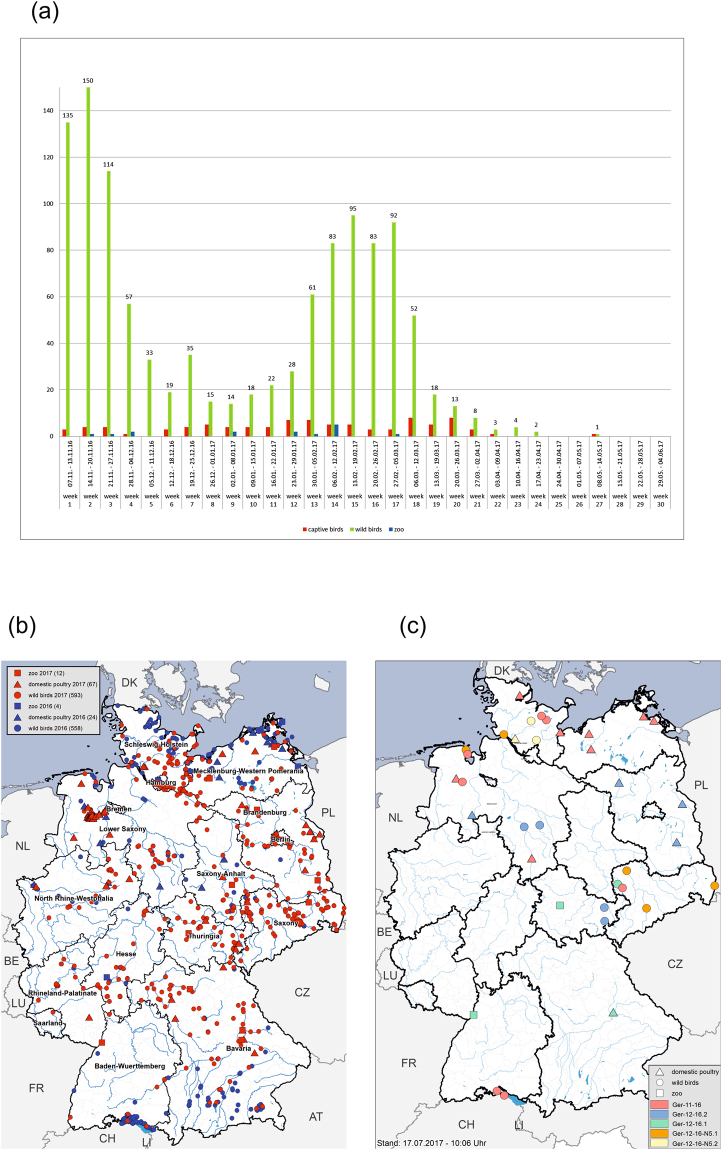
(a) Number of HPAI H5Nx cases in Germany 2016/2017 per week in wild birds (green), domestic poultry (red) and zoos (blue). (b) Geographical distribution of HPAI H5Nx cases in Germany 2016/2017 Distribution in time showing H5Nx cases in 2016 (blue) and 2017 (red). (c) Geographical distribution of distinct reassortants. Maps were plotted using ArcGIS Desktop software (version 10.3.1; ESRI, Redlands, CA, USA; http://www.esri.com/ ).
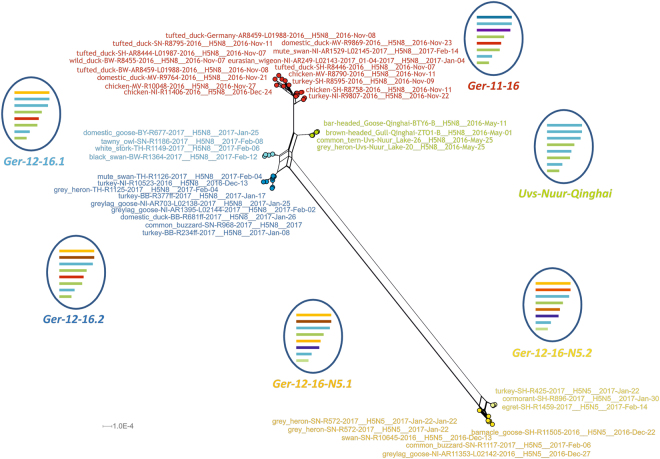
Super-network from Maximum Likelihood (ML) trees of PB2, PB1, PA, HA, NP, NA, MP, and NS genes of viruses from Germany 2016/2017 and selected reference strains. ML analyses were done using RAxML including bootstrapping for 1000 iterations. Network analysis was done with SplitsTree4. Schematic reassortant viruses grouped according to phylogenetic results are shown for each cluster.
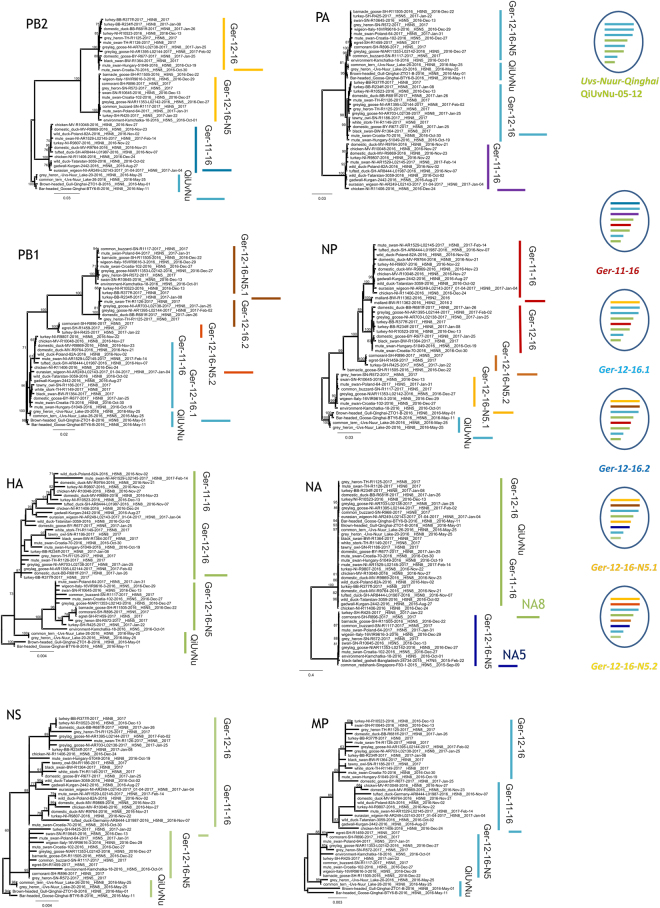
Phylogenetic analyses of PB2, PB1, PA, HA, NP, NA, MP, and NS genes from viruses Germany 2016/2017 and selected reference strains done by Maximum likelihood using RAxML. Bootstrap values of 1000 cycles are included. Scale bars indicate nucleotide substitutions per site. Reassortants grouped according to phylogenetic results are shown to the right.
References
-
- Smith GJ, Donis RO, World Health Organization/WorldOrganisation for Animal, H. F. & Agriculture Organization, H. E. W. G Nomenclature updates resulting from the evolution of avian influenza A(H5) virus clades 2.1.3.2a, 2.2.1, and 2.3.4 during 2013-2014. Influenza Other Respir Viruses. 2015;9:271–276. doi: 10.1111/irv.12324. - DOI - PMC - PubMed
-
- Verhagen, J. H. et al. Wild bird surveillance around outbreaks of highly pathogenic avian influenza A(H5N8) virus in the Netherlands, 2014, within the context of global flyways. Euro Surveill20 (2015). - PubMed
Publication types
MeSH terms
LinkOut - more resources
Full Text Sources
Other Literature Sources
Medical
