. 2018 Jan 8;9(1):91.
doi: 10.1038/s41467-017-02591-0.

Linked cycles of oxidative decarboxylation of glyoxylate as protometabolic analogs of the citric acid cycle

Affiliations

Linked cycles of oxidative decarboxylation of glyoxylate as protometabolic analogs of the citric acid cycle

Greg Springsteen et al. Nat Commun. .

Abstract

The development of metabolic approaches towards understanding the origins of life, which have focused mainly on the citric acid (TCA) cycle, have languished-primarily due to a lack of experimentally demonstrable and sustainable cycle(s) of reactions. We show here the existence of a protometabolic analog of the TCA involving two linked cycles, which convert glyoxylate into CO2 and produce aspartic acid in the presence of ammonia. The reactions proceed from either pyruvate, oxaloacetate or malonate in the presence of glyoxylate as the carbon source and hydrogen peroxide as the oxidant under neutral aqueous conditions and at mild temperatures. The reaction pathway demonstrates turnover under controlled conditions. These results indicate that simpler versions of metabolic cycles could have emerged under potential prebiotic conditions, laying the foundation for the appearance of more sophisticated metabolic pathways once control by (polymeric) catalysts became available.


Conflict of interest statement

The authors declare no competing financial interests.

Figures
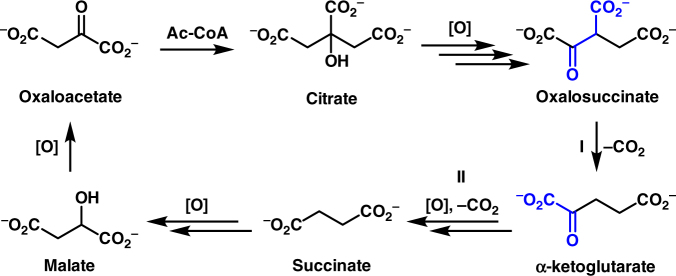
Fig. 1
Fig. 1
Oxidation and decarboxylation within the modern TCA cycle. A net transformation of Ac-CoA into CO2 occurs through a decarboxylation of a β-ketoacid (I) and an oxidative decarboxylation of an α-ketoacid (II)
Fig. 2
Fig. 2
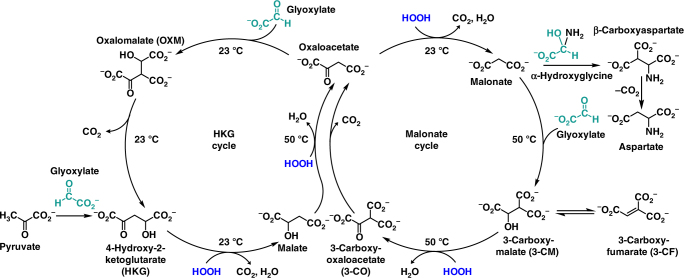
Two abiotic cycles each oxidize glyoxylate into CO2 with the regeneration of oxaloacetate. All reactions of both the HKG and Malonate cycles progress significantly in hours at pH values 7–8.5 at the listed temperature of 50 °C or 23 °C
Fig. 3
Fig. 3
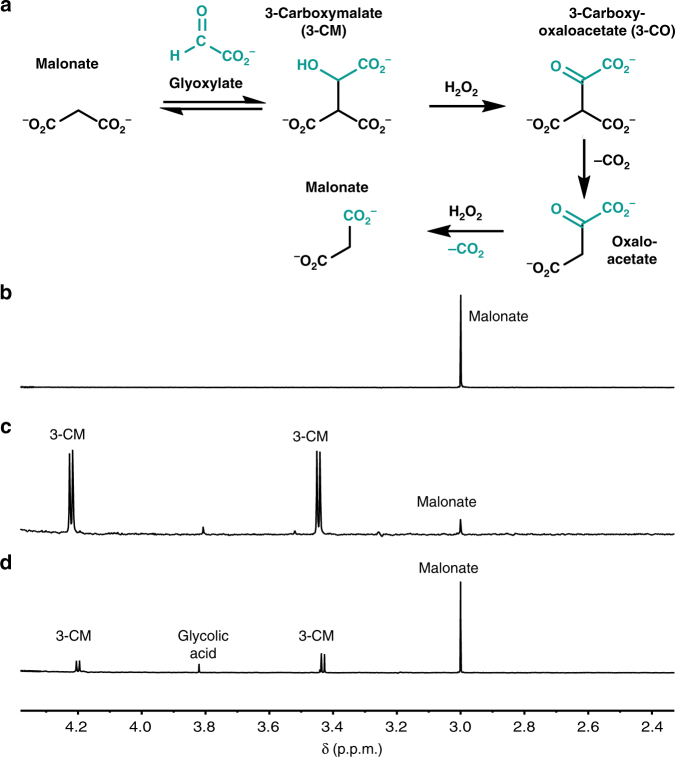
Progression around the Malonate cycle. a The reaction pathway of the Malonate cycle, with glyoxylate-sourced atoms in turquoise. b 1H NMR (in D2O) of a reaction aliquot from 90 mM disodium malonate in 1.0 M aq. bicarbonate buffer, pH 8.4. c A total of 3 eq. of glyoxylate was added and the reaction was heated for 24 h at 50 °C. d A total of 30 eq. of H2O2 was added and the reaction continued at 50 °C for an additional 48 h. The production of malonate through the oxidative decarboxylation of oxaloacetate, apart from the retro-aldol of 3-CM, was demonstrated by 13C labeling, as will be shown below
Fig. 4
Fig. 4
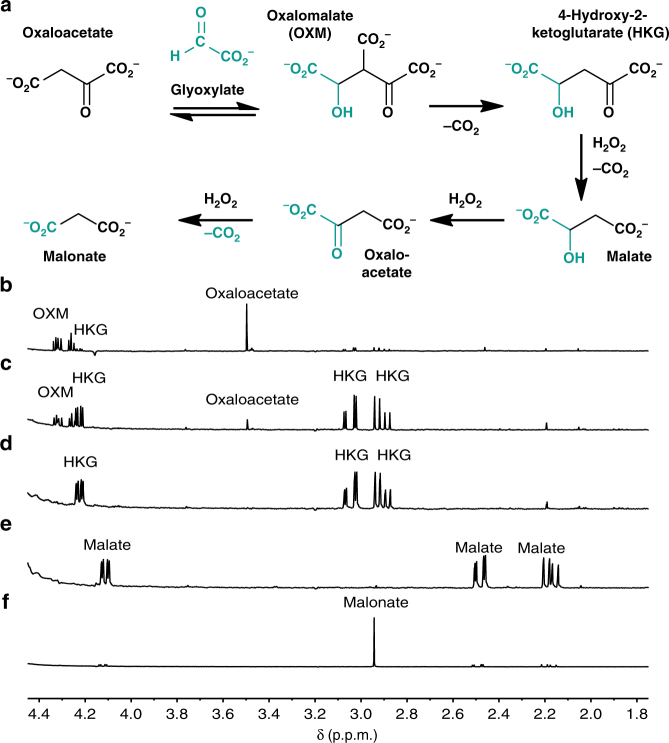
Progression around the HKG cycle. a The reaction pathway of the HKG cycle. b 1H NMR (in D2O) of a reaction aliquot from 90 mM oxaloacetate in 1.0 M aq. phosphate buffer, pH 7.0, with 1.2 eq. of glyoxylic acid, stirred at 23 °C for 5 min, c for 60 min, and d for 180 min. e A total of 2 eq. of H2O2 was added and the reaction was stirred for additional 20 min. f An additional 15 eq. of H2O2 was added and the reaction was heated at 50 °C for 24 h
Fig. 5
Fig. 5
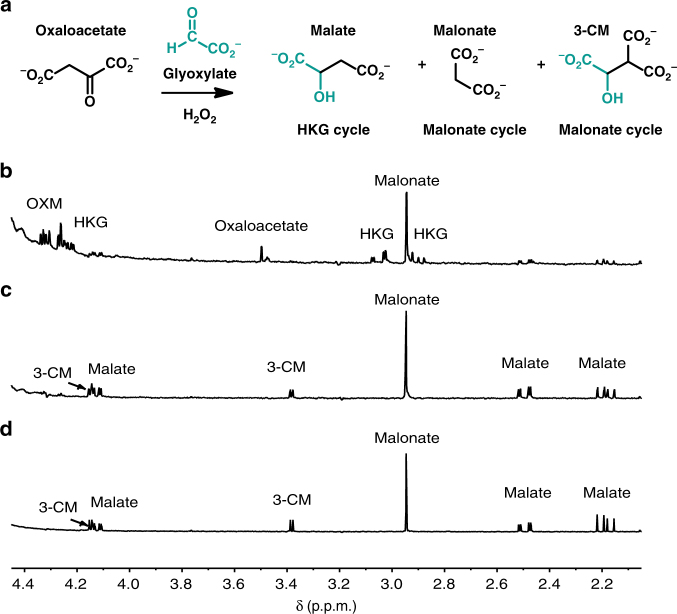
Both HKG and Malonate pathways progress in the presence of glyoxylate and H2O2. a Intermediates of both pathways are detected, OXM, HKG, and malate from the HKG cycle, and malonate and 3-CM from the Malonate cycle. b 1H NMR (in D2O) of a reaction aliquot from 90 mM oxaloacetate, 1.25 eq. glyoxylic acid, with 5 eq. of H2O2 added over 1 h, in 1.0 M phosphate buffer, pH 7.0, at 23 °C for 10 min, c for 30 min, and d for 48 h
Fig. 6
Fig. 6
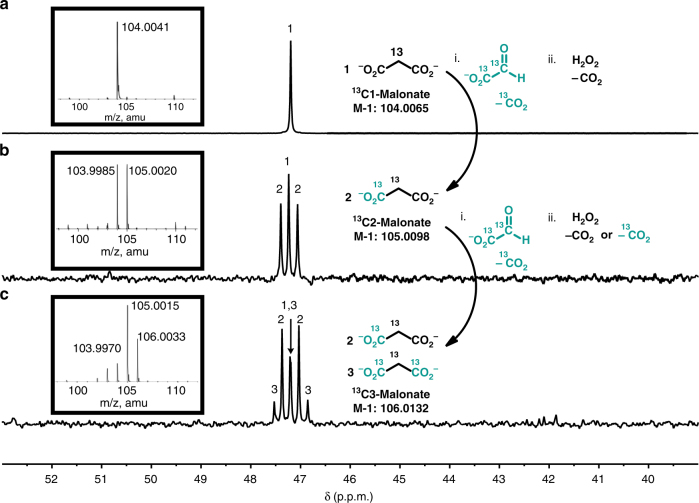
The progression from mono- to di- to tri-13C-labeled malonate indicates two full iterations of the Malonate cycle. a 13C NMR (in D2O) of a reaction aliquot from 2.0 ml of 200 mM (2-13C1)malonic acid in 1.0 M aqueous NaHCO3. b A total of 2 eq. of (1,2-13C2)glyoxylic acid was added, and the reaction was stirred at 50 °C for 3 h. Then, 30 wt% aqueous H2O2 was subsequently added to the solution at a rate of 40 eq./h, and the reaction was stirred at 50 °C for 10 h. c The reaction volume was reduced under vacuum back to 2.0 ml, and the procedure was repeated starting from the addition of (1,2-13C2)glyoxylic acid
Fig. 7
Fig. 7
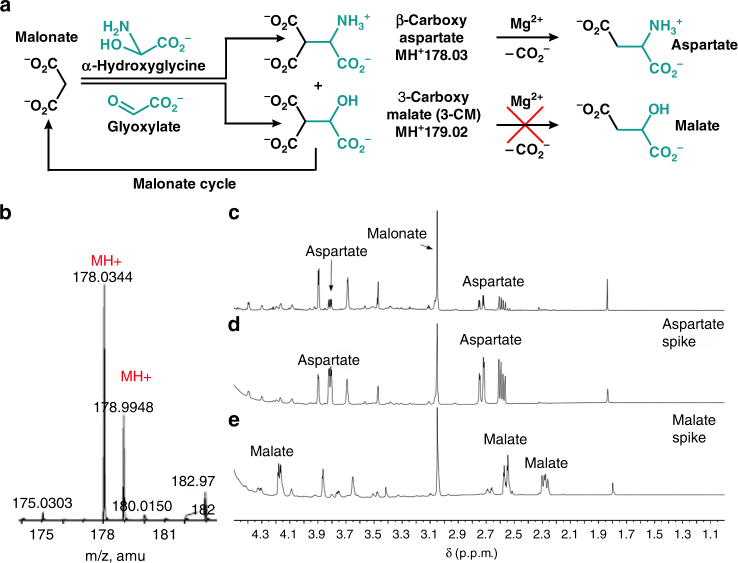
Aspartate synthesis from malonate, glyoxylate, and ammonia. a Malonate in the presence of a 1:1 mixture of glyoxlate and α-hydroxyglycine produces 3-CM and β-carboxyaspartate. The β-carboxyaspartate selectively decarboxylates to aspartate. b HRMS of a reaction aliquot from 0.5 M malonate and 1 eq. of both α-hydroxyglycine and glyxolate in a pH 6.8 bicarbonate buffer stirred at 23 °C for 5 days. c Subsequent addition of 1 eq. of MgCl2 and stirring at 50 °C for 5 h produces aspartate, but not malate. d, e Aspartate and malate spikes, respectively, to c

References

    1. Dyson, F. Origins of Life (Cambridge University Press, Cambridge, 1999).
    1. Wächtershäuser G. Before enzymes and templates: theory of surface metabolism. Microbiol. Rev. 1988;52:452–484. - PMC - PubMed
    1. Anet FA. The place of metabolism in the origin of life. Curr. Opin. Chem. Biol. 2004;8:654–659. doi: 10.1016/j.cbpa.2004.10.005. - DOI - PubMed
    1. Morowitz HJ, Kostelnik JD, Yang J, Cody GD. The origin of intermediary metabolism. Proc. Natl. Acad. Sci. USA. 2000;97:7704–7708. doi: 10.1073/pnas.110153997. - DOI - PMC - PubMed
    1. Orgel LE. The implausibility of metabolic cycles on the prebiotic earth. PLoS Biol. 2008;6:0005–0013. doi: 10.1371/journal.pbio.0060018. - DOI - PMC - PubMed

Publication types